

Legal Representative Under Motor Vehicles Act Not Confined Merely To Spouse, Parent, Children: Karnataka High Court
The Court said that Legal Representative under the Act extends beyond the nuclear family to include anyone suffering financial loss from the victim's death, bypassing strict legal heirship disputes.

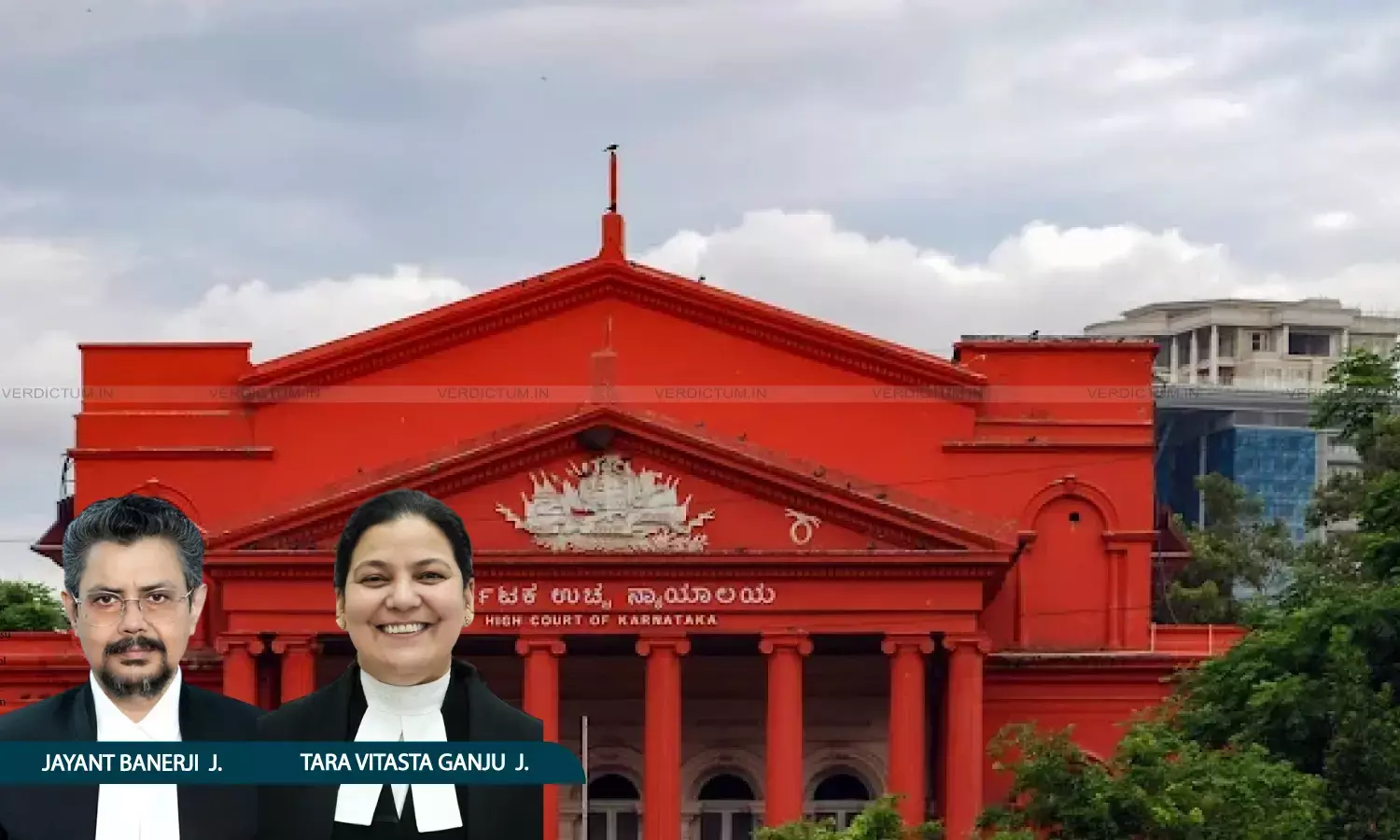
The Karnataka High Court has enhanced a motor accident compensation award while reiterating that the term "legal representative" under the Motor Vehicles Act must be given a wide, flexible interpretation rather than being restricted to a first spouse, parent, or child.
The Court noted that for benevolent laws like the MV Act, actual financial dependency on the deceased matters more than strict legal status.
Applying this principle, the Court included a second wife and a minor daughter as valid dependents to recalculate the loss of dependency, set aside a lower income estimate used by the lower tribunal, and substantially increased the overall payout to the grieving family with nine per cent annual interest.
The Division Bench comprising Justice Jayant Banerji and Justice Tara Vitasta Ganju reiterated, "the Supreme Court while examining the meaning of a legal representative as applicable to the amended MV Act has held that a legal representative need not necessarily be confined to the wife, husband, parent and child of the deceased and that every person who represents the estate of the deceased and also suffers on account of the death of a person in a motor vehicle accident should have a remedy for realisation of compensation. The Court further held that the expression "legal representative" under the Motor Vehicles Act is to be accorded a wider meaning and is not confined merely to the spouse, parent and children of the deceased."
Advocate G.J. Sunkapur appeared for the Appellants, while Advocate HS Lingaraj appeared for the Respondents.
A Miscellaneous First Appeal (MFA) was filed under Section 173(1) of the Motor Vehicles Act against the judgment and award passed by the Motor Vehicles Accident Claims Tribunal (MACT), Davanagere, seeking enhancement of the compensation awarded to the claimants.
Brief Facts
The claim petition arose out of a fatal motor vehicle accident. The deceased was riding as a pillion rider on a motorcycle when an Alto car, driven in a rash and negligent manner at high speed, attempted to overtake an Innova car. The Alto car collided with the front side of the Innova car, causing the Innova car to subsequently crash into the motorcycle. As a result of the impact, the deceased fell, sustained grievous injuries, and succumbed to them on the spot.
The claim petition was preferred by the first wife and the mother of the deceased, asserting that the deceased was an agriculturist growing flower crops and earning a substantial monthly income. The second wife and a minor daughter of the deceased were also arrayed as respondents to the petition. The multi-dependent nature of the family led the Tribunal to frame an additional issue regarding the marital relationship and status of the claimants and the private respondents.
Contentions of the Parties
The appellants/claimants contended that the Tribunal erred in assessing the monthly notional income of the deceased at a lower rate, whereas the standard Chart prepared by the Karnataka State Legal Services Authority prescribed a higher notional income for the relevant year. It was further urged that the quantum under the head of loss of dependency required a consequential upward revision. Additionally, it was submitted that the first wife and the second wife had amicably resolved their internal dispute by agreeing to share the awarded amount equally.
The Respondent Insurance Company was unable to controvert the income parameters established by the Legal Services Authority's chart. However, the insurer challenged the overall enhancement sought under the head of loss of dependency.
Observations of the Court
The High Court observed that the issue of who constitutes a "dependent" or "legal representative" entitled to seek compensation under the Motor Vehicles Act is well-settled by the Apex Court.
"...it was reiterated that every legal representative who suffers on account of the death of a person due to a motor vehicle accident should have a remedy for realisation of compensation and that dependency, rather than strict legal status, is the determinative factor. The Supreme Court also reiterated that the expression “legal representative” is of wide import and is not confined to legal heirs alone", the Court remarked.
Relying on established precedents, the Court reiterated that the expression "legal representative" must be accorded a wide and liberal interpretation in benevolent legislation. Status as a dependent, rather than strict legal heirship, remains the determinative factor for maintaining a claim.
Consequently, the second wife and minor daughter were rightly factored in as dependents, justifying a one-fourth deduction toward personal and living expenses.
The Court observed that the subordinate Tribunal had indeed undervalued the monthly notional income of the deceased.
Correcting this error, the Court re-calculated the dependency by factoring in an additional forty percent towards future prospects alongside the appropriate multiplier based on the age of the deceased.
Furthermore, the Court observed that conventional heads such as loss of consortium, loss of estate, and funeral expenses required adjustment in alignment with settled legal principles.
"Accordingly, and in view of the settled law, since the respondent Nos. 3 and 4 were also dependents on the income of the deceased, they would be taken into account for calculating the compensation", the Court said.
Accordingly, the High Court partly allowed the appeal, enhanced the total compensation significantly, and directed the Insurance Company to deposit the enhanced quantum along with interest at the rate of nine percent per annum.
Cause Title: Smt Asha and Anr. v. Ramakrishna S Ghatge and Ors. [Neutral Citation: 2026:KHC:29484-DB]
Appearances:
Appellants: Advocate G.J. Sunkapur
Respondents: Advocate HS Lingaraj
Click here to read/download the Judgment