

Karan Murmu Judgment Not Authoritative Pronouncement On Existence Of Santhal Custom Excluding Inheritance By Daughters: Jharkhand High Court
The Bench resolved conflict between two Single Judge judgments, holds Narayan Soren, which follows Madhu Kishwar, correctly states the law; dismisses 2006 second appeal.

The Jharkhand High Court has held that a party relying on a Santhal custom that bars daughters from inheriting their father's property must prove that the custom exists and continues. It declined to treat an earlier Single Judge ruling in Karan Murmu v. The Commissioner, Santhal Pargana, Dumka (2004) as an authoritative pronouncement that such a custom exists.
Resolving the conflict between two Single Judge decisions, the Bench held that Narayan Soren & Ors. v. Ranjan Murmu & Ors (2009), which relies on the Supreme Court's decision in Madhu Kishwar v. State of Bihar (1996), correctly lays down the legal position. It dismissed a second appeal pending since 2006 and upheld a decree declaring a woman owner of the entire suit property.
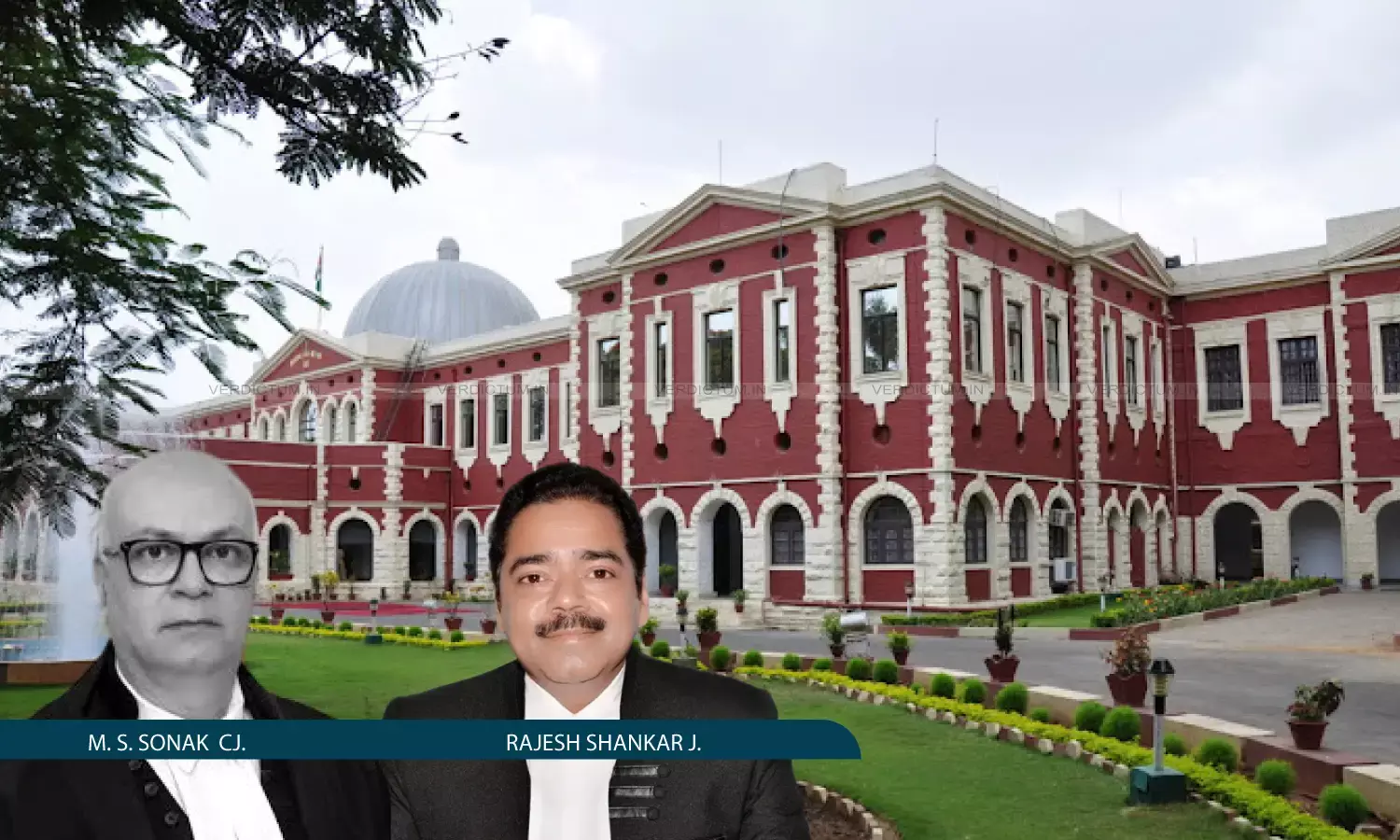
A Division Bench of Chief Justice M. S. Sonak and Justice Rajesh Shankar observed, “…with due respect, we do not agree that Karan Murmu (supra) is an authoritative pronouncement on whether a custom under which a female does not inherit her father's property exists or continues in the Santhal Pargana Law of Inheritance. In any event, based on the reasoning or the conclusion in Karan Murmu (Supra), we are satisfied that no case is made out to interfere with the impugned judgment and decree”.
“Although Narayan Soren (supra) does not take cognisance of the earlier decision in Karan Murmu (supra), we are more than satisfied that the later decision in Narayan Soren (supra), which relies upon the decision of the Hon’ble Supreme Court in Madhu Kishwar (supra), correctly lays down the legal position regarding the customs of the Santhal Tribals in relation to the inheritance of property by female Santhali Tribals. In any event, the reasoning in Narayan Soren (supra) is to be preferred over that in Karan Murmu (supra)”.
Senior Advocate Jay Prakash Jha appeared for the appellants, Advocate Atanu Banerjee appeared for the respondents, and Advocate Sumeet Gadodia assisted as Amicus Curiae.
The plaintiff, a woman of Turka village in Jamtara, filed a Title Suit seeking a declaration of title by inheritance, confirmation of possession and delivery of possession. The Trial Court partly decreed the suit in 1996 and declared her owner of one-third of the property. The defendants did not challenge that decree. On her appeal, the First Appellate Court decreed the suit in its entirety on March 4, 2006.
The defendants' second appeal was admitted in 2009 on whether the finding needed reconsideration in light of the conflicting decisions in Karan Murmu and Narayan Soren. On the day of final hearing, the appellants sought to add a question on perversity. The Court called this "quite improper" but heard it.
The appellants argued that the plaintiff had admitted daughters inherit only where the marriage is in the Gharjamai form, and that she had not deposed to residence in the village. The respondent submitted that the plaintiff examined about 13 witnesses and relied on revenue records, and that the onus lay on the defendants, and the Amicus relied on Laxmibai v. Bhagwantbuva and Madhu Kishwar.
On perversity, the Court held that the plaintiff's statements could not be read out of context, and that perversity does not mean insufficient evidence. It held the alleged admission could not be read as an admission of a custom barring female inheritance. Since the defendants asserted the custom, the onus was on them, and they "adduced no cogent evidence".
On the conflict, the Court gave four reasons for not treating Karan Murmu as authoritative. The foundational fact of adoption was not proved there. It did not consider Madhu Kishwar or any statutory provision. It was decided in writ jurisdiction. It did not address onus. It also noted that the Supreme Court had dismissed the SLP against Ismail Hansda (2025), which required strict proof of such a custom.
Cause Title: Sanatan Hembram and Others v. Hite Lal Hembrom and Others (Neutral Citation: 2026:JHHC:33313-DB)
Appearances:
Appellants: Jay Prakash Jha, Senior Advocate, with Anant Kumar Sinha, Aishwerya Prakash and K.K. Mishra, Advocates.
Respondents: Atanu Banerjee and Durga Charan Mishra, Advocates Amicus Curiae: Sumeet Gadodia, Shilpi Sandil, Ranjeet Kushwaha and Nidhi Lal, Advocates.