Mere Inclusion In Select List Confers No Right To Appointment Against Future Vacancies: J&K&L High Court Rejects Subordinate Judges' Seniority Claim
The Court observed that an appointment against future vacancies, made only as a compassionate measure, was de hors the Recruitment Rules and could not entitle such candidates to seniority based on their inter se merit in the original selection.
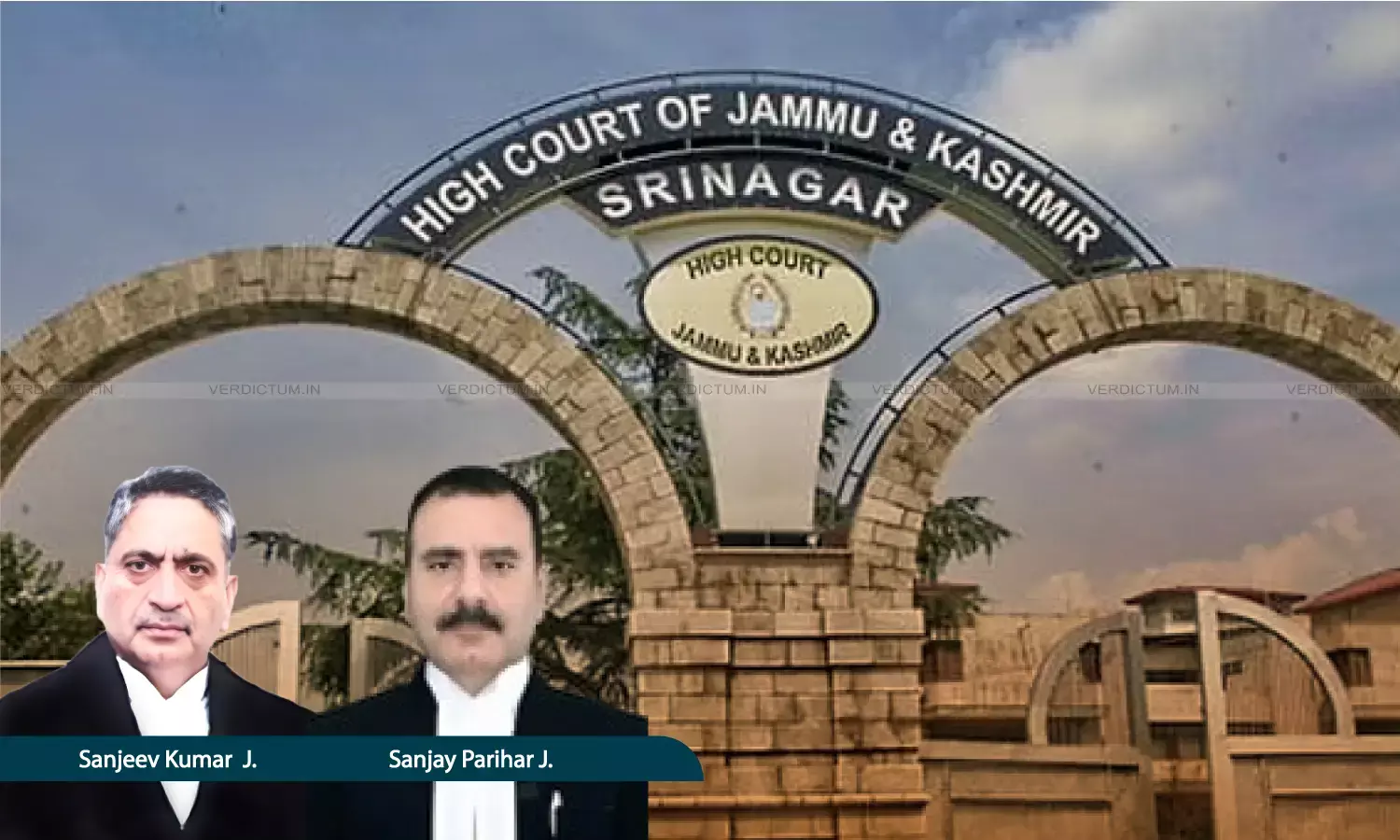
Justice Sanjeev Kumar, Justice Sanjay Parihar, Jammu & Kashmir and Ladakh High Court
The Jammu & Kashmir and Ladakh High Court dismissed a writ petition filed by four Judicial Officers seeking seniority based on their position in a select list prepared by the Public Service Commission (PSC).
The Court held that the petitioners had been selected only because of a clerical mistake committed by the Law Department, which erroneously referred to 35 vacancies instead of the actual 31 available vacancies. It was observed that the petitioners acquired no enforceable right to appointment merely because their names appeared in the select list.
A Division Bench comprising Acting Chief Justice Sanjeev Kumar and Justice Sanjay Parihar held that the petitioners were ultimately accommodated against future vacancies only as a compassionate measure, and such appointments, being de hors the Rules, could not entitle them to claim seniority over candidates regularly appointed against existing vacancies.
The Bench observed: "To put it succinctly, we have no manner of doubt that the appointment of the petitioners against the future vacancies was de hors the Rules and, in any case, irregular, if not void ab initio. Viewed from this angle, it cannot be legitimately contended that the petitioners, having been appointed against the four future vacancies, form a class with those selected and appointed against the clear vacancies and, therefore, their seniority must be fixed on the basis of inter se merit obtained by them in the selection process initiated in terms of advertisement notification of 2008."
Advocate Salih Pirzada appeared on behalf of the petitioners, while Advocate M.I. Qadiri, Waseem Gul, GA & Faheem Nisar Shah, GA, represented the respondents.
Background
The dispute arose from the recruitment process for Munsiffs initiated in 2008. The High Court had requisitioned 31 vacancies, including four backlog vacancies reserved for Scheduled Tribes. However, while forwarding the requisition to the Public Service Commission, the Law Department mistakenly treated the four backlog vacancies as being in addition to the 31 vacancies, resulting in an advertisement for 35 posts.
Consequently, the PSC selected 35 candidates, and the Government approved the entire selection list. Before appointments were made, however, the High Court detected the clerical error and found that only 31 clear vacancies actually existed. It accordingly recommended the appointment of only 31 candidates.
The petitioners, who fell beyond the available vacancies, were not appointed initially. Subsequently, after promotions created fresh vacancies, the High Court recommended their appointment against four future vacancies, and the Government appointed them in September 2011. They later challenged the seniority list, contending that their placement in the original merit list entitled them to seniority over several officers appointed earlier.
Court's Observations
The Court found that there was no factual dispute regarding the number of vacancies available when the recruitment process commenced.
It observed that the High Court's requisition had clearly specified 31 vacancies, inclusive of the four backlog Scheduled Tribe vacancies, and that the entire controversy arose solely because the Law Department mistakenly referred 35 vacancies to the PSC.
The Bench observed: "Indisputably, when the process of selection for recruitment of Munsiffs was initiated, there were in all 31 vacant posts of Munsiffs available... the Department of Law, while making a formal reference to the PSC, committed a clerical mistake... Instead of 31, 35 candidates came to be selected as Munsiffs by the PSC... It is not in dispute that had the Department of Law referred 31 available posts and not committed the mistake of referring 35 posts, the petitioners would not have figured in the select list."
The Court held that once the mistake was detected, the High Court rightly recommended the appointment of only 31 candidates corresponding to the actual available vacancies.
It observed: "The High Court did nothing wrong in recommending the appointment of only 31 candidates selected by the PSC to fill the 31 available posts of Munsiffs. With the appointment of 31 candidates, which of course were to the exclusion of the petitioners, the select list came to be exhausted."
Rejecting the petitioners' argument that inclusion in the select list entitled them to appointment, the Court reiterated the settled principle that a candidate merely figuring in a select list acquires no indefeasible right to appointment.
The Bench observed: "There could be no dispute with regard to the proposition that the petitioners acquired no right to be appointed only on the basis of their mere placement in the select list, particularly when they were the candidates selected over and above the available vacancies of Munsiffs. The petitioners could have been very well denied the appointment and there was no obligation on the respondents to accommodate them against the future vacancies."
The Court noted that the High Court had nevertheless taken a compassionate view by accommodating the petitioners against future vacancies that arose on account of promotions. However, it held that such accommodation was contrary to the Recruitment Rules and the settled legal position because future vacancies ought to have been advertised afresh.
The Bench observed: "Ordinarily, these future posts... ought to have been notified afresh for selection... The utilisation of four future vacancies to accommodate the petitioners was clearly de hors the Rules and against the settled position of law."
The Court further held that the selection process had concluded with the appointment of candidates against the 31 available vacancies and that the petitioners' later appointments could neither be treated as a continuation of that selection process nor as appointments from a waiting list.
The Bench observed: "The selection process... came to close with the appointment of Munsiffs against the 31 available posts. The subsequent appointment of the petitioners against future vacancies is neither by operation of a waiting list nor a continuation of the selection process initiated in the year 2008... Rule 24 of the CCA Rules will not, therefore, be attracted."
Interpreting Rule 24 of the Jammu and Kashmir Civil Services (Classification, Control and Appeal) Rules, the Court explained that merit governs seniority only where candidates are appointed simultaneously pursuant to the same recruitment process.
Since the petitioners were appointed nearly six months later against different vacancies, they could not claim parity with those appointed on April 1, 2011.
The Court observed: "The petitioners were admittedly appointed on 29.09.2011, whereas the private respondents... came to be appointed as Munsiffs on 01.04.2011... The date of first appointment of the petitioners is, and has to be taken as, 29.09.2011, and, therefore, they have to take their seniority accordingly."
The Bench also reiterated that candidates appointed irregularly or de hors the Rules cannot claim precedence over those regularly appointed in accordance with statutory rules. Relying upon Shankarsan Dash, Sudesh Kumar Goyal and State of U.P. v. Rafiquddin, the Court held that mere inclusion in a select list creates no indefeasible right to appointment and that appointments made in breach of recruitment rules cannot confer superior seniority.
The Court additionally found that the writ petition suffered from gross delay, noting that the seniority list had remained unchallenged for seven years and had already been acted upon through promotions.
Conclusion
Holding that the petitioners' appointments against future vacancies were irregular, contrary to the Recruitment Rules and incapable of conferring seniority over regularly appointed candidates, the High Court dismissed the writ petition.
The Court observed that the petitioners had already benefited from compassionate appointments and subsequent promotions, despite having acquired no indefeasible right to appointment in the first place. It further held that the challenge to the seniority list was barred by delay and laches, particularly since the seniority had remained settled and had already been acted upon.
Accordingly, the Court concluded that the writ petition was devoid of merit and liable to be dismissed.
Cause Title: Tabassum Qadir Parray & Ors. v. High Court of Jammu & Kashmir & Ors (Neutral Citation: 2026:JKLHC-SGR:87-DB)
Appearances
Petitioners: Salih Pirzada, Advocate.
Respondents: M.I. Qadiri, Advocate; Waseem Gul, GA; Showkat Ali Khan, Advocate; Faheem Nisar Shah, GA.