

J&K And Ladakh High Court Denies Bail To Accused In Hizbul Mujahideen Conspiracy Case Involving Now Terminated DSP Devender Singh
The Court held that there was sufficient prima facie material showing the appellant’s role as an intermediary between Hizbul Mujahideen militants and suspended police officer Devender Singh in an alleged conspiracy involving the movement of militants, transfer of funds, and facilitation of terrorist activities.
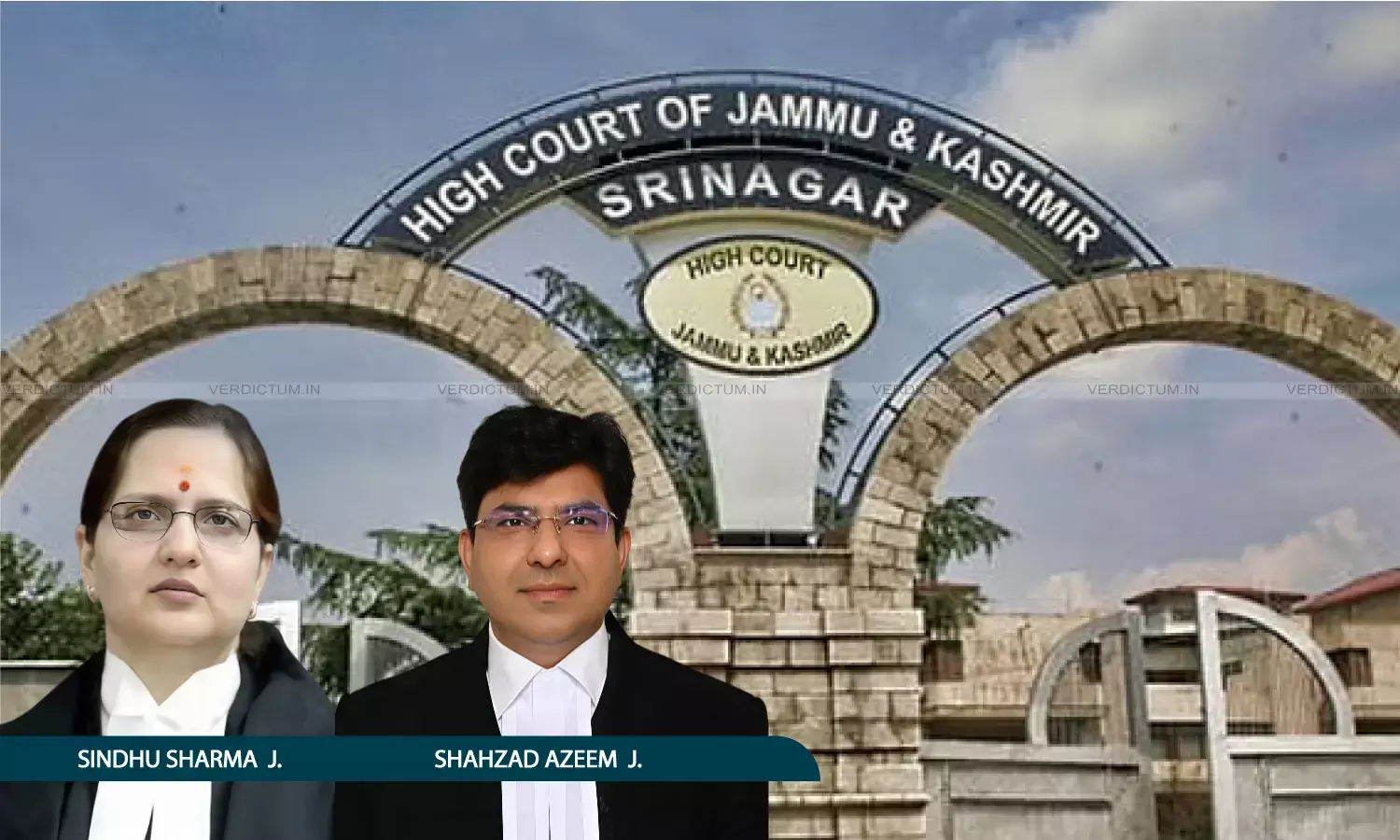
The High Court of Jammu & Kashmir and Ladakh has denied bail to an accused in a Hizbul Mujahideen terror conspiracy case linked to DSP Devender Singh, who was terminated from the service, observing that the material collected during the investigation prima facie established his role as a conduit between militants, handlers and co-accused involved in terrorist activities.
The Court was hearing an appeal under Section 21 of the National Investigation Agency Act, 2008 challenging an order of the Special Judge, NIA Cases, Jammu rejecting the appellant’s bail application in a case involving offences under Sections 120-B, 121, 121-A and 122 IPC along with Sections 17, 18, 19, 38, 39 and 40 of the Unlawful Activities (Prevention) Act, 1967.
A Division Bench of Justice Sindhu Sharma and Justice Shahzad Azeem observed: “The appellant has been found to be part of this larger conspiracy and acted as an intermediary, who facilitated the safe movement of A-1 (his real brother and District Commander of HM), and other militants from Shopian to Jammu in the month of February 2019 for ex-filtration to Pakistan with the help of HM leadership”.
The Bench further added: “The appellant has acted as a go-between A-1, A-2 & Devender Singh, a police officer in Anti-Hijacking Unit (A-3). There is sufficient prima facie material supporting the raising of funds and their transfer to A-3 for their safe passage. The call detail records prima facie show that the appellant allegedly made hundreds of calls to A-1, A-2 & A-3 as a part of the conspiracy to supply arms/ammunition, to harbour militants and to wage war against India”.
Advocate Molvi Aijaz Ahmad appeared for the appellant. Vishal Sharma, DSGI, appeared for the NIA.
Background
According to the prosecution, the appellant was charge-sheeted along with ten co-accused in a Hizbul Mujahideen terror conspiracy case involving allegations of arms and ammunition recovery, fund raising, transfer of money, harbouring militants and conspiracy to wage war against India.
The prosecution alleged that the appellant acted as an intermediary between accused Naveed Mushtaq, described as a District Commander of Hizbul Mujahideen and the appellant’s elder brother, co-accused Irfan Shafi Mir and suspended police officer Devender Singh for extending support to the banned terrorist organisation in furtherance of the conspiracy.
The investigation further alleged that Devender Singh, then posted in the Anti-Hijacking Unit, remained in constant touch with the co-accused and provided support, including the supply of arms and ammunition in exchange for funds.
The trial court had rejected the appellant’s bail plea after observing that several material witnesses, including bank officials, forensic experts and investigating officers, were yet to be examined. The trial court also relied upon bank records, call detail records, witness statements and voice sample material.
Before the High Court, the appellant argued that only a limited number of prosecution witnesses had been examined despite the trial continuing for several years and contended that no direct incriminating material had surfaced against him. It was also argued that no recovery had been made from him and that he was a government employee and PhD scholar with a clean antecedent record.
Court’s Observation
The High Court observed that the case pertained to allegations of waging war against India, conspiracy, smuggling of arms and ammunition, and support to a banned terrorist organisation.
Referring to the material collected during the investigation, the Court held that there existed sufficient prima facie material indicating the appellant’s involvement in facilitating the movement of militants and coordinating with co-accused persons, including DSP Devender Singh.
The Bench noted that the prosecution relied upon call detail records allegedly showing hundreds of calls exchanged between the appellant, co-accused militants and Devender Singh as part of the alleged conspiracy.
The Court also took note of allegations relating to the transfer of Rs.50,000 from the appellant’s bank account to the account of Devender Singh for facilitating the safe passage of militants.
Rejecting the appellant’s contention that he was merely helping society and had no links with militancy, the Bench observed: “Such a plea cannot be accepted in the present proceedings. The same can, however, be a valid defence at the appropriate stage during trial.”
The Court further noted that during the pendency of the appeal, the appellant had filed another application before the trial court seeking short-term bail and transfer from District Jail, Karnal, on medical grounds while simultaneously pursuing similar relief before the High Court.
The Bench termed the conduct as forum shopping and abuse of process. The Court observed: “By such conduct, the appellant is disentitled to the discretionary relief.”
The Court also rejected the medical grounds urged by the appellant after referring to a medical report stating that the appellant suffered only from a minor eyelid lesion requiring a simple procedure under local anaesthesia and not necessitating an attendant.
The Bench further held that the rigours of Section 43-D(5) of the UAPA stood attracted once charges had been framed and prima facie satisfaction regarding commission of offences had already been recorded by the trial court.
Referring to Union of India v. Barakathullah (2024), National Investigation Agency v. Zahoor Ahmad Shah Watali (2019), Gurwinder Singh v. State of Punjab (2024) and State of Punjab v. Sukhwinder Singh @ Gora (2026), the Court reiterated that while considering bail under the UAPA, courts must examine the totality of material collected by the investigating agency and presume such material to be true at the stage of bail.
The Bench observed that the conventional principle of “bail is the rule, jail is the exception” does not apply with the same force in cases governed by the UAPA.
The Court also rejected the plea of prolonged incarceration and delayed trial. The Bench held: “Once the appellant is prima facie shown to have involved in such a heinous crime, the right to speedy trial does not come to his rescue.”
The Court further observed that evaluating only the already examined witnesses while ignoring the remaining evidence would amount to conducting a “mini-trial”, which is impermissible at the bail stage.
Conclusion
The High Court held that sufficient prima facie material existed showing the appellant’s role as an intermediary in the alleged Hizbul Mujahideen conspiracy involving transfer of funds, movement of militants and coordination with DSP Devender Singh and other co-accused.
The Court further held that the restrictions contained in Section 43-D(5) of the UAPA were attracted and that neither prolonged incarceration nor medical grounds justified the grant of bail in the facts of the case.
Accordingly, the Division Bench dismissed the appeal and rejected the appellant’s plea for bail.
Cause Title: Syed Irfan Ahmad v. NIA Jammu (Neutral Citation: 2026:JKLHC-JMU:1514-DB)
Appearances
Appellant: Advocate Molvi Aijaz Ahmad
Respondent: Vishal Sharma, DSGI; Eishan Dadhichi, CGSC; Advocate Sumant Sudan; Chandan Kumar Singh, PP, NIA; Ashwani Verma, PP, NIA
