

Propriety Of Judicial Conduct & Temper In Addressing Members Of Bar Non-Negotiable Aspect Of Judicial Grace: J&K And Ladakh High Court
The Court held that the tone and tenor of judicial orders must reflect balance and restraint, particularly when dealing with experienced members of the Bar.
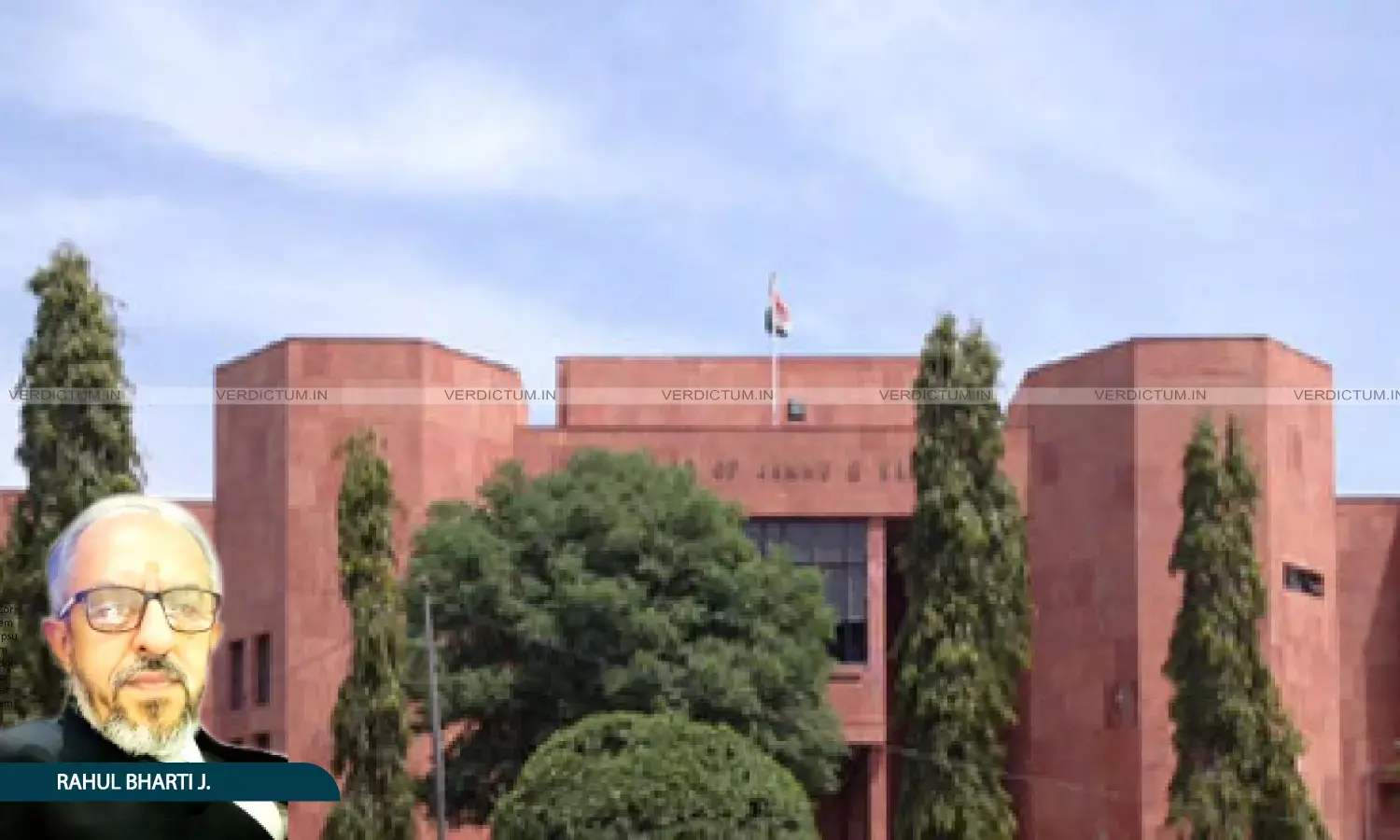
Justice Rahul Bharti, Jammu & Kashmir and Ladakh High Court
The High Court of Jammu & Kashmir and Ladakh has emphasised that propriety in judicial conduct and temper while addressing the Bar, especially Senior Advocates, is a non-negotiable aspect of judicial grace, and that the tone and tenor of judicial orders must reflect balance, restraint, and composure.
The Court was hearing a petition under Article 227 of the Constitution of India challenging an order passed by the Court of Munsiff, Katra, whereby the petitioners’ right to advance arguments in an application under Order VIII Rule 9 of the Code of Civil Procedure, 1908, was closed.
A Bench of Justice Rahul Bharti observed: “This Court would humbly remind the Presiding Officer of the court of Munsiff, Katra that proprietary of a judicial conduct and temper in addressing itself with the learned Bar is a non-negotiable aspect of judicial grace, particularly when seniority bearing Advocates having long standing experience and due sense of responsibility not only towards their clients but also towards court are representing the litigants in courts, then a court is supposed to moderate its tone and tenor and which get reflected and exposed from very text of an order passed in that state of mind, be it agitative or equipoised.”
G.S. Thakur, Advocate, appeared for the Petitioners.
Background
The petitioners had instituted a civil suit seeking a declaration and consequential relief, along with an application for a temporary injunction. An ex parte ad interim status quo order was granted in respect of the suit property.
Despite the passage of time, the temporary injunction application remained pending. Meanwhile, the petitioners filed an application under Order VIII Rule 9 CPC seeking leave to file a replication to the written statements filed by the respondents.
By an order, the Trial Court closed the right of the petitioners to advance arguments in the said application, leading to the filing of the present petition before the High Court.
Court’s Observation
The Court first examined the sequence of proceedings before the Trial Court and found that the approach adopted in closing the right of the petitioners to advance arguments was not justified in the facts of the case.
It noted that on the previous date, the matter had merely been adjourned due to the Presiding Officer being on leave, without any clarity as to the nature of proceedings to be undertaken on the next date.
The Court observed that on the date when the impugned order was passed, there was no compelling reason for the Trial Court to adopt a rigid approach, particularly when the counsel for the petitioners was an outstation Advocate. It noted that the Presiding Officer ought to have exercised patience and awaited the counsel, especially when court hours were available for conducting proceedings.
The Court found that the conduct and “over-seriousness on the part of the Presiding Officer of the court of learned Munsiff, Katra bit misplaced, even if appear to be well meaning of inducing and injecting urgency into the proceedings, but then there was no occasion for the Presiding Officer of the court of Munsiff, Katra, to get exhausted”.
It was observed that the decision to close the right of arguments had led to unnecessary litigation and wastage of judicial time, compelling the petitioners to approach the High Court.
In this backdrop, the Court issued directions for expeditious disposal of the pending applications, prioritising the adjudication of the temporary injunction application before considering the application under Order VIII Rule 9 CPC. It further granted liberty to the Trial Court to regulate proceedings and timelines while ensuring fairness to both sides.
Furthermore, the Court examined the broader aspect of judicial conduct and underscored that the manner in which a court engages with members of the Bar forms an integral part of judicial discipline. It held that maintaining propriety and restraint in dealing with advocates is an essential element of judicial functioning, and that when experienced members of the Bar appear, the Presiding Officer is expected to exhibit composure and ensure that the tone adopted in proceedings remains balanced and measured.
The Court underscored that the tenor of judicial orders reflects the state of mind of the court and must exhibit balance, regardless of whether the circumstances are pressing or routine. It held that maintaining such a balance is integral to the dignity of the judicial process and the confidence of the Bar.
Conclusion
The High Court disposed of the petition with directions to the Trial Court to first decide the pending application for temporary injunction within a stipulated timeline, and thereafter consider the application under Order VIII Rule 9 CPC.
It further directed that a copy of the order be forwarded to the Court of Munsiff, Katra, for compliance and notice.
Cause Title: Sanjay Kumar & Anr. v. Mohan Singh & Anr. (Neutral Citation: 2026:JKLHC-JMU:1084)
