Delegated Legislation Also Protected Under Article 33 Of Constitution: J&K&L High Court Upholds Constitutional Validity Of Rule 147-A Army Rules
The Court held that the expression “law” under Article 33 of the Constitution includes rules framed by the Government under delegated authority conferred by Parliament under the Army Act, 1950.
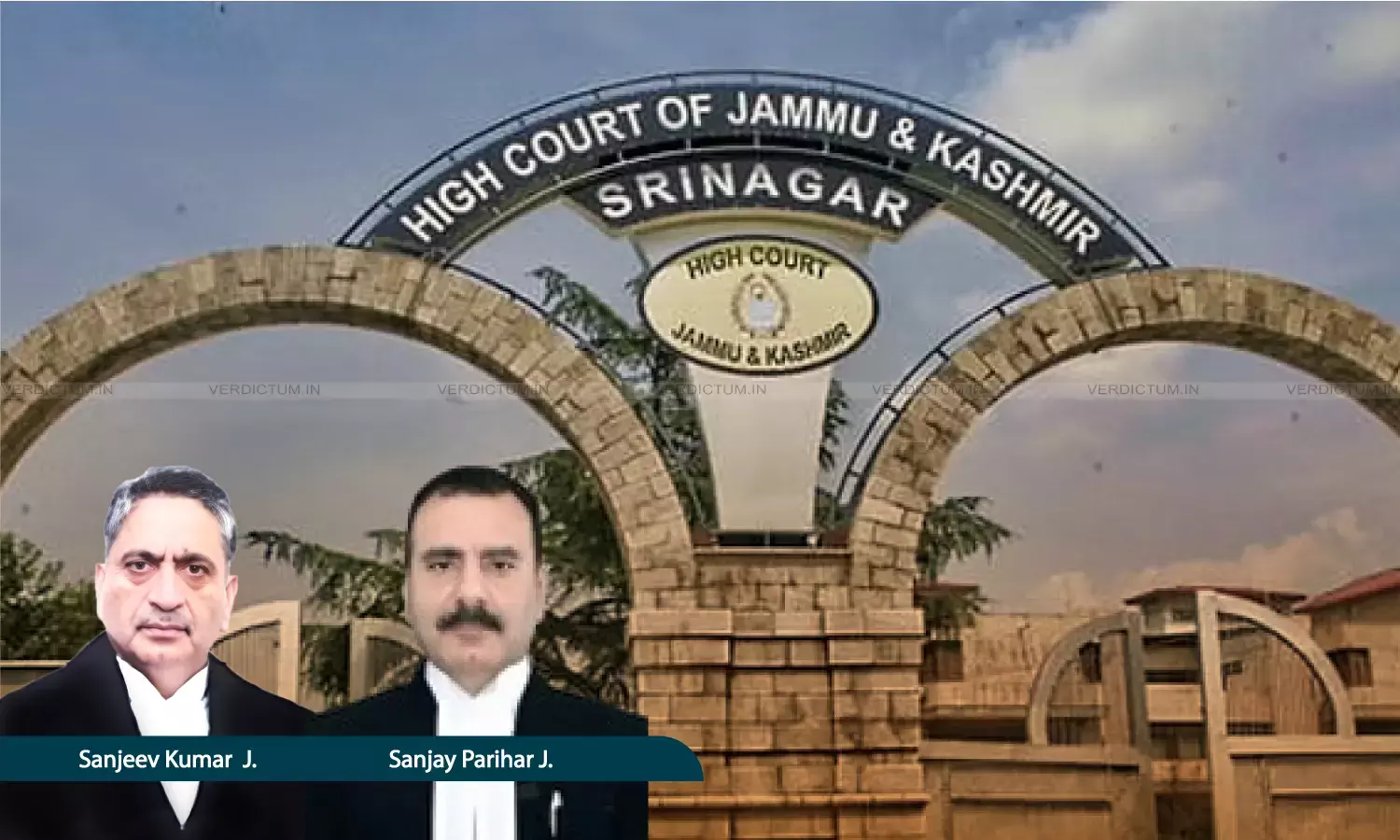
The High Court of Jammu & Kashmir and Ladakh has upheld the constitutional validity of Rule 147-A of the Army Rules, 1954, holding that rules framed under delegated authority conferred by Parliament are also protected under Article 33 of the Constitution and can validly restrict fundamental rights in their application to armed forces personnel.
The Court was hearing a writ petition challenging an order passed by the Armed Forces Tribunal dismissing an appeal filed against a conviction by a Summary General Court Martial on the ground that it was not accompanied by a certified copy of the conviction order. The petitioner had also challenged the constitutional validity of Rule 147-A of the Army Rules, 1954.
A Division Bench of Justice Sanjeev Kumar and Justice Sanjay Parihar observed: “From a careful reading of Article 33, it would become evident that the provision talks about the law made by the Parliament and not the act of Parliament. The rules framed by the Government under the authority delegated under the Act are nothing but a law made by the Parliament.”
The Bench further observed: “To emphasise, we would like to reiterate that the expression ‘law’ used in Article-33 encompasses the rules made by the Government under the delegated authority conferred upon it by the Act framed by the Parliament.”
Advocate Nida Nazir appeared for the petitioner. Tahir Majid Shamsi, DSGI, appeared for the respondents.
Background
The petitioner challenged an order dated April 23, 2024, passed by the Armed Forces Tribunal, Regional Bench, Srinagar at Jammu, whereby his appeal against conviction by a Summary General Court Martial had been dismissed for not being accompanied by a certified copy of the conviction order.
Before the High Court, the petitioner contended that the proceedings of the Summary General Court Martial had not been supplied to him by the authorities by taking shelter under Rule 147-A of the Army Rules, 1954.
The petitioner argued that Rule 147-A was violative of Articles 14 and 21 of the Constitution and that protection under Article 33 extends only to legislation enacted by Parliament and not to subordinate legislation or rules framed under the Army Act, 1950.
The respondents defended the rule by contending that Rule 147-A specifically permits denial of copies of court martial proceedings where the Central Government certifies that disclosure would be against the interests of security of the State or friendly relations with foreign States.
Court’s Observation
The High Court first examined Rules 147 and 147-A of the Army Rules, 1954. The Court observed that Rule 147 confers a right upon every person tried by a court-martial, other than a summary court-martial, to obtain copies of proceedings free of cost upon written request.
The Bench noted that Rule 147-A carves out an exception by permitting denial of copies where the Central Government certifies that disclosure would adversely affect the security of the State or friendly relations with foreign States.
At the same time, the Court observed that the rule still permits inspection of proceedings by the concerned person or legal adviser where proceedings are required for instituting legal action or filing petitions under the Army Act.
The Court then examined Article 33 of the Constitution, which empowers Parliament to determine the extent to which fundamental rights may be restricted or abrogated in their application to members of the armed forces.
Referring to Section 191 of the Army Act, 1950, the Bench observed that Parliament had expressly delegated rule-making powers to the Central Government for carrying into effect the provisions of the Act, including rules relating to court martial procedure, confirmation, revision and petitions against findings and sentences.
Rejecting the petitioner’s contention that only an enactment passed directly by Parliament could curtail fundamental rights under Article 33, the Court held that delegated legislation framed under parliamentary authority also falls within the expression “law” under Article 33.
The Court observed: “It is, therefore, an argument in despair that the fundamental rights in relation to armed forces can be abrogated or restricted only by an Act of Parliament.”
The Bench further held: “In view of the clear provisions of Article-33, the validity of Rule 147-A of the Rules cannot be assailed on the ground that it violates Article 14 and 21 of the Constitution of India.”
The Court also relied upon Mulkh Raj v. Union of India (1983), where a Single Bench of the High Court had previously upheld the constitutional validity of Rule 147-A. The Division Bench observed that it fully concurred with the earlier view.
Referring to Maneka Gandhi v. Union of India (1978), the Court observed that Article 21 requires deprivation of liberty only according to a valid, just, fair and reasonable procedure established by law. The Court held that Rule 147-A, being a law framed under parliamentary authority, satisfied that requirement and stood protected by Article 33.
The Bench also referred to Article 13(3)(a) of the Constitution and observed that the expression “law” includes rules, regulations and notifications having the force of law in India.
The Court, while observing, “different meaning to the term ‘law’ used in Article 33 of the Constitution of India is neither called for nor desirable”, concluded that “Rule 147-A is protected by Article 33 of the Constitution and, therefore, cannot be said to be ultra vires the Constitution.”
The High Court further noted that the Army Act and Rules contain sufficient inbuilt safeguards to ensure fairness in court martial proceedings and observed that denial of copies under Rule 147-A operates only in exceptional situations involving national security or foreign relations concerns.
However, while upholding Rule 147-A, the Court found fault with the Tribunal’s refusal to entertain the petitioner’s appeal merely because certified copies had not been annexed.
The Bench observed: “The tribunal ought to have summoned the record of the General Court Martial Proceedings in a sealed cover and examined the appeal of the petitioner on merits.”
Conclusion
The High Court upheld the constitutional validity of Rule 147-A of the Army Rules, 1954, holding that the rule is protected under Article 33 of the Constitution and cannot be termed ultra vires Articles 14 and 21.
At the same time, the Court held that the Armed Forces Tribunal erred in dismissing the petitioner’s appeal solely for want of certified copies despite the petitioner having been legitimately denied copies under Rule 147-A.
Accordingly, the High Court set aside the Tribunal’s order, restored the appeal to its original number, and directed the Tribunal to consider the appeal on merits after summoning the record of the Summary General Court Martial and permitting inspection in accordance with Rule 147-A.
Cause Title: Mushtaq Ahmad Malik v. Union of India (Neutral Citation: 2026:JKLHC-SGR:112-DB)
Appearances
Petitioner: Advocate Nida Nazir
Respondents: Tahir Majid Shamsi, DSGI; Faizan Ahmad Ganie, CGSC; Advocate Rehana Qayoom; Pawandeep Singh, Officer In Charge, Legal Cell (Army)