

"Dismissal" Of Employee After Retirement Based On Previously Initiated Disciplinary Proceedings Valid Where Rules Permit: J&K And Ladakh High Court
The Court also reiterated that constitutional courts exercising writ jurisdiction cannot function as appellate forums in departmental enquiries and may interfere only where the findings are perverse, unsupported by evidence, or vitiated by a violation of principles of natural justice.
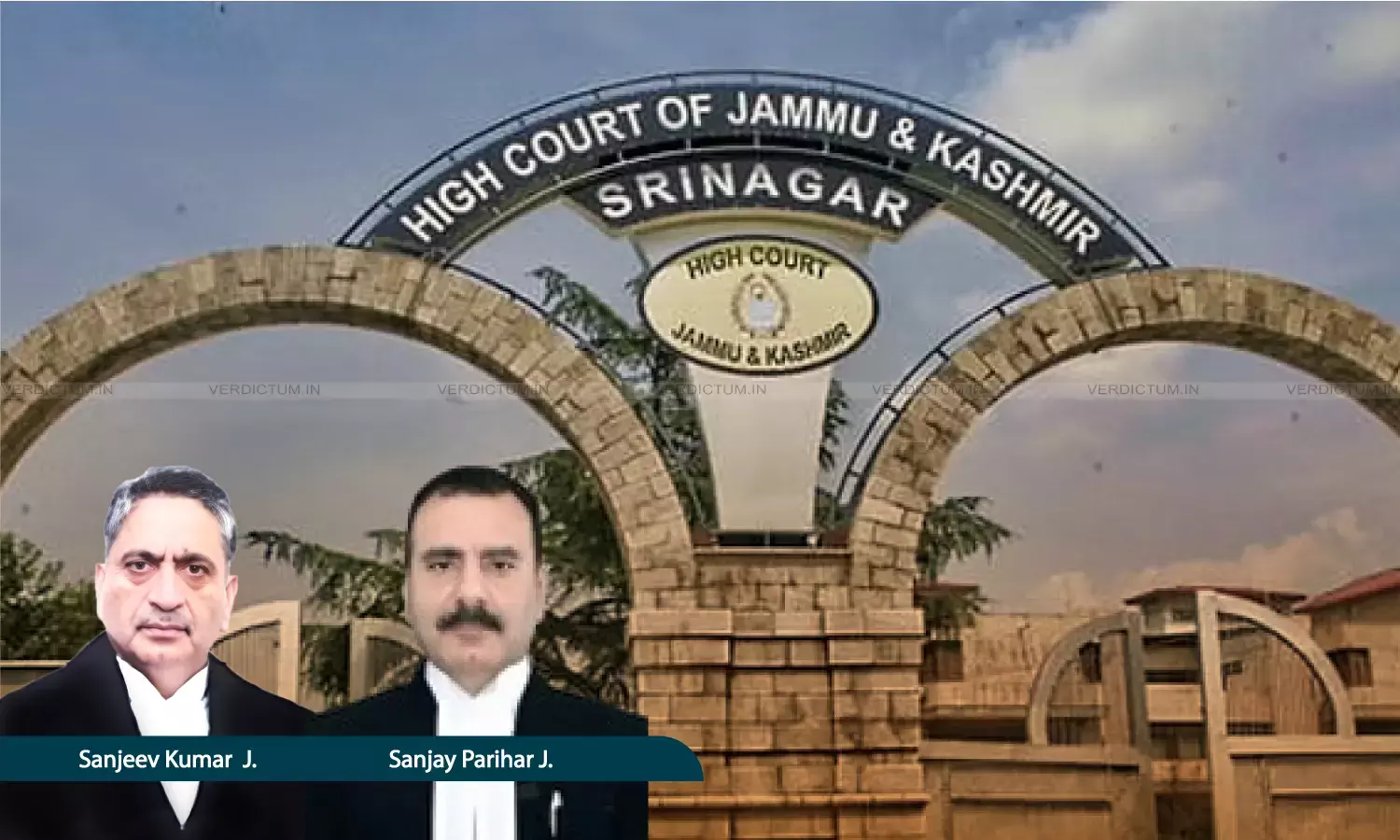
The High Court of Jammu & Kashmir and Ladakh has held that disciplinary proceedings initiated against an employee before attaining the age of superannuation can validly continue after retirement if the applicable service regulations so permit, and even if such proceedings culminate in the penalty of dismissal from service.
The Court observed that for the limited purpose of continuation and conclusion of disciplinary proceedings, the delinquent employee is deemed to continue in service by virtue of the relevant service rules.
The Court was hearing an intra-court appeal filed by Jammu & Kashmir Bank Ltd. challenging a judgment of the Single Judge whereby the dismissal of a retired Branch Head of the Bank had been quashed.
The employee had been subjected to disciplinary proceedings in relation to alleged irregular sanctioning of Temporary Overdrafts (TODs) during his tenure as a Branch Head.
A Division Bench of Justice Sanjeev Kumar and Justice Sanjay Parihar observed: “If the extant service rules/regulations permit continuance of disciplinary proceedings initiated against an officer/employee before he had attained the age of superannuation, those can be continued and taken to their logical end even after he had attained the age of superannuation.”
The Court further reiterated: “… if disciplinary proceedings under the relevant rules of service have been initiated against a delinquent employee before he ceased to be in service, then by the operation of or by virtue of any of the rules or regulations, the disciplinary proceedings may continue and be brought to the logical conclusion as if the officer was in service. Such deemed continuation in service shall only be for the purposes of continuance and conclusion of the disciplinary proceedings.”
Advocate Shafqat Nazir appeared with Advocate Heena Baqal for the appellants. Advocate Shuja-ul-Haq appeared for the respondent.
Background
The respondent employee retired on superannuation from Jammu & Kashmir Bank Ltd. as Branch Head. Before his retirement, he had been placed under suspension on 17.03.2021 in contemplation of a disciplinary enquiry into alleged acts of omission and commission committed during his tenure as Branch Head at the various branches.
Following a preliminary enquiry, the Bank issued a charge sheet dated 21.05.2021 relating to misconduct allegedly committed during one of his postings. Subsequently, another charge sheet dated 28.06.2021 was issued concerning alleged irregularities committed during his tenure at another branch.
The disciplinary authority appointed separate enquiry officers to conduct departmental enquiries in relation to both charge sheets. While the enquiries were pending, the respondent attained the age of superannuation on 30.06.2021. However, the enquiries continued thereafter in terms of the applicable service regulations.
Upon conclusion of the enquiries, the enquiry officers submitted reports holding most of the imputations against the respondent proved. The disciplinary authority thereafter issued a composite show-cause notice proposing a penalty and also granted a personal hearing to the respondent.
By order dated 01.04.2022, the disciplinary authority dismissed the respondent from service with effect from the date of his superannuation, i.e., 30.06.2021. The appellate authority upheld the dismissal order on 09.11.2022.
The respondent challenged the dismissal before the writ court, which quashed the disciplinary action on the ground that the misconduct was not sufficiently proved and that adequate opportunity had not been granted during the enquiry proceedings.
Aggrieved thereby, the Bank preferred the present intra-court appeal.
Court’s Observation
The Division Bench first examined whether disciplinary proceedings initiated while an employee was in service could continue after retirement and culminate in dismissal from service.
The Court referred to Rule 259 of the Officers’ Service Manual, 2000, which specifically provided that disciplinary proceedings initiated before superannuation would continue as if the employee remained in service until conclusion of proceedings and passing of final orders.
The Court noted that the rule further empowered the Bank to impose any of the penalties provided under the service regulations even after retirement and also authorised recoveries from terminal benefits in the event the employee was found guilty of causing financial loss to the Bank.
Relying upon the Supreme Court judgment in Virinder Pal Singh v. Punjab and Sind Bank (2026), the Court reiterated that where service regulations permit continuation of disciplinary proceedings beyond retirement, such proceedings can be carried to their logical conclusion and may even culminate in dismissal resulting in forfeiture of retirement benefits.
The Court then extensively examined the scope of judicial review over disciplinary proceedings.
Referring to State of Andhra Pradesh v. Sree Rama Rao (1963), State Bank of India v. Ram Lal Bhaskar (2011) and other judgments, the Court reiterated that High Courts do not function as appellate courts in departmental matters and cannot re-assess evidence led before enquiry officers.
The Court observed that once it is demonstrated that the enquiry has been conducted fairly and findings are supported by some evidence, adequacy or reliability of such evidence cannot ordinarily be examined in writ jurisdiction.
Quoting from Sree Rama Rao, the Court observed: “The High Court is not constituted in a proceeding under Article 226 of the Constitution a Court of appeal over the decision of the authorities holding a departmental enquiry against a public servant.”
The Division Bench undertook an examination of the enquiry record and concluded that the Bank had complied with all statutory and procedural requirements while conducting the disciplinary proceedings.
The Court noted that clear and specific charges had been framed, the respondent was granted adequate opportunity to defend himself, and elaborate enquiry proceedings had been conducted strictly in accordance with the Bank’s regulations.
The Court rejected the finding of the writ court that the denial of cross-examination of one Azad Ahmad Banday vitiated the enquiry. It was observed that Banday had never entered the witness box and had merely responded to an official email query from the enquiry officer confirming that no post-facto sanction proposals had been received from the respondent.
The Court further noted that the respondent had never sought the summoning of the relevant records or examination of Banday during the enquiry proceedings.
The Court found from the enquiry record that there existed sufficient documentary evidence establishing that the respondent had granted Temporary Overdraft facilities beyond his authorised powers without approval of the competent authority and without proper assessment of the borrowers’ creditworthiness.
The Court noted that several TOD accounts subsequently turned Non-Performing Assets, causing substantial financial loss to the Bank.
Relying again upon Virinder Pal Singh, the Court observed: “A bank officer holds a position of trust as he deals with public funds. Sanction of loan beyond one’s power, or not ensuring end-use of the loan, amounts to financial irregularity which exposes the Bank to financial risk.”
The Court further reiterated: “Any dereliction in discharge of duties by such an employee or officer, whether by way of negligence/casualness, or with deliberate intention, constitutes misconduct.”
The respondent had relied upon Rule 337(C) of the Officers’ Service Manual, contending that the TODs had been sanctioned pursuant to verbal directions issued by superior officers.
Rejecting this contention, the Court held that the rule only protected employees acting under directions of superiors provided they obtained written directions or written confirmation of such directions as soon as practicable.
The Court observed: “Rule does not permit an employee to act otherwise than in his best judgment nor does it permit the employee to act beyond his authority.”
The Court further noted that the respondent had failed to produce any material showing that he had obtained written confirmation of the alleged verbal directions or that he had sought valid post-facto approval from the competent authority.
Conclusion
Holding that the writ court had exceeded the permissible limits of judicial review by re-appreciating evidence as an appellate forum, the Division Bench allowed the appeal, set aside the judgment of the writ court and dismissed the writ petition filed by the respondent employee.
Cause Title: Jammu & Kashmir Bank Ltd. & Ors. v. Naseer Ahmad Sheikh
