

Actively Sharing Inflammatory Propaganda Online To Further Ideology Of Banned Organisation Will Attract UAPA Charges: Jammu & Kashmir And Ladakh High Court

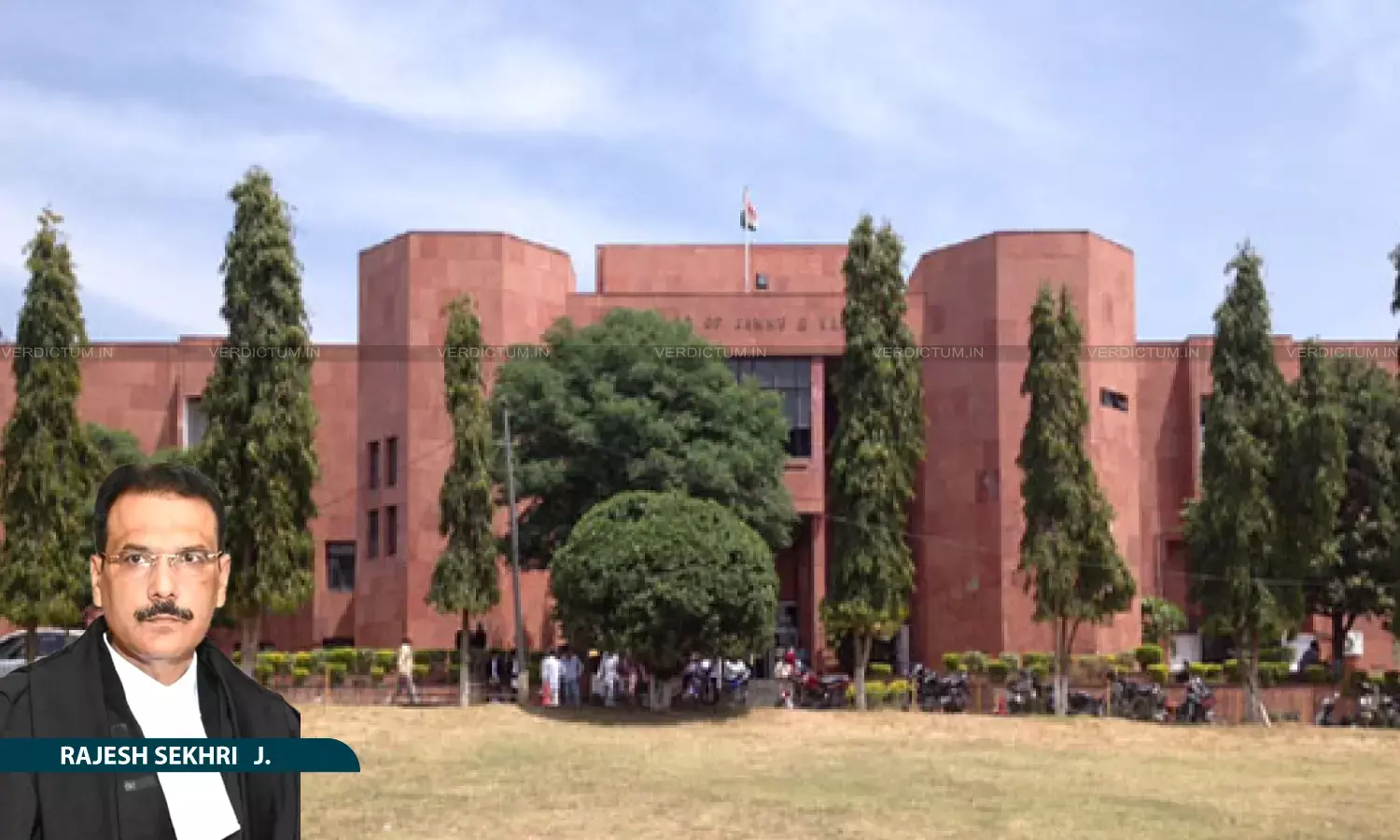
Justice Rajesh Sekhri, Jammu & Kashmir and Ladakh High Court
The Jammu & Kashmir and Ladakh High Court has held that while passive possession of unbanned material may not trigger charges under the Unlawful Activities (Prevention) Act (UAPA) but actively sharing inflammatory propaganda online, operating social media toolkits for the radicalisation or recruiting others to further the ideology of a banned organisation would certainly attract the charges.
The petitioner had approached the High Court invoking Section 528 of the BNSS, for the quashing of the order passed by the Additional Sessions Judge, Special Judge designated under the NIA Act, Jammu (Trial Court), whereby he came to be charged with offences under Sections 13 and 20 of the Unlawful Activities (Prevention) Act, 1967 and Section 201 of the IPC.
The Single Bench of Justice Rajesh Sekhri held, “While owning a book is generally protected, its material can be used as evidence to support charges, if prosecution succeeds to establish specific links that book is used to advocate, abet, incite or plan an unlawful or terrorist act or it is used to recruit or raise funds for a banned terrorist organisation or intended to further the violent activities of a terrorist gang. Therefore, while passive possession of an unbanned material may not trigger UA(P)A charges, however, actively sharing inflammatory propaganda online, operating social media toolkits for radicalisation or recruiting others to further the ideology of a banned organisation would certainly attract the charges.”
Senior Advocate A. M. Dar represented the Petitioner while Senior Advocate (DSGI) Vishal Sharma represented the Respondent.
Factual Background
The case dates back to the year 2024 when the police received source information that some unknown terrorists, in furtherance of their intention to revive militancy and terrorise people of the area, fired upon two non-locals with illegal weapons, resulting in the on-the-spot death of a non-local and a critical injury to the other. An FIR for offences under Sections 302, 307 IPC, 7/27 of the Arms Act and Sections 15,16,20 of UA(P)A came to be registered. The investigation revealed that The Resistance Front (TRF) and Lashkar-e-Taiba (LeT) conspired to strike terror in the minds of the people of Jammu and Kashmir by targeting the non-local community. It surfaced that in 2023, accused Adil Manzoor Langoo (A-1), after reading a book on jihad and watching jihad videos on YouTube, became radicalised. The accused persons started a WhatsApp group and shared details.
It was further alleged that A-4 motivated A-1 to assist members of LeT and TRF. As per the investigating agency, on the instructions of A-1, the petitioner collected a polythene bag, which, after collecting the aforesaid parcel containing a pistol and magazines, was thrown by A-1 near Nund Rishi Bund. This bag, according to the investigating agency, came to be recovered on the disclosure and at the instance of the petitioner. According to the investigating agency, the petitioner was highly radicalised and was in close contact with both A1 and A-2 through social media. During the investigation, the injured, namely Rohit Massi, also succumbed to his injuries.
According to the investigating agency, there was sufficient evidence available on the record to establish beyond any reasonable doubt that all the accused persons, including the petitioner entered into a criminal conspiracy to wage war against the Government of India and commit terror activities in the UT of Jammu and Kashmir. The Trial Court concluded that there was nothing in the record to show that the petitioner was part of the conspiracy to kill non-locals, but he was a member of the gang with A-1 and A-2, and his role came to the fore after the killing of the non-locals, i.e., to destroy the evidence. Accordingly, the petitioner was discharged by the Trial Court for offences under Sections 302, 120-B IPC and offences under Sections 16, 18 and 23 UA(P)A. However, was charged for offences under Sections 13 and 20 UA(P)A and 201 of the IPC.
Reasoning
On a perusal of the provisions of the UAPA, the Bench explained that “terrorist act” as defined under Section 2(1)(k) is to be construed having regard to the meaning assigned to it in Section 15 of the Act and to invoke Section 20 of the Act, prosecution is obliged to prove that the accused was a member of a terrorist gang or an organisation that carries on or indulges in terrorist acts as defined in Section 15 of the Act.
After considering the facts of the case, the Bench held that there was nothing in the record to suggest that the petitioner had committed or indulged in a “terrorist act” as defined under Section 2(k), which carries the meaning assigned to it in Section 15 because no covert or overt terrorist act had been attributed to him. It was further noticed that the Central Government, after carefully examining the entire material placed on record and the recommendations of the authority, being satisfied that a prima facie case was made out against the accused persons under the relevant sections of law, accorded sanction for prosecution of the petitioner-Dawood under Sections 16, 18, 20 and 23 UA(P)A.
The Bench found sufficient material, including the statement of the protected witness and the scientific evidence, to disclose a prima facie case against the petitioner that he had committed, advocated and incited the commission of unlawful activities by signs and visible representation, which was intended to bring about the cession of a part of the territory of India from the Union, punishable under Section 13. Therefore, the Bench found no illegality or infirmity in the lower Court’s order framing charge against the petitioner under Section 13 of the UAPA.
Considering that the charge sheet revealed that the FSL report was positive with respect to the matching of the polythene bag sent by the investigating agency to CFSL with the photo of the polythene which was sent by the accused persons, the Bench held that there was sufficient evidence on record to disclose a prima facie offence under Section 201 IPC against the petitioner.
Thus, allowing the petition in part, the Bench set aside the impugned order to the extent of framing of charge against the petitioner under Section 20 UAPA. “However, the impugned order concerning charge against the petitioner for offences under Sections 13 UA(P)A and 201 IPC is upheld”, it ordered.
Cause Title: Dawood v. Union Territory of Jammu & Kashmir (Case No.: CRM(M) No. 889/2025)
Appearance
Petitioner: Senior Advocate A. M. Dar, Advocate Harish Sharma
Respondent: Senior Advocate (DSGI) Vishal Sharma, Central Govt. Standing Counsel Karan Sharma, Public Prosecutors Chandan Kumar Singh, Ashwani Verma