

Constitutional Courts Can Intervene Where UAPA Accused Remained In Custody for Long Period: Jammu & Kashmir and Ladakh High Court
The petitioner had approached the High Court seeking an expedited trial in a case arising out of an FIR registered under the Unlawful Activities (Prevention) Act.

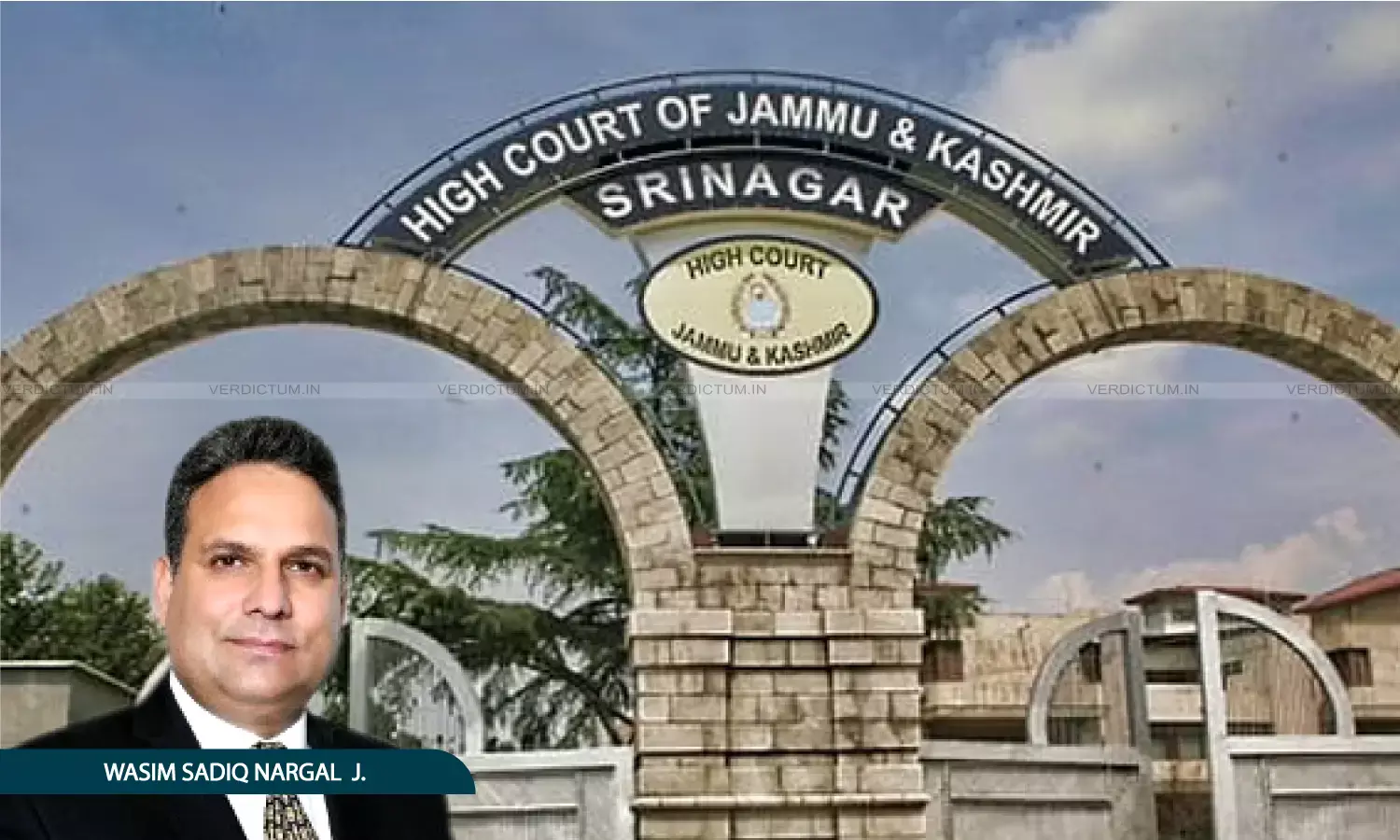
Justice Wasim Sadiq Nargal, Jammu & Kashmir & Ladakh High Court
While directing a trial to be expedited, the Jammu & Kashmir and Ladakh High Court has reiterated that even under stringent provisions of the UAPA, the Constitutional Courts can intervene where an accused has remained in custody for a long period.
The petitioner had approached the High Court by filing a petition under Article 226 of the Constitution seeking issuance of appropriate directions commanding the Trial Court/Special Court to conclude the trial arising out of an FIR registered under Sections 16, 18, 20 and 23 of the Unlawful Activities (Prevention) Act, 1967, Sections 3,4 of the Explosive Substances Act and Sections 307 and 427 IPC, within a time-bound period.
The Single Bench of Justice Wasim Sadiq Nargal stated, “This Court is of the view that even in cases arising under stringent statutory provisions, prolonged delay in trial cannot be ignored and constitutional courts are duty bound to balance national security concerns with individual liberty. If trials under such enactments remains pending , the process itself may become punitive. Therefore, while safeguarding societal and national interests, courts must equally ensure that undertrial prisoners are not subjected to endless incarceration without timely adjudication.”
Referring to the judgment of the Apex Court in Syed Iftikhar Andrabi vs National Investigation Agency (2026), the Bench stated, “The aforesaid judgment further make it clear that even under stringent provisions of the UAPA, constitutional courts can intervene where an accused has remained in custody for a long period and the trial is not likely to conclude within a reasonable time. Prolonged detention and delay in conclusion of trial itself is violative of Article 21of the Constitution of India.”
Advocate Hussain Rashid represented the Appellant.
Arguments
It was the case of the petitioner that the FIR came to be registered on March 30, 2020, and after completion of the investigation, a charge-sheet was filed before the competent Court. It was pleaded that though the prosecution had cited around 20 witnesses, statements of several witnesses already stood recorded, and according to the petitioner, the prosecution evidence had substantially progressed, yet the trial was not being conducted on a day-to-day basis.
Reasoning
The Bench, at the outset, mentioned, “Before adverting to the factual matrix of the case, it becomes necessary to reiterate that the right to speedy trial is no longer res integra. It stands crystallized as a constitutional guarantee flowing directly from Article 21 of the Constitution of India.Fair procedure under Article 21 necessarily includes fair investigation, fair inquiry and expeditious conclusion of trial.”
The Bench took note of the fact that the petitioner had remained in custody for a considerable period and the trial had remained pending for years after the framing of charges. Considering that no sufficient reason was forthcoming that the allegations against the petitioner were serious in nature, the Bench held that the constitutional rights guaranteed under Article 21 cannot be defeated by prolonged delay in trial.
The Bench noted that the FIR in question came to be registered on March 30, 2020, for offences punishable under Sections 16, 18, 20 and 23 of the UAPA, Sections 3,4 of the Explosive Substances Act, and Sections 307 and 427 of the IPC. It was further noticed that the investigation admittedly culminated in the presentation of a chargesheet on October 10, 2020, and charges were framed on March 29, 2021. “Despite the passage of more than five years thereafter, the trial has not culminated into final adjudication. Such delay inevitably causes prejudice to the accused not merely in terms of deprivation of liberty but also by subjecting him to prolonged uncertainty and mental agony”, it added.
The Bench stated, “This Court is of the considered view that unnecessary adjournments, unless warranted by compelling circumstances, defeat the very object of speedy trial. The learned Trial Court is therefore expected to regulate the proceedings in an effective manner and ensure meaningful progress of the case on each date of hearing.”
Thus, finding merit in the grievance projected by the petitioner regarding the delay in the conclusion of the trial, the Bench disposed of the petition with a direction to the Trial Court/Special Court concerned to accord priority to the trial arising out of FIR and make all possible endeavors to conclude the same expeditiously.
Cause Title: Arif Billa Sheikh v. Union Territory of Jammu & Kashmir (Case No.: WP(C) 964/2026)