Posters Attempting To Alienate J&K Residents From India Sufficient To Frame UAPA Charges: J&K And Ladakh High Court
The Court held that where the material on record raises a prima facie presumption of guilt under the UAPA, disputed questions of fact and pleas of false implication must be tested at trial and cannot be used to quash charges at the threshold.
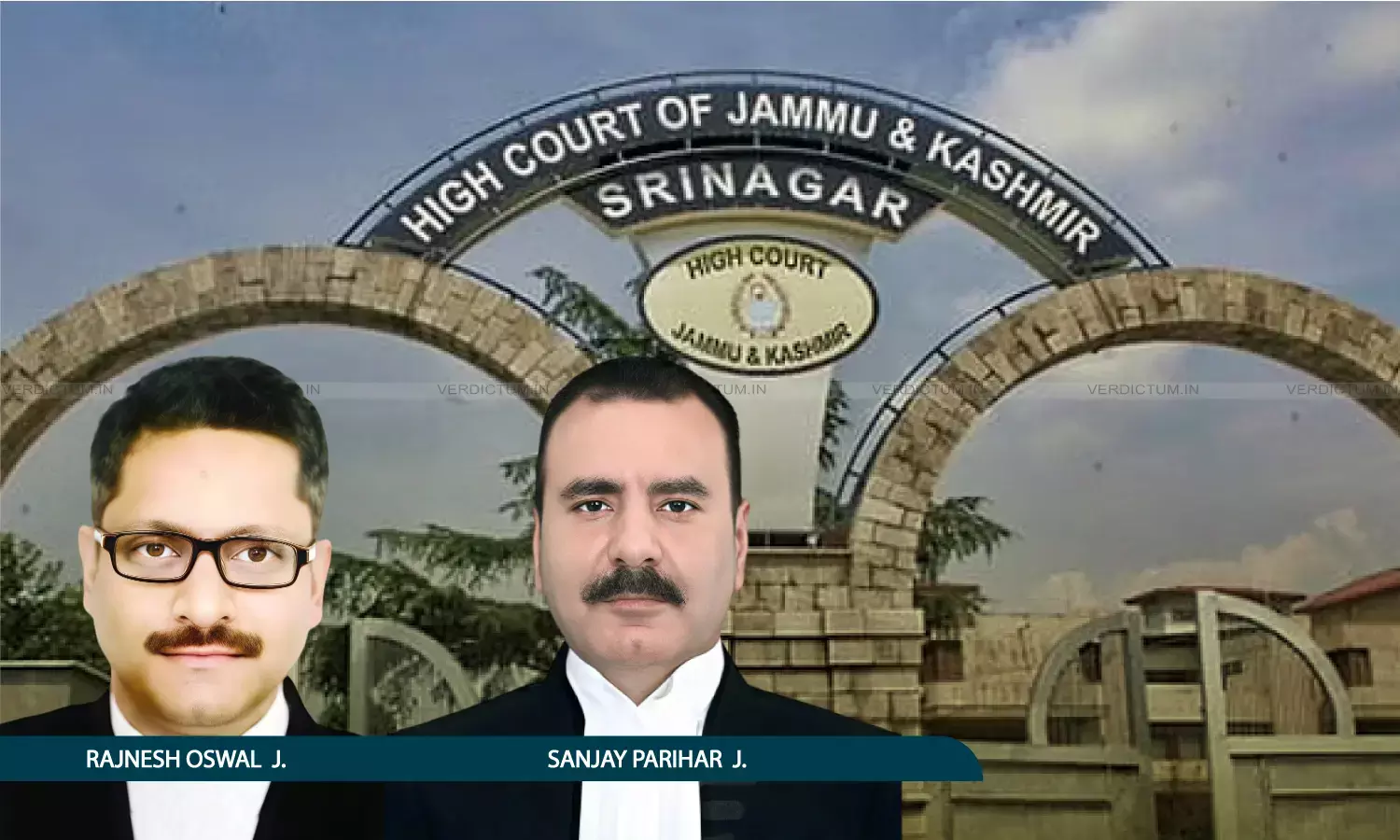
The Jammu & Kashmir and Ladakh High Court has held that posters containing material that makes a deliberate attempt to alienate residents of Jammu and Kashmir from the rest of India are sufficient, at the stage of framing charge, to attract Section 13 of the Unlawful Activities (Prevention) Act, 1967.
The Court was hearing two connected criminal appeals challenging an order passed by the Designated Special Court under the NIA Act, whereby charges were framed against the appellants under different provisions of the UAPA and the IPC.
A Bench of Justice Rajnesh Oswal and Justice Sanjay Parihar observed: “Be that as it may, at this stage of the proceedings, the contents of the posters running across the record are, in our estimation, amply sufficient for charging the appellants with the commission of an offence under Section 13 of the Act. In the text of these posters, a deliberate attempt has been made to alienate the local residents of Jammu and Kashmir from the rest of India, which is sufficient to spread disaffection against the nation.”
Advocate Shariq Jan Reyaz appeared for the appellant, while Mohsin Qadiri, Senior AAG, appeared for the State.
Background
The appellants challenged the order framing charges against them under the UAPA and the IPC, primarily contending that the ingredients of Sections 13 and 39 of the UAPA were not made out and that the trial court had relied on alleged confessional or disclosure statements which were legally impermissible in the absence of corroborative recovery or discovery.
The prosecution's case was that a threat message relating to the upcoming Parliamentary elections had been posted on a social media group associated with a proscribed outfit. During checking, the appellants were allegedly found carrying posters, cash and adhesive material. The prosecution further alleged that they were in contact with a Pakistan-based handler and were acting pursuant to directions to paste posters at different places to dissuade people from participating in elections.
The appellants argued that there was no legally admissible material to connect them with the offences under Sections 18, 39 and 40(2) of the UAPA, and one of them also claimed false implication on the basis of earlier habeas corpus proceedings. The respondent relied on the recovery of posters, cash, adhesive material, mobile-location data, forensic extraction from phones and alleged digital communication to support the order framing charges.
Court’s Observations
The High Court first reiterated the settled principles governing framing of charge and discharge. Referring to State of Andhra Pradesh v. Golconda Linga Swamy and Sajjan Kumar v. CBI (2004), the Court noted that, at this stage, evidence cannot be meticulously examined and that a charge may be framed if the material shows the possibility of commission of the offence, as distinguished from certainty.
The Bench observed: “Thus, as mandated by Sections 227 and 228 of the Cr.P.C. (sections 250(2) and 251 of BNSS), while considering the issue of framing of charge or discharge of the accused, the court must form an opinion based on the material placed on record by the Investigating Officer to ascertain whether sufficient grounds exist for presuming that the accused has committed the offence. At this stage, the court cannot indulge in a meticulous or critical evaluation of the evidence, which is a domain reserved strictly for the final appreciation of evidence upon the conclusion of the trial”.
The Bench added: “While a charge may be framed even on the basis of grave suspicion, the trial court is simultaneously not expected to act merely as a post office and frame charges mechanically simply because a charge sheet has been filed. The trial court may sift the prosecution's evidence to ascertain whether the unrebutted material satisfies the essential ingredients of the alleged offence; however, it cannot conduct a „mini-trial‟ to determine whether the final matrix would warrant a conviction. If the foundational ingredients of the offence are conspicuously lacking, the court has no option but to discharge the accused.”
The Court noted that the appellants had effectively confined their challenge to the charges under Sections 18, 39 and 40(2) of the UAPA, as the strict bail limitations under Section 43D(5) were triggered by the more serious offences. However, the Court held that, even at the threshold, the contents of the posters were sufficient for charging the appellants under Section 13 of the Act.
The Bench rejected the reliance placed by the appellants on U.T. of J&K v. Ghulam Mohd. Lone (2024), holding that the said judgment could not assist them at the stage of framing a charge. It held that the text of the posters disclosed a deliberate attempt to alienate local residents of Jammu and Kashmir from the rest of India, which was sufficient to spread disaffection against the nation.
The Court then considered the challenge to the charge under Section 18 of the UAPA. It noted that the prosecution's case extended beyond mere possession of posters and currency, and included allegations of contact with a Pakistan-based handler and a terrorist associated with a proscribed outfit.
The Bench observed: “The case against the appellants extends beyond the mere possession of incriminating posters and currency notes. They are further alleged to have been in contact with a Pakistan-based handler and an active terrorist, Momin Gulzar, who was later neutralized in an encounter. Notably, a photograph of the deceased terrorist was found on the mobile phone of appellant Mohammad Manan Dar. Since this photograph was entirely unavailable on the open internet or any social media platform, it rules out the possibility of it being downloaded or retrieved from the public domain. The record indicates that the Telegram channel of the banned terrorist organization TRF was operated by a Pakistan-based handler. The recovered posters and the sum of ₹1,00,000/- were intended for delivery to a terrorist, Momin Gulzar, who was later killed in an encounter. The physical transportation of these posters alongside unaccounted-for cash demonstrates that the appellants and 'Momin Gulzar ' were part of a wider conspiracy to strike terror among the public, specifically targeting polling personnel on electoral duty, and to challenge the sovereignty of India. Therefore, at this threshold stage, the contention that there is no evidence to connect the appellants with the offense under Section 18 of the Act is legally unsustainable.”
On Section 39 of the UAPA, the Court held that there was incriminating material to show that the appellants were allegedly working as associates of the proscribed outfit. It relied on recovery of propaganda posters, cash and adhesive material from their conscious possession, along with the alleged digital link between the recovered posters and earlier publication on a Telegram channel.
The Bench observed: “Insofar as the offence under Section 39 of the Act is concerned, there is incriminating material on record to demonstrate that the appellants were actively working as associates of the proscribed TRF outfit. This link is substantiated by the recovery of propaganda posters, cash, and adhesive material (glue) from their conscious possession. Furthermore, a digital nexus is established by the fact that the contents of the posters recovered from the appellants on 19.03.2024 were previously published online on 14.03.2024 by the 'Kashmir Fights' Telegram channel”.
The Court further held that disputed factual questions raised by the appellants could not be evaluated at the stage of framing the charge and would have to be determined at trial. It also found no error in framing a charge under Section 40(2) of the UAPA, particularly in view of the allegation that one appellant had failed to justify possession of ₹1 lakh and there were no corresponding bank withdrawals.
Dealing with the plea of false implication based on habeas corpus proceedings, the Court held that bald averments in such proceedings could not constitute unimpeachable evidence of sterling quality. It was observed that, at best, the plea was a defence to be established during trial and could not be a ground to quash the order framing charges.
The Bench observed: “To invoke the extraordinary power of quashing an FIR or charge sheet, the record must disclose unimpeachable evidence of sterling quality that requires no further proof; self-serving pleadings do not meet this threshold. At best, the appellant's contention constitutes a matter of defence to be established at trial, rather than a ground to quash the order framing charges. Notably, this ground was not raised in the memo of appeal.”
The Court relied on State of Orissa v. Debendra Nath Padhi (2005) to reiterate that at the stage of framing charge, the defence of the accused cannot be examined by holding a mini-trial. It held that the hearing of the accused at that stage is confined to the record filed by the prosecution and the documents submitted with it.
The Bench held that the trial court was neither required nor positioned to conclusively determine the adequacy of the evidence at the stage of framing charges. The only question was whether a prima facie presumption of guilt existed against the appellants.
The Court observed: “Upon reviewing the record, we find no error in the impugned order. At the stage of framing charges, the learned trial court was neither required nor positioned to conclusively determine the adequacy of the evidence; it was only tasked with ascertaining whether a prima facie presumption of guilt exists against the appellants.”
Conclusion
The High Court held that there was no error or infirmity in the trial court’s order framing charges against the appellants. It dismissed the appeals as devoid of merit and misconceived.
However, the Court clarified that all observations made while determining the validity of the charge-framing order were tentative in nature and would not be treated as an expression of opinion on the merits of the case during trial. The trial court was directed to arrive at its own independent conclusion upon the culmination of the trial.
Cause Title: Adan Bashir Bangroo & Anr. v. U.T. of J&K through Police Station Shaheed Gunj, Srinagar (Neutral Citation: 2026:JKLHC-SGR:213-DB)
Appearances
Appellants: Advocates Shariq Jan Reyaz and Danish Majid Dar.
Respondent: Mohsin Qadiri, Senior AAG, with Advocate Maha Majeed.