

Adverse Possession Requires Open & Hostile Intention To Dispossess Owner, Mere Possession Insufficient: Himachal Pradesh High Court
The Court rejected the State’s adverse-possession claim over private land used for constructing a public road and upheld the decree for possession granted to the landowner.
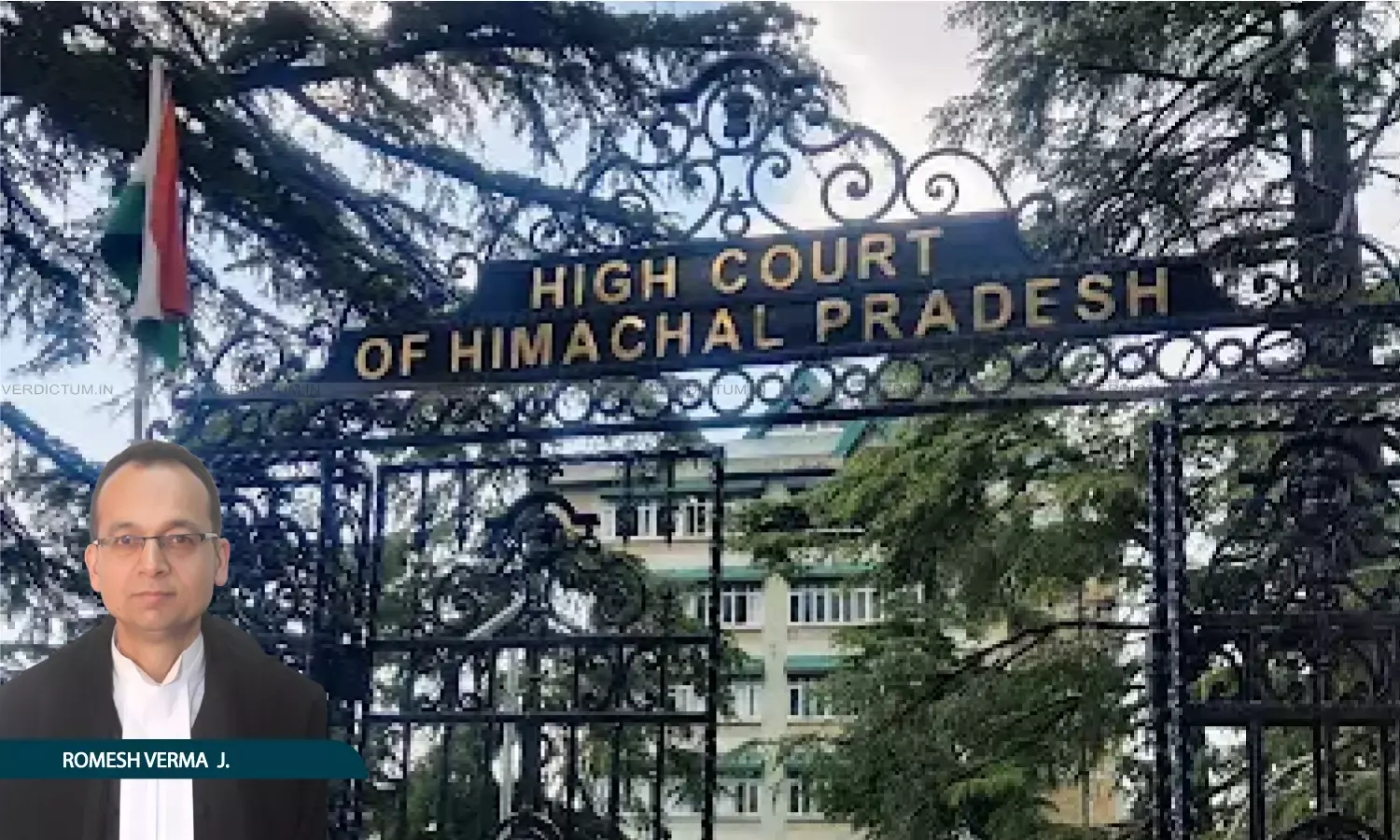
Justice Romesh Verma, Himachal Pradesh High Court
The Himachal Pradesh High Court has held that adverse possession requires an open and hostile intention to dispossess the true owner. Mere physical possession or an intention to possess cannot substitute the positive intention to exclude the owner from the property.
The Court was hearing the State’s Regular Second Appeal against an Additional District Judge’s decision reversing the dismissal of the landowner’s suit and granting him a decree for possession on the strength of his title.
A Bench of Justice Romesh Verma observed: “The intention to dispossess needs to be open and hostile enough to bring the same to the knowledge and the plaintiff has an opportunity to object. After all adverse possession right is not a substantive right but a result of the waiving or omission of the right to defend or care for the integrity of property on the part of the owner of the property on paper. Adverse possession statutes, like other statutes of limitation, rest on a public policy that does not promote litigation and aims at the repose of conditions that the parties have suffered to remain unquestioned long enough to indicate their acquiescence. Intention implies knowledge on the part of adverse possessor”.
The Bench added: “The issue is that intention of the adverse user gets communicated to the owner of the property on paper. This is where the law gives importance to hostility and openness as pertinent qualities of manner of possession. It follows that the possession of adverse possessor must be hostile enough to give rise to a reasonable notice and opportunity to the owner of the property on paper. Intention to possess cannot be substituted for intention to dispossess which is essential to prove adverse possession. Physical fact of exclusive possession and the animus possidendi to hold as owner in exclusion to the actual owner are the most important factors that are to be accounted in cases of this nature. Plea of adverse possession is not a pure question of law but a blended one of fact and law.”
Diwakar Dev Sharma, Additional Advocate General, appeared for the State, while N.K. Thakur, Senior Advocate, represented the landowner.
Background
The landowner instituted a suit for possession after alleging that the State had used his land for constructing a public road without acquiring it, obtaining his consent or paying compensation. He approached the court after the authorities allegedly attempted to widen the road further.
The State admitted the landowner’s recorded title but contended that the road had existed since 1971-72 and that its possession was open and hostile to his knowledge. It claimed to have acquired ownership through adverse possession.
The Trial Court dismissed the suit after finding that the landowner had known about the road for several decades and had not brought the suit within 12 years of its construction. The First Appellate Court reversed that decision and granted a decree for possession, while permitting the State to acquire the land in accordance with law.
Court’s Observations
The Court observed that a party claiming adverse possession must clearly establish when it entered possession, the nature and duration of that possession, whether it was known to the true owner, and whether it remained open and undisturbed. It held that the burden rests upon the person seeking to defeat the recorded owner’s title.
The Bench stated: “A person pleading adverse possession has no equities in his favour since he is trying to defeat rights of true owner, it is for him to clearly plead and establish all facts necessary to prove his adverse possession.”
The Court distinguished continuous possession from the positive intention required to dispossess the owner. It observed that adverse possession does not arise merely because the owner has neglected to reclaim the property; the possessor must demonstrate conduct directed at excluding the owner.
The Bench remarked: “Adverse possession is a right which comes into play not just because someone loses his right to reclaim the property out of continuous and willful neglect, but also on account of possessor’s positive intent to dispossess.”
The Court relied upon T. Anjanappa and Others v. Somalingappa and Another (2006), which required clear and unequivocal evidence that the possession was hostile to the true owner and amounted to a denial of title. It also referred to Chatti Konati Rao and Others v. Palle Venkata Subba Rao (2010), which reiterated that mere possession, however long, does not become adverse unless it is open, continuous and hostile to the owner.
Applying these principles, the Court found that the State had acknowledged the landowner’s title by pleading adverse possession but had failed to furnish the necessary particulars. It characterised the plea as vague and unsupported by the evidence required to establish hostile possession.
The Bench observed: “The ingredients of adverse possession have neither been pleaded nor proved by the defendants. The pleading qua adverse possession is cryptic, vague and confusing.”
The Court referred to Vidya Devi v. State of Himachal Pradesh (2020), which held that the State cannot take private property without legal sanction, due process and payment of fair compensation. It observed that the State, as a welfare State governed by the rule of law, cannot place itself beyond the constitutional safeguards protecting private property.
The Court further relied upon State of Haryana and Another v. Amin Lal (2024), which held that the State cannot perfect its title over a citizen’s property by invoking adverse possession. The Bench observed that permitting such a claim would undermine constitutional rights and public confidence in government.
The Court stated: “Allowing the State to appropriate private property through adverse possession would undermine the constitutional rights of citizens and would erode public trust in the government.”
On limitation, the Court referred to Sukh Dutt Ratra and Another v. State of Himachal Pradesh and Others (2022). It observed that the State could not rely upon delay to avoid responsibility where private land had been used without lawful acquisition or payment of compensation.
The Court also found that the State’s witnesses had admitted the landowner’s recorded title, that the land had not been acquired and that the State had no right to interfere with privately owned land without following the prescribed process. It consequently held that the landowner’s title could prevail unless the State established adverse possession, which it had failed to do.
Conclusion
The Court found no illegality, perversity or jurisdictional error in the First Appellate Court’s judgment. It dismissed the State’s Regular Second Appeal and upheld the decree for possession granted to the landowner, with liberty to the State to acquire the land in accordance with law.
The Court also disposed of the pending applications.
Cause Title: State of Himachal Pradesh & Ors. v. Prittam Singh (Neutral Citation: 2026:HHC:41838)
Appearances
Appellants: Diwakar Dev Sharma, Additional Advocate General
Respondent: N.K. Thakur, Senior Advocate, assisted by Divya Raj Singh, Advocate
