

Preference To Local Candidates In Public Employment Cannot Override Merit: Himachal Pradesh High Court
The Bench noted that the Courts cannot act as appellate authorities to re-assess interview marks or comparative merit absent proven bias.

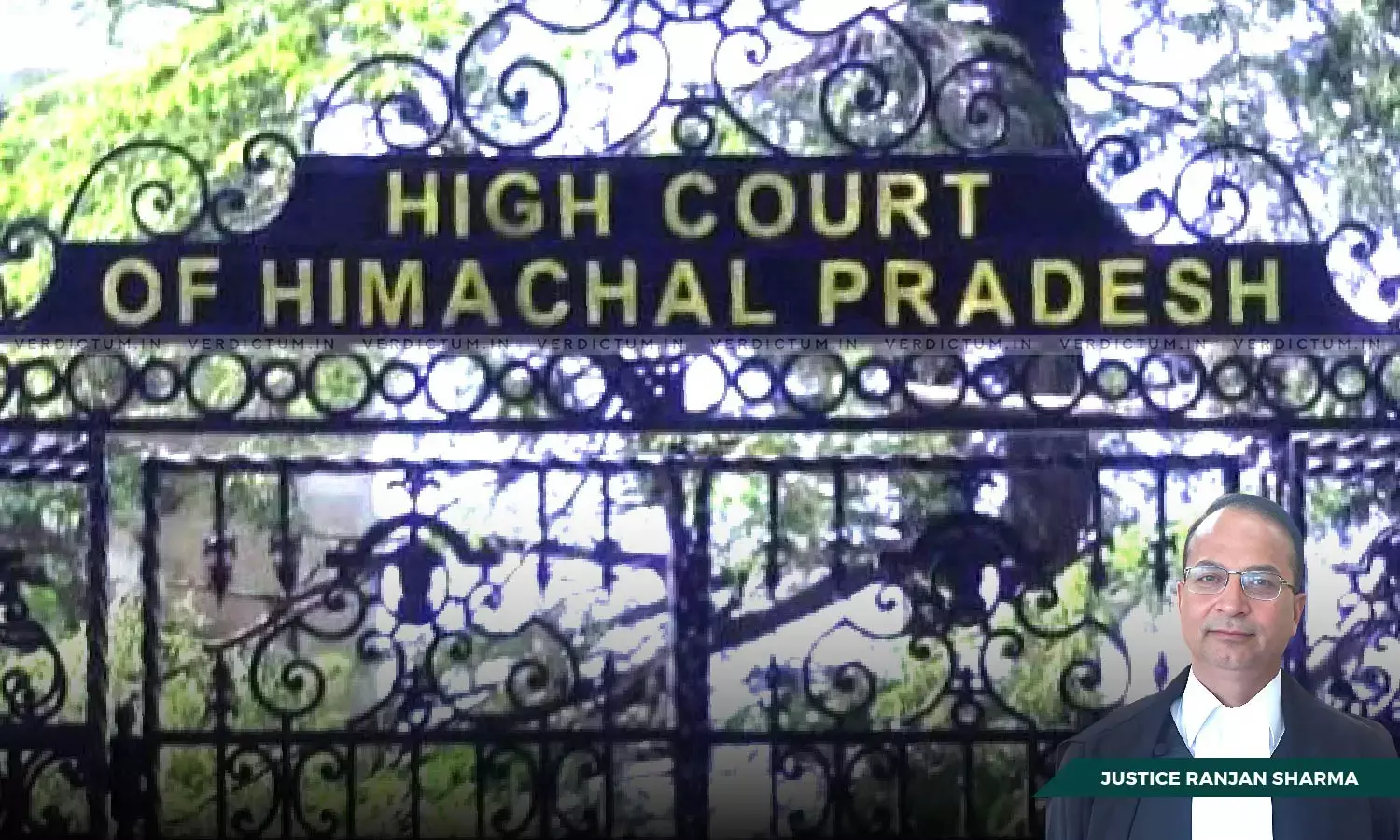
Justice Ranjan Sharma, Himachal Pradesh High Court
The Himachal Pradesh High Court has explicitly held that a preferential clause in public selection policies cannot be leveraged to bypass or override relative merit. The Court held that a local candidate possesses no right or locus to claim preferential selection or appointment over a more meritorious candidate unless the overall comparative scores of both aspirants are equal.
While dismissing a writ petition challenging the selection of a Post-Graduate Teacher (PGT) under the State's School Management Committee (SMC) Policy, the Court categorically rejected the petitioner's plea for a judicial re-evaluation or re-allocation of interview marks. Referring to a series of Supreme Court precedents, the Bench noted that assessing candidate suitability is the exclusive domain of the expert committee.
A Single Judge Bench of Justice Ranjan Sharma observed, “…once the petitioner had lower over-all merit vis-à-vis the higher merit of the Respondent No.6 [Gitanjali] determined by duly constituted Selection Committee for post of Post-Graduate Teacher [Political Science] in GSSS Gai Ghat, in District Solan, therefore, in case of unequal merit, the petitioner has neither any right nor any locus to claim preference in selection/ appointment”, by giving a complete go-bye to relative merit in selection and such a claim is impermissible. The plea of the appointment, by giving her preference, but by ignoring the comparative merit shall negate the core principle of public employment and therefore the contention of the petitioner, is turned down…
“…once the petitioner had faced Interview/Selection for post of Post-Graduate in Political Science in GSSS Gai Ghat, before a duly constituted Three Members Selection Committee, consisting of SubDivisional Magistrate as Chairman, President of concerned SMC as Member and Head of Institution/Secretary of the SMC as the third Member, therefore, in the absence of any proof of malafide or bias or violation of any Statutory Rules or infraction of any Scheme or Policy, including the SMC Policy [Annexure P-1 & Annexure P-2], mere contention that the petitioner was awarded lesser marks in Interview whereas the Private Respondent was awarded more marks, cannot come to the aid of the petitioner. Even judicial re-assessment of comparative merit, including award of marks in Interview, by a duly constituted Selection Committee does not fall within the domain of this Court. Moreover, the Selection Committee had awarded marks to candidates in terms of seven parameters out of a total 60 marks, as per the SMC Scheme-Policy”, the Bench further noted.
Advocate Ankit Chandel appeared for the petitioner and Gautam Sood, Deputy Advocate General appeared for the respondent.
The matter pertained to a selection process conducted on October 31, 2014, to fill a vacant post of Post-Graduate Teacher (PGT) in Political Science at Government Senior Secondary School (GSSS) Gai Ghat, District Solan. A total of 23 candidates appeared before a duly constituted three-member Selection Committee headed by the Sub-Divisional Magistrate.
The petitioner, Manju Devi, challenged the selection of private respondent Gitanjali, advancing two primary contentions:
-under Clause 5 of the SMC Policy notified on July 17, 2012 (and amended on August 16, 2014), preference was to be given to local eligible candidates. As a local resident of the concerned Patwar Circle, she claimed priority over Gitanjali, who belonged to another circle.
-She alleged that the Selection Committee acted arbitrarily by awarding Gitanjali 9.5 out of 10 marks in the viva-voce/interview, while giving her only 2.33 out of 10 marks.
The State Authorities and the selected candidate opposed the petition by placing the official evaluation chart before the Court. The records revealed that while Manju Devi received the full 10 marks allocated for belonging to the local Patwar Circle, Gitanjali possessed higher academic scores across Graduation, B.Ed., and Post-Graduation sub-heads.
Taking into account all seven evaluation criteria (including academic qualifications, local residence, and the interview), Gitanjali secured a grand total score of 30.52, outscoring Manju Devi’s total score of 30.33.
Accepting the petitioner's argument for automatic appointment based on local status despite her lower overall merit would create an anomalous situation that undermines the core principles of public service recruitment.
“…In absence of any express mandate in the Scheme-Policy for awarding the marks during the Interview-viva-voce [sub-head wise], then, in such an eventuality, the over-all assessment-performance adjudged by a duly constituted Selection Committee, cannot be interfered with by this Court. Moreover, this Court cannot assume the role of a Selection Committee or an Expert Body or an Appellate Authority. The job assigned to the Selection Committee or Expert Body is not liable to be interfered with, except for the exigencies as spelt out in the mandate of law, as referred to above, which in instant case are absent. Resultantly, the contention of petitioner is misplaced and is turned down”, the Bench noted.
Therefore, on finding no infirmity, bias, or illegality in the selection conducted by the panel, the High Court dismissed the writ petition. The Court formally affirmed the selection and continued appointment of respondent Gitanjali as PGT (Political Science) at GSSS Gai Ghat, directing both parties to bear their respective costs.
Cause Title: Manju Devi v. State of Himachal Pradesh and others (Neutral Citation: 2026:HHC:39618)
Appearances:
Petitioner: Ankit Chandel, Advocate vice, A.K. Bansal, Advocate.
Respondents: Gautam Sood, Deputy Advocate General, Rajesh Verma, Advocate.
Click here to read/download the Judgment