

Himachal Pradesh High Court Flags Age-Proof Lapses In POCSO Case; Issues Directions To Police
The Court also held that the omission of an available matriculation certificate was a curable irregularity where the additional evidence would support the prosecution’s existing case without changing its nature or prejudicing the accused.
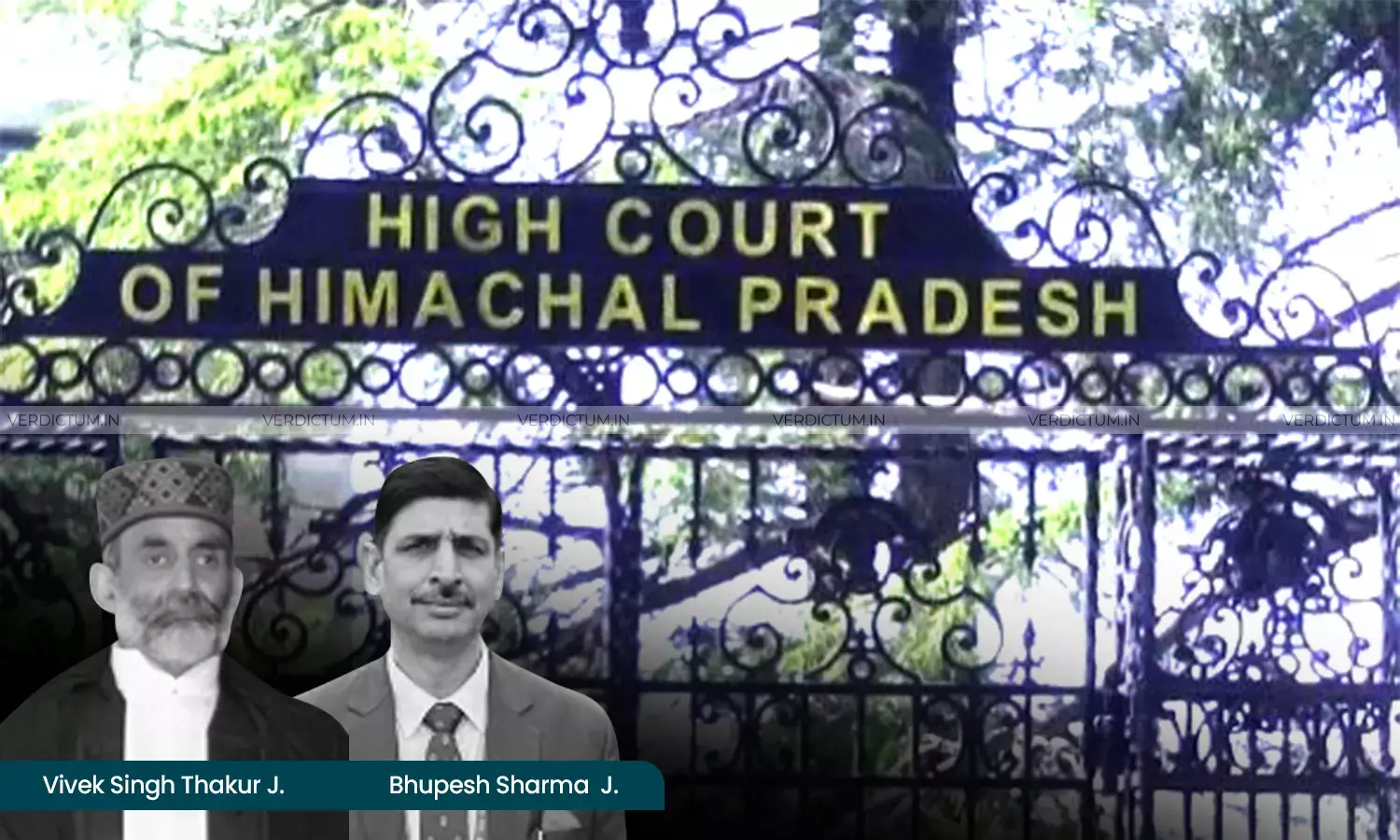
The Himachal Pradesh High Court, while hearing a POCSO matter, flagged the failure of the police to collect the victim’s available matriculation certificate and school records, and to cite the relevant record custodian as a witness, for proving her age in a POCSO case.
The High Court directed the Director General of Police to circulate Section 94 of the Juvenile Justice (Care and Protection of Children) Act, 2015, with guidelines requiring strict compliance with the provision, collection of preferential and corroborating age records, and efforts to cite witnesses necessary to prove those documents.
The Court was hearing the State’s application under Section 432 of the Bharatiya Nagarik Suraksha Sanhita, 2023 for additional evidence in a pending appeal against a Sessions Court conviction, including a 20-year rigorous imprisonment sentence under Section 4(2) of the Protection of Children from Sexual Offences Act, 2012
A Bench of Justice Vivek Singh Thakur and Justice Bhupesh Sharma observed: “While hearing various Criminal Appeals and Revisions, it had been noticed in large number of cases that for lapse in investigation, especially with respect to collecting evidence related to age proof of child in conflict with law as well as minor victim, the prosecution cases fail.”
The Bench directed: “Therefore, before parting, in order to avoid similar lapse in investigation, Director General of Police, Himachal Pradesh is directed to circulate provisions of Section 94 of the Juvenile Justice (Care and Protection of Children) Act, 2015 alongwith necessary guidelines/ instructions to all Investigating Officers in Himachal Pradesh, directing them that for collecting evidence with respect to age proof of child in conflict with law as well as minor victim, not only strictly adhere to mandate of Section 94 of the J.J. Act by collecting preferential evidence, but also to collect all available evidence regarding proof of date of birth by obtaining date of birth certificate from the school, Matriculation or equivalent certificate from the concerned examination Board/School, birth certificate issued by Corporation or Municipal Authority or Panchayat as the case may be and also other corroborating supporting documents indicating the same date of birth and in absence of any documents or doubtful documents, to resort to option of ossification test or any other latest age determining test by taking orders of the Committee or the Board/Court if required.”
Advocates Virbahadur Verma and Aditya Singh Rathore appeared for the appellant, while Senior Additional Advocate General I.N. Mehta appeared for the State.
Background
The appellant had been convicted under Sections 354A, 354D, 376 and 506 of the Indian Penal Code and Section 4(2) of the Protection of Children from Sexual Offences Act, 2012. During trial, the prosecution relied on a birth certificate issued by the Panchayat’s local Registrar and a family register to establish the victim’s age. Both recorded the same date of birth.
While preparing final arguments in the appeal, the State noticed that the victim’s school records and matriculation certificate had not been produced. The relevant school-record official had also not been cited as a prosecution witness. The State submitted that she had passed matriculation before the incident and that the omission was inadvertent and beyond her control. It argued that the proposed evidence would substantiate the age already asserted, rather than introduce a new case, and that the appellant could cross-examine the witnesses.
The appellant opposed the application, arguing that the prosecution could not repair omissions caused by negligence at the appellate stage after failing to produce preferential age evidence during trial. Relying on Swapan Kumar Chatterjee v. Central Bureau of Investigation (2019) and Jagdeep Kumar v. Himachal Pradesh State Cooperative Bank Limited (2019), he contended that additional-evidence powers could not be used as a disguised retrial or to fill gaps in the prosecution case.
Court’s Observations
The Court examined Sections 348 and 432 of the Bharatiya Nagarik Suraksha Sanhita, 2023, corresponding to Sections 311 and 391 of the Code of Criminal Procedure, 1973. It noted that Section 348 requires examination or recall of a witness where the evidence appears essential to a just decision, while Section 432 permits the appellate court to take necessary additional evidence itself or direct an appropriate lower court to take it, after recording reasons. The latter provision also protects the accused’s or advocate’s right to be present when that evidence is taken.
Referring to Natasha Singh v. Central Bureau of Investigation (2013), Varsha Garg v. State of Madhya Pradesh (2022) and V.N. Patil v. K. Niranjan Kumar and Others (2021), the Bench reiterated that courts have a role in securing essential evidence, but must exercise their discretion judiciously and for strong and valid reasons.
The Court also referred to Rajeshwar Prasad Misra v. The State of West Bengal and Another (1965), Rambhau and Others v. State of Maharashtra (2001) and Ashok Tshering Bhutia v. State of Sikkim (2011). It emphasised that additional evidence is an exceptional measure to prevent a failure of justice, not a means to change the prosecution case or conduct a fresh trial. The principles reproduced from Sonu v. State of Himachal Pradesh (2020) also required an opportunity for cross-examination and rebuttal.
The Court underscored: “It is duty of the Court whenever it is possible without causing any prejudice to the opposite party to ensure production of necessary and essential evidence to ascertain the truth to arrive at just decision for the ends of justice.”
Applying these principles, the Bench found that the proposed evidence would support the date of birth consistently asserted by the prosecution. It would neither change the nature of the case nor operate as a disguised retrial. The Court held that the investigating agency’s negligence or ignorance did not justify refusing evidence necessary to establish that existing case.
The Court explained: “Application has been filed to produce on record additional evidence to rectify the irregularity for subserving the ends of justice which does not run counter to the concept of justice. It is not a defect incurable in nature, but is a mere irregularity which, in our considered opinion, required to be cured in the ends of justice.”
The Bench observed that the Panchayat evidence might not suffice in light of the requirements of Section 94 of the Juvenile Justice (Care and Protection of Children) Act, 2015. It considered the matriculation certificate or school records essential to ascertain the victim’s age and expressly preserved the appellant’s right to cross-examine the witnesses on the date-of-birth evidence.
The Court noted that, in the present case, the failure to collect school records had also led to the relevant record custodian not being cited as a prosecution witness.
The Court directed: “The Investigating Officer also be directed to make a effort to cite all those persons in the list of witnesses, who are necessary to be examined to prove the contents of such documents as well as those who are author of entry, legal custodian of the record, documents and/or certificate issuing official/author and also witnesses in whose presence such documents are obtained/taken in possession.”
The Court’s instructions addressed both the nature of the age documents relied upon and the method of proving them.
The Court directed: “Investigating Officers also be directed to make an endavour to prove date of birth by all means to avoid any adverse impact on the prosecution case due to different interpretation and explanation rendered by the Court regarding nature of document relied upon for proving the date of birth and mode of proof of such document.”
Conclusion
Allowing the State’s application, the Court permitted re-examination of the victim and examination of the relevant school-record officials with the entire relevant record, limited to producing the matriculation certificate or related records and proving her date of birth.
The DGP was directed to issue the instructions at the earliest, and no later than October 15, 2026. The Senior Additional Advocate General was directed to transmit the order for compliance.
The Court directed listing before the Registrar (Judicial) on September 28, 2026 to fix a date for recording additional evidence. Steps to recall or summon witnesses were to be taken within three days, with notices issued for the date fixed by the Registrar.
Cause Title: Kulwinder Singh v. State of H.P. (Neutral Citation: 2026:HHC:39173)
Appearances
Appellant: Advocates Virbahadur Verma and Aditya Singh Rathore
Respondents: Senior Additional Advocate General I.N. Mehta
