

Himachal Pradesh High Court Bars Ex-Officio Member MLAs From Voting In Municipal Chief Elections To Preserve Autonomy Of Local Self-Government
The Court stayed a state government clarification after finding that the statutory rules explicitly restrict the electoral college for choosing or removing a municipality's president and vice-president to its elected members alone.

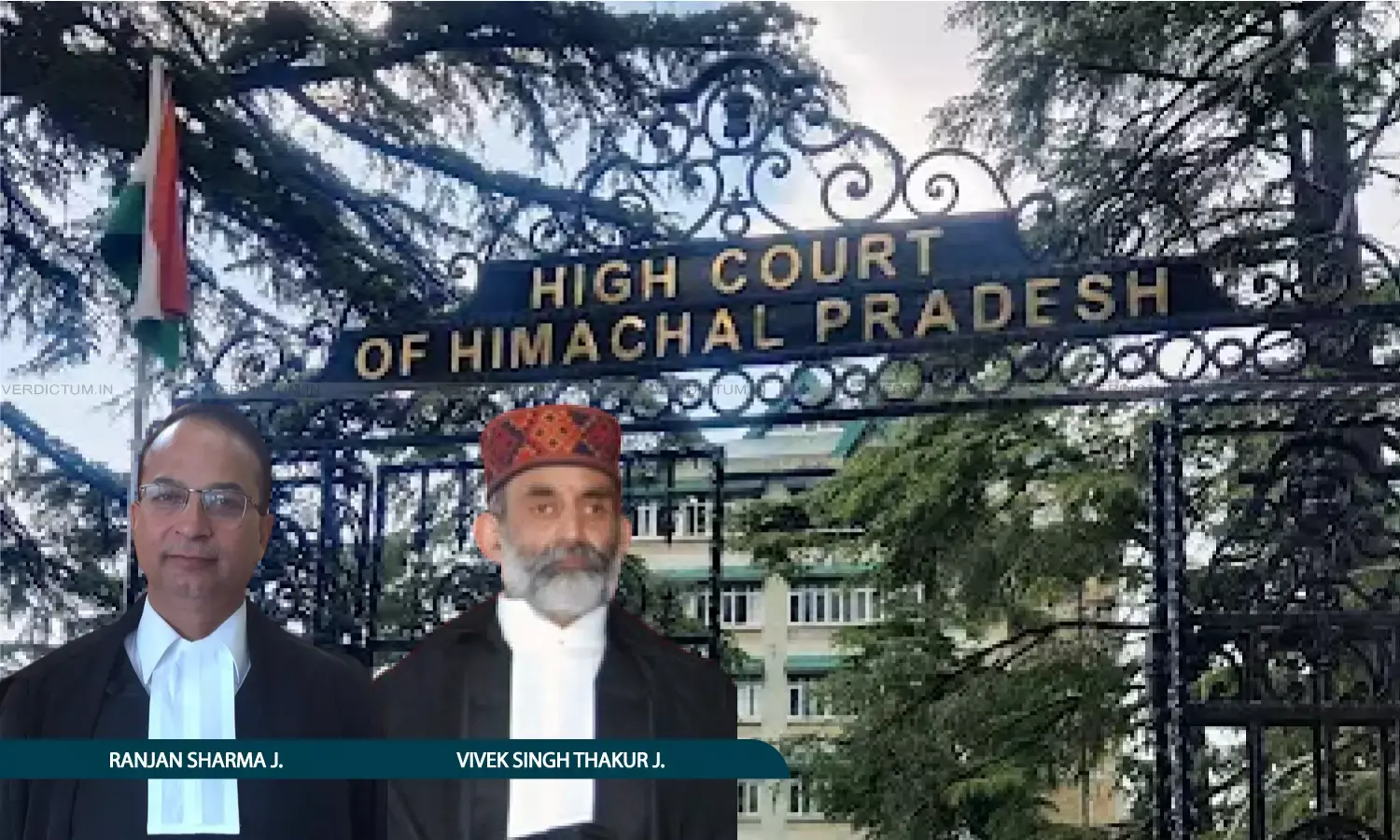
The Himachal Pradesh High Court granted interim protection by restraining Ex-officio Members, specifically Members of the Legislative Assembly (MLAs), from casting their votes in the upcoming elections for the offices of President and Vice President across various Municipalities in the State.
While staying an executive clarification issued by the Urban Development Department that sought to permit such voting, the Court observed that under the Himachal Pradesh Municipal Corporation Act, 1994, and the corresponding Election Rules of 2015, the right to elect and remove civic leadership is exclusively vested in directly "Elected Members."
The Bench highlighted that introducing legislative members into this local electoral process would defeat the legislative intent, amount to an unwarranted interference in the democratic autonomy of local self-government institutions, and breach the direct mandate of the electorate.
The Division Bench of Justice Vivek Singh Thakur and Justice Ranjan Sharma observed, "The plea of learned Advocate General is that wherever there is conflict of the Rules with the Act, the Act should prevail, is also not relevant as we have not found any provision of the Rules contrary or in conflict with Constitutional mandate or the provisions of the Act, as the Rules do not take away any right of Ex officio Members to cast their votes, wherever they have right to cast it, but Rules provide manner of election to the post of President or Vice President, which is in consonance with provisions of the HPMC Act as well as mandate of Article 243R(2)(b)."
Senior Advocate Anshul Bansal appeared for the Petitioners, while Advocate General Anup Rattan appeared for the State.
Brief Facts
An interim order was sought in a batch of applications before the High Court of Himachal Pradesh regarding the upcoming elections for the offices of President and Vice President across various Municipalities in the State. The central controversy emerged over whether a Member of the Legislative Assembly (MLA), who serves as an Ex-officio Member of a Municipality, possessed the legal and constitutional right to cast a vote in the election of the President and Vice President of that respective Municipality. The petitioners approached the Court seeking an interim injunction to restrain such Ex-officio Members from participating and voting in the executive elections of the local bodies.
Contentions of the Parties
The Petitioners contended that the constitutional scheme under Article 243R, read alongside the substantive provisions of the Himachal Pradesh Municipal Corporation Act, 1994, and the Himachal Pradesh Municipal Election Rules, 2015, consciously excluded Ex-officio Members from the electoral college responsible for choosing or removing the civic leadership.
It was argued that Rule 2(d) expressly defined the Chairman as a member elected strictly by the elected members. Furthermore, the procedural rules governing nominations, quorums, and No-Confidence motions explicitly mandated participation by "Elected Members" alone, thereby leaving no room for Ex-officio interference.
The State opposed the interim relief, asserting that Section 10(3) of the Act unconditionally granted voting rights to Ex-officio Members, which naturally extended to the election of the President and Vice President. It was argued that restraining the MLAs from voting would run counter to the legislative mandate and amount to staying a validly enacted statute. The State further pointed out that the statutory provision had remained unchallenged for over twenty-six years, disentitling the petitioners to any urgent equitable relief.
Observations and Findings of the Court
The Court observed that the judgments cited by the State were inapplicable to the present matter. The municipal frameworks of Rajasthan and Karnataka featured distinctly structured definitions of "Corporation" and "Councilor" that statistically bundled all categories of members together, whereas the Himachal Pradesh Act and Rules carefully segregated them.
The Court found that while Section 10(3) of the Act generally attached a right to vote to Ex-officio Members, it did not clarify the specific occasions for exercising that right. However, Rule 89 functioned as the substantive provision dictating the actual manner of executive elections, which consistently restricted the nomination, seconding, and voting process to "Elected Members."
The Court noted that under Section 25 of the Act and Rule 92 of the Rules, the right to initiate and pass a No-Confidence Motion to remove a President or Vice President was exclusively vested in the majority of the total Elected Members. Adopting the legal maxim that the power to elect and the power to remove must go hand in hand, the Court held that Ex-officio members were excluded from both.
The Court highlighted that Municipalities are institutions of local self-government. The legislative intent was to preserve the democratic supremacy and autonomy of the direct mandate given by the local electorate, which would be compromised if outside legislative members were permitted to tilt the balance of power in internal civic elections.
The Court observed that a clarification issued by the Urban Development Department allowing MLAs to vote was self-contradictory and legally infirm. Under the rules, the State Election Commission held the final authority on interpretation, and its opinion was never sought by the department.
"The Municipalities are local Self Government Institutions. The Legislative intent is clear that to maintain the supremacy of the mandate of the people with respect to local Self Bodies, and therefore, Ex-officio members have not been included in the eligible members along with elected members of the Municipalities to elect President/Vice-President in the Municipalities as inclusion of Ex-officio members as an elector to the office of President/Vice-President would have amounted an interference in the autonomy of the Local Self Government as well as breach of mandate of people for local self Government", the Court observed.
The Court concluded that a prima facie case was established in favor of the petitioners. Consequently, the Court stayed the operation of the executive clarification and directed the respondents to conduct and conclude the elections for the offices of President and Vice President across the Municipalities by permitting only the elected members to vote, explicitly barring Ex-officio Members (MLAs) from casting their votes in the process, subject to the final outcome of the main writ petitions.
Cause Title: Vandana Kumari & Ors. v. State of H.P. & Ors. [CMP No.12658 of 2026 in CWP No.8679 of 2026]
Appearances:
Petitioners:Senior Advocate Anshul Bansal, Advocate Ruma Kaushik, Advocate Vikas Rathore, Advocate Nand Lal Thakur, Advocate Ajay Sipahiya, Advocate Mandeep Chandel, Advocate Anshul Attri, Advocate Piyush Dhanotia, Advocate Ankit Dhiman, Advocate Udit Shaurya Kaushik, Advocate Tarun Mehta, Advocate Ankit Chandel, Advocate K.K. Chauhan.
Respondents:Advocate General Anup Rattan, Additional Advocate General Ramakant Sharma, Deputy Advocate General Raj Negi, Deputy Advocate General Swati Draik, Advocate Surinder K. Sharma, Advocate Vivek Sharma.