

Junior Officer Cannot Be Given Graver Punishment Than His Superior Who Forced Him Into Misdemeanour: Himachal Pradesh High Court
The Court noted that the ITBP Superior officer found guilty of recording subordinate's illicit act with his wife on laptop, and yet received only pension forfeiture; the Court replaced removal from service with compulsory retirement.

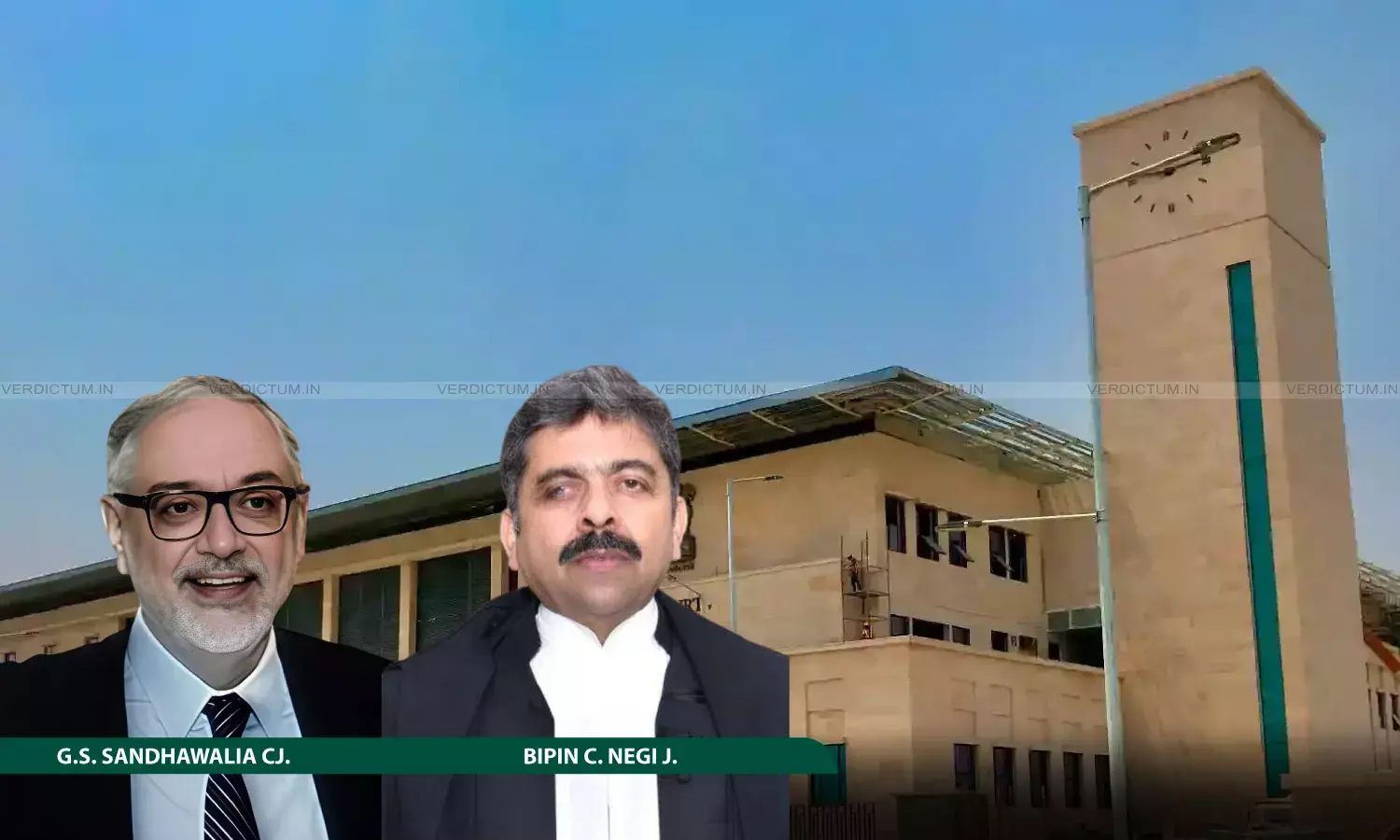
Chief Justice G.S. Sandhawalia, Justice Bipin C. Negi, Himachal Pradesh HC
The Himachal Pradesh High Court has held that a junior cannot be imposed with a punishment graver than that imposed on the superior officer who coerced him into the misdemeanour. Exercising the rare power to modify punishment itself rather than remand, the Court substituted removal from service with compulsory retirement, holding that proportionality review must account for the circumstances under which the misconduct was committed, not merely its gravity.
The appellant, was appointed as a Constable in the ITBP in 1999 and was posted as Security Assistant to the Assistant Commandant at Leh.
The Court noted that the superior officer was held guilty of recording the sexual act involving his wife and the appellant’s security aide and was punished with stoppage of increments for two years. It further observed that the incidents occurred in November 2008 at Leh, and the superior officer thereafter accompanied the appellant and the couple from Leh to Reckong Peo, indicating his knowledge and acceptance of the relationship. Holding that the appellant’s removal from service was discriminatory and disproportionate compared to the punishment imposed on the superior officer, the Court set aside the removal order.
A Division Bench comprising Chief Justice G.S. Sandhawalia and Justice Bipin Chander Negi observed, “…we are of the considered opinion that once the superior officer had been held guilty of preparing the CD with the help of his laptop and forcing his junior to enter into the acts of misdemeanor, the present appellant cannot be imposed a grave punishment of removal from service. Therefore, in the given facts and circumstances, we are of the considered opinion that the order of compulsory retirement would redress the issue as such, keeping in view the manner in which the misconduct which was sordid in nature, has taken place”.
“…the scope for interference by the Court is very limited and restricted to exceptional cases e.g. punishment awarded is ‘shocking to the conscience of the Court, in the sense that it was in defiance of logic or moral standards’ i.e. is disproportionate to the gravity of the misconduct (doctrine of proportionality). While examining the issue of proportionality, the Court can also consider the circumstances under which the misconduct was committed. In a given case, the prevailing circumstances might have forced the accused to act in a certain manner, though he had not intended to do so”, the Bench noted further.
Advocate Vinod Kumar Sharma appeared for the appellant and Balram Sharma, Deputy Solicitor General of India appeared for the respondents.
The Court invoked the exceptional power recognised by the Supreme Court in S.R. Tewari v. Union of India, (2013) 6 SCC 602 to modify the punishment itself rather than remand the matter to the disciplinary authority, holding that in rare cases, shortening of litigation justifies the Court imposing appropriate punishment with cogent reasons.
In the matter, between August 2008 and January 2009, consensual illicit relations developed between the appellant and the wife of the Assistant Commandant at the official residence. The wife subsequently filed a complaint alleging sexual harassment and recording of the act on a CD.
The appellant was tried by a Summary Force Court, found guilty under Section 49 read with Section 43 of the ITBP Act, and removed from service with effect from June 29, 2010. His appeal was rejected. A writ petition before the Single Judge was dismissed on June 29, 2018, leading to the present Letters Patent Appeal.
The Assistant Commandant was separately tried before a General Force Court on two charges. He was exonerated of forcing his wife into relations with the appellant but was held guilty of recording the sexual act on his laptop and was sentenced only to forfeiture of two years past service for pension purposes.
The Division Bench, examining the comparative punishment and the circumstances, found it unconscionable that the subordinate who was manipulated and threatened by his commanding officer received removal from service while the superior received a far lesser penalty. Noting that the superior was found to be a motivating party to the misconduct, the Court set aside the order of removal and substituted compulsory retirement with all consequential benefits.
“Discipline and character are the backbone of the Indo Tibetan Border Police and all serving the force are expected to act and behave in a manner befitting their respective positions. Besides everyone serving the force are also at all times responsible for ensuring that good order and discipline in the services is maintained. As a member of the disciplined force, the petitioner was expected to have control over his mind and passion. The petitioner has given an indecent burial to self-control, diligence and strength of will power. Moreover, it is generally understood that acts, whether in personal or professional life, if they involve the possibility of domestic dis-cord, they have the potential to adversely impact operational efficacy given that mental/psychological stability is the key. If an act of an employee reflects upon his character and integrity, the employer can legitimately raise a plea of losing confidence in the employee, warranting his non-continuance in the employment”, the Bench noted.
“…the exercise of discretion in imposition of punishment by the disciplinary authority or appellate authority is dependent on host of factors such as gravity of misconduct, past conduct, the nature of duties assigned to the delinquent, responsibility of the position that the delinquent holds, previous penalty, if any, and the discipline required to be maintained in the department. From the impugned appellate order dated 28.07.2011 (Annexure P-16 Page 141 of the writ paper book) affirming the penalty imposed, it is evident that while considering the sentence in the case at hand, the fact that in terms of the act for the offence committed by the petitioner dismissal as a punishment could have been imposed, but keeping in view the past record of the petitioner, his age and mitigation made by him, a lesser penalty of removal from service was ordered by the Summary Court and up-held in appeal”, it noted further.
Cause Title: A v. Union of India and Others LPA No.24 of 2018
Appearances:
Appellant: Vinod Kumar Sharma, Advocate.
Respondents: Balram Sharma, Deputy Solicitor General of India.