Executive Authorities Along With Police Cannot Facilitate Private Recovery Of Possession Without Lawful Authority: Gauhati High Court
The Court held that the police-assisted dispossession violated Articles 14 and 300A of the Constitution. A subsequent settlement did not validate the officials’ actions.
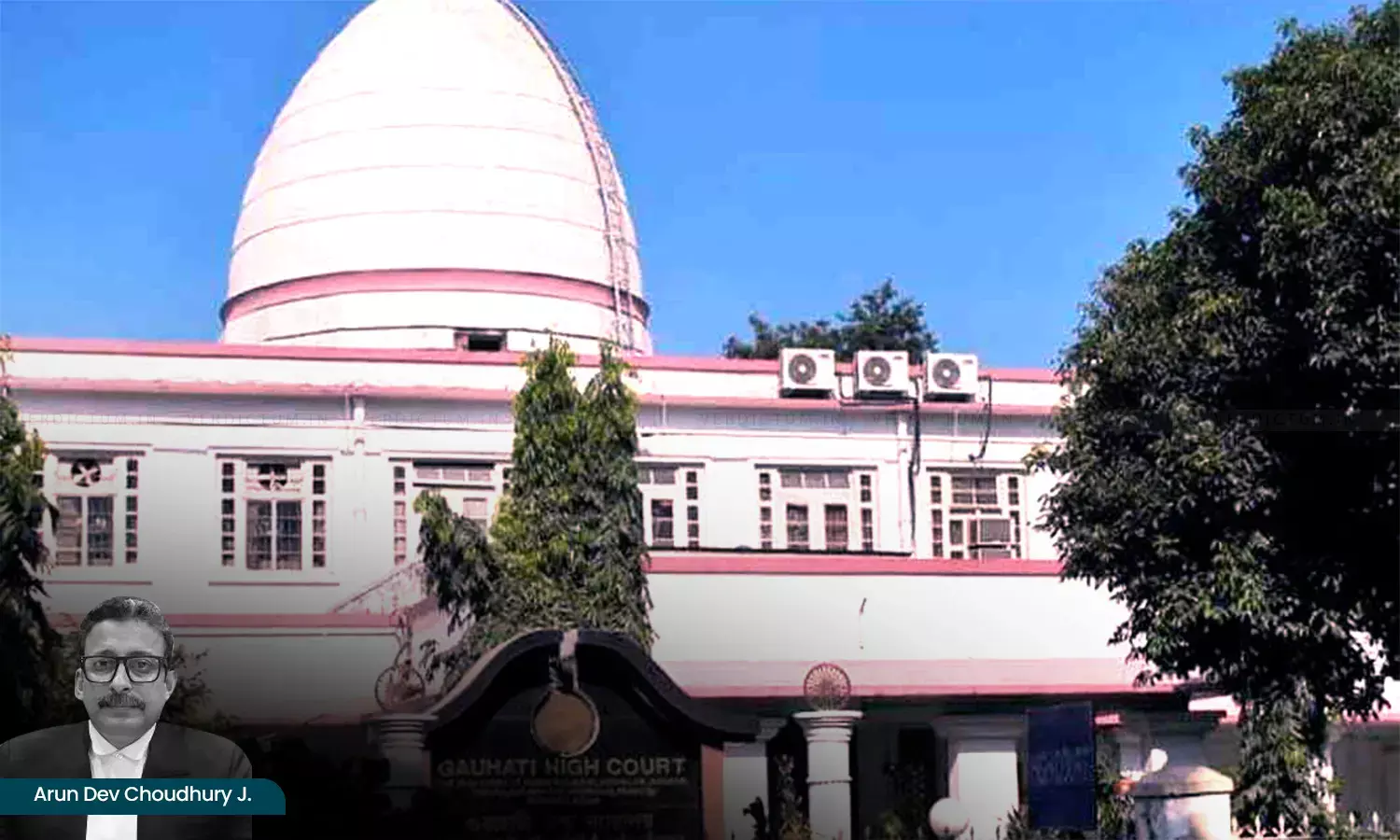
Justice Arun Dev Choudhury, Gauhati High Court
The Gauhati High Court has held that executive authorities and the police cannot adjudicate competing civil rights or facilitate a private party’s recovery of possession without lawful authority.
Finding that State machinery had been used to dispossess a tenant during a pending civil suit, the Court imposed personal costs of ₹75,000 and ₹25,000 on two officials.
The Court was hearing a writ petition challenging the petitioner’s dispossession while the landlord’s possession suit was pending.
A Bench of Justice Arun Dev Choudhury observed: “The Executive administration may take steps authorized by law to prevent a breach of peace, and the police may act in accordance with their statutory duties. Neither is empowered to adjudicate competing civil rights or to facilitate a private party's recovery of possession in disregard of the procedure prescribed by law. The presence of an Executive Magistrate and police personnel cannot make legal, an act for which no independent lawful authority exists.”
Advocate B. J. Mukherjee appeared for the petitioner. Additional Advocate General B. Goswami represented the State authorities.
Background
The petitioner occupied a tenanted room, and the landlord had instituted a civil suit seeking possession, rent arrears and damages. While the suit was pending, the landlord approached the police, alleging that the tenancy had expired and that the petitioner had defaulted on rent. The investigation led to a charge sheet for offences under Sections 406, 420 and 506 of the IPC.
The police subsequently requested the deputation of an Executive Magistrate to assist during the proposed eviction. An Additional Deputy Commissioner deputed one to address the law-and-order situation during the proposed eviction. After notice to the petitioner, the shutter lock was broken and the premises were entered in her absence with police personnel present.
The petitioner later stated that the dispute had been settled, that she had received compensation and that she no longer sought restoration. The Court nevertheless examined the officials’ conduct. The official who issued the deputation order offered no explanation, while the police officer apologised and undertook not to use police authority to adjudicate private civil disputes.
Court’s Observations
Possession Could Be Recovered Only Through Lawful Process
Referring to Lallu Yeshwant Singh v. Rao Jagdish Singh (1968) and Krishna Ram Mahale v. Shobha Venkat Rao (1989), the Court held that even an owner could not forcibly dispossess someone in settled possession.
The Court observed: “The Supreme Court held that even where the law recognizes a consequence of default, the person claiming entitlement to possession cannot take possession by force and must follow the procedure established by law. The decision affirms the fundamental principle that a claim to possession, however substantial, does not confer a right to enforce it by force or self-help.”
The civil court had to decide the landlord’s entitlement to possession. The criminal proceedings did not authorise the police to execute an eviction.
Law-And-Order Authority Did Not Include Eviction Power
The Court held that an order deputing an Executive Magistrate to maintain law and order did not confer eviction powers.
It observed: “An order to maintain law and order cannot become an instrument for delivering possession of premises to a private party, especially when the dispute is under adjudication. The authority to prevent an untoward incident is distinct from the authority to evict a person. The former cannot be used to assume the latter.”
The premises were entered after the shutter lock was broken in the petitioner’s absence, as part of an exercise undertaken with police assistance, although no eviction decree, delivery warrant or statutory order authorised her dispossession.
The Court stated: “The absence of lawful authority goes to the very root of the action itself. The State's coercive machinery was employed in a matter concerning private civil rights, resulting in an interference with possession without the intervention of a competent court. Such conduct amounts to a high-handed exercise of public authority and cannot be countenanced in a constitutional system governed by the rule of law.”
It held that the action lacked legal sanction and circumvented the pending judicial process.
Dispossession Violated Articles 14 And 300A
The Court held that Article 300A of the Constitution required every deprivation of property to have a lawful source and follow an authorised procedure.
It observed: “An administrative arrangement made to maintain law and order cannot be treated as an authority of law for eviction where the arrangement is not legally authorized. Therefore, such dispossession of the petitioner, in the circumstances recorded hereinabove, cannot be sustained.”
It also held that using State machinery to enforce a private possession claim without lawful authority was arbitrary under Article 14 of the Constitution.
Settlement Did Not Validate Unlawful Official Action
Referring to Satrughna Atmaram Patil v. Vinod Dodu Choudhari (2024), the Court held that a private settlement did not end judicial scrutiny of the misuse of public power.
The Court observed: “The settlement may resolve the private dispute and may make any further direction for restoration of possession unnecessary; however, it cannot retrospectively validate the public authorities' action or extinguish the constitutional concern arising from the use of state machinery without lawful authority.”
The later withdrawal of the eviction suit reinforced the distinction between adjudication and executive intervention.
Personal Costs Imposed To Deter Similar Conduct
The Court held that consequences had to follow. One official offered no explanation, while the police officer’s apology did not absolve him of responsibility.
The Court stated: “The purpose of imposing costs is to mark the court's disapproval of the unlawful use of public authority and to reinforce the principle that the coercive powers of the State cannot be employed to secure possession for a private party in disregard of the judicial process. It also serves as a deterrent against similar conduct in the future.”
The Court imposed costs of ₹75,000 on the official who issued the order and ₹25,000 on the police officer. The lower amount reflected the latter’s apology and undertaking.
Conclusion
The High Court held that the petitioner had been dispossessed without legal authority. It directed the two officials to deposit ₹75,000 and ₹25,000, respectively, with the High Court Legal Services Authority within six weeks.
The Court accepted the police officer’s apology, subject to its findings. It declined to restore possession because the dispute had been settled and the petitioner no longer sought that relief.
The Court directed that a copy of the judgment be furnished to the Senior Government Advocate for communication to the Chief Secretary and the Director General of Police, Assam, who were required to ensure compliance. The Registry was directed to relist the matter in case of default.
Cause Title: Sabita Paul v. State of Assam and Others
Appearances
Petitioner: B. J. Mukherjee, Advocate
Respondents: B. Goswami, Additional Advocate General, Assam; D. Nath, Senior Government Advocate, Assam; B. C. Muchahary, Standing Counsel; U. K. Das & S. K. Poddar, Advocates