

Heinous Nature Of Offence Cannot Be Sole Ground To Deny Remission: Gauhati High Court Sets Aside Review Board’s Bulk Rejection Of 89 Life Convicts' Remission Proposals
The Court held that indecisive opinion of Presiding Judge obliges Review Board to seek fresh opinion rather than defer; and noted that the petitioners had each served over twenty years in incarceration.

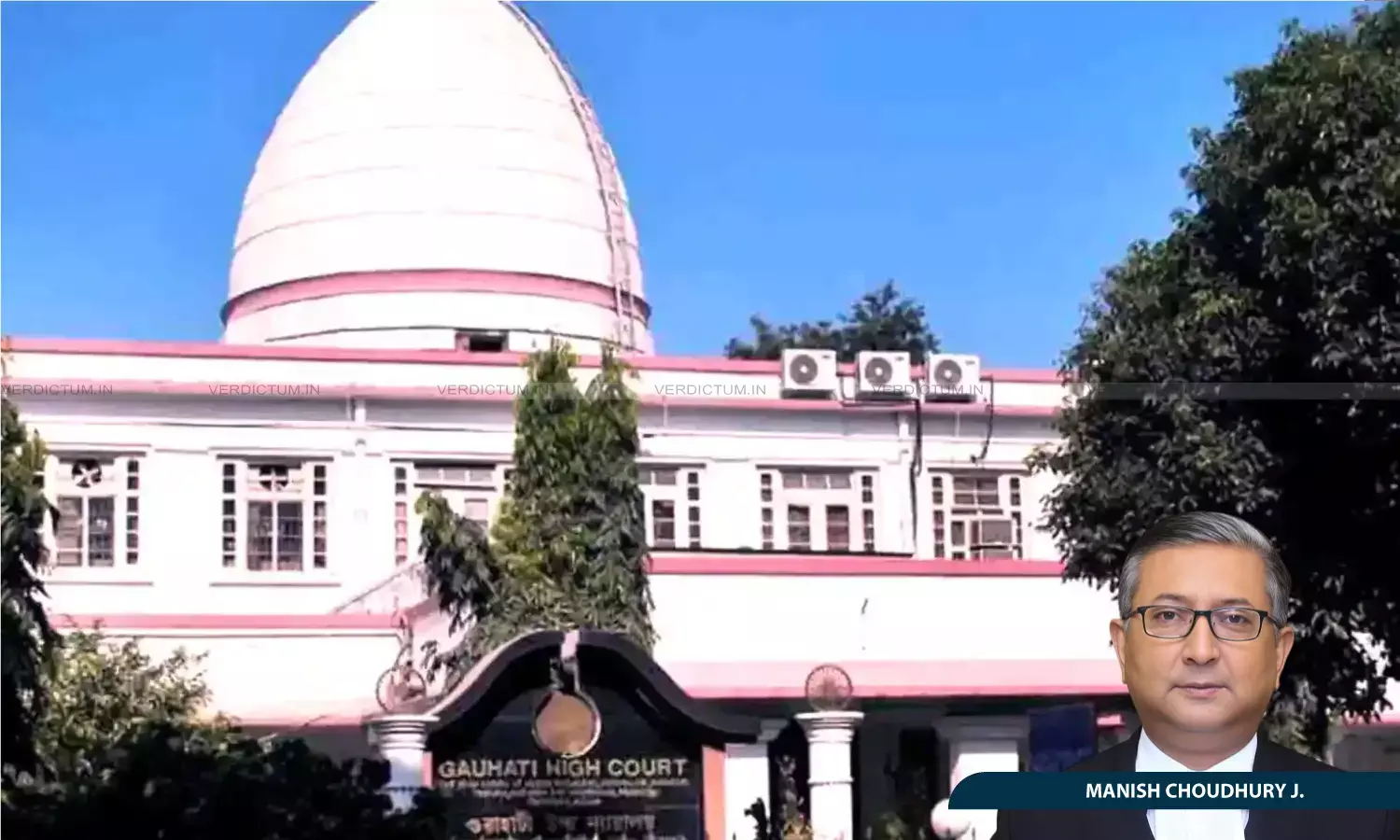
Justice Manish Choudhury, Gauhati High Court
The Gauhati High Court has reiterated that the heinous nature of an offence cannot be the sole ground for deferring a life convict's proposal for remission, and that the Assam State Level Review Board is obligated to consider remission proposals strictly on a case-by-case basis and cannot dispose of proposals in a wholesale manner without recording individual reasons. The Inspector General of Prisons, Assam was directed to place all four remission proposals before the Review Board within July 2026 for fresh consideration strictly in accordance with all relevant factors.
The Court additionally held that where the opinion of the Presiding Judge is indecisive or does not consider the relevant factors prescribed for grant of remission, the Review Board cannot simply defer the proposal on that ground, it must instead request the Presiding Judge to furnish a fresh opinion after considering all relevant factors with adequate reasoning.
Furthermore, it said that for a convict above 75 years of age, the State Government's own policy under the Office Memorandum dated October 06, 2015 mandates obtaining a Medical Board opinion on whether the convict is likely to pose any threat to society before a deferral decision is taken.
Justice Manish Choudhury in four connected writ petitions filed by life convicts challenging decisions of the Assam State Level Review Board, referred to Rohit Chaturvedi v. State of Uttarakhand and others, 2026 SCC OnLine SC 865 and noted, “…the nature of the offence cannot be the sole ground for denying remission. The decision on remission must emerge from a holistic assessment of the prisoner and after balancing societal interests with the prisoner's right to be considered for release on fair and reasonable criteria which are already outlined in the case of Laxman Naskar [supra]”.
“…it is evidently clear that the proposals for remission were not considered on case-to-case basis and the proposals other than one of life-convict, were considered as a whole as no separate reasons are recorded in case of 89 proposals for remission of life convicts placed before the Review Board on 19.03.2026…In such view of the matter, this Court is of the view that the petitioners’ proposals for remission are to be given re-consideration by the Review Board afresh…”, the Bench observed.
Advocate A. Atreya appeared for the petitioner and S.S. Roy, Government Advocate appeared for the respondent.
The four petitioners had each served over twenty years in incarceration. In three cases the Review Board, in its meeting of July 22, 2024, deferred proposals citing the heinous nature of the offences without examining any other factor. In the fourth case the Board deferred the proposal on the ground that the Presiding Judge's opinion was unclear.
The Court found that in its meeting of March 19, 2026, the Review Board returned 89 proposals in bulk to the Inspector General of Prisons without recording individual reasons, directly contrary to the Supreme Court's direction in Sangeet and another v. State of Haryana, [2013] 2 SCC 452 that remissions can only be granted on a case-to-case basis and not in a wholesale manner.
In one case, the Court noted that the co-accused convicted for the same offence had been granted remission while the petitioner's proposal was deferred, raising a clear parity argument.
On noting an indecisive opinion given by the Presiding Judge as stated in a petition, the Bench observed, “…it was mentioned that he could not say whether the remission was to be given to the petitioner or not, and he had nothing to say whether the sentence of life imprisonment imposed upon the petitioner was to be commuted or not. The said opinion of the Presiding Judge, in the considered view of this Court, is an indecisive one and it cannot be said to be an opinion which considered the factors laid down in Laxman Naskar [supra]. In the event of receipt of such an opinion, obligation is also cast on the appropriate Government and for that matter, the Review Board is to request the Presiding Judge to consider the matter of the petitioner afresh in the light of the relevant factors and to give a fresh opinion”.
“…the decision of the Review Board in view of the provisions of Section 432[2], CrPC must be accompanied by reasons which should be demonstrative of the fact that the authority had given due consideration to the relevant factors and the reasons must not be mechanical. It has been held in Ram Chander [supra] that if an opinion accompanied by inadequate reasoning would not satisfy requirements of Section 432[2] of the CrPC, it would not serve the purpose for which the exercise under Section 432[2] is to be undertaken”, it further noted.
Cause Title: Ganesh Bhumij and Others v. State of Assam and Others (Neutral Citation: 2026:GAU-AS:9422)
Appearances:
Petitioners: A. Atreya, Advocate.
Respondent: S.S. Roy, Government Advocate.