

Bail Granted On Technical Grounds Need Not Be Cancelled Before Re-Arrest By Investigating Agency: Gauhati High Court
The Court held that bail granted on technicalities or curable defects in the earlier arrest procedure stands on a different footing from bail granted on merits, and does not always require a formal cancellation order before re-arrest.
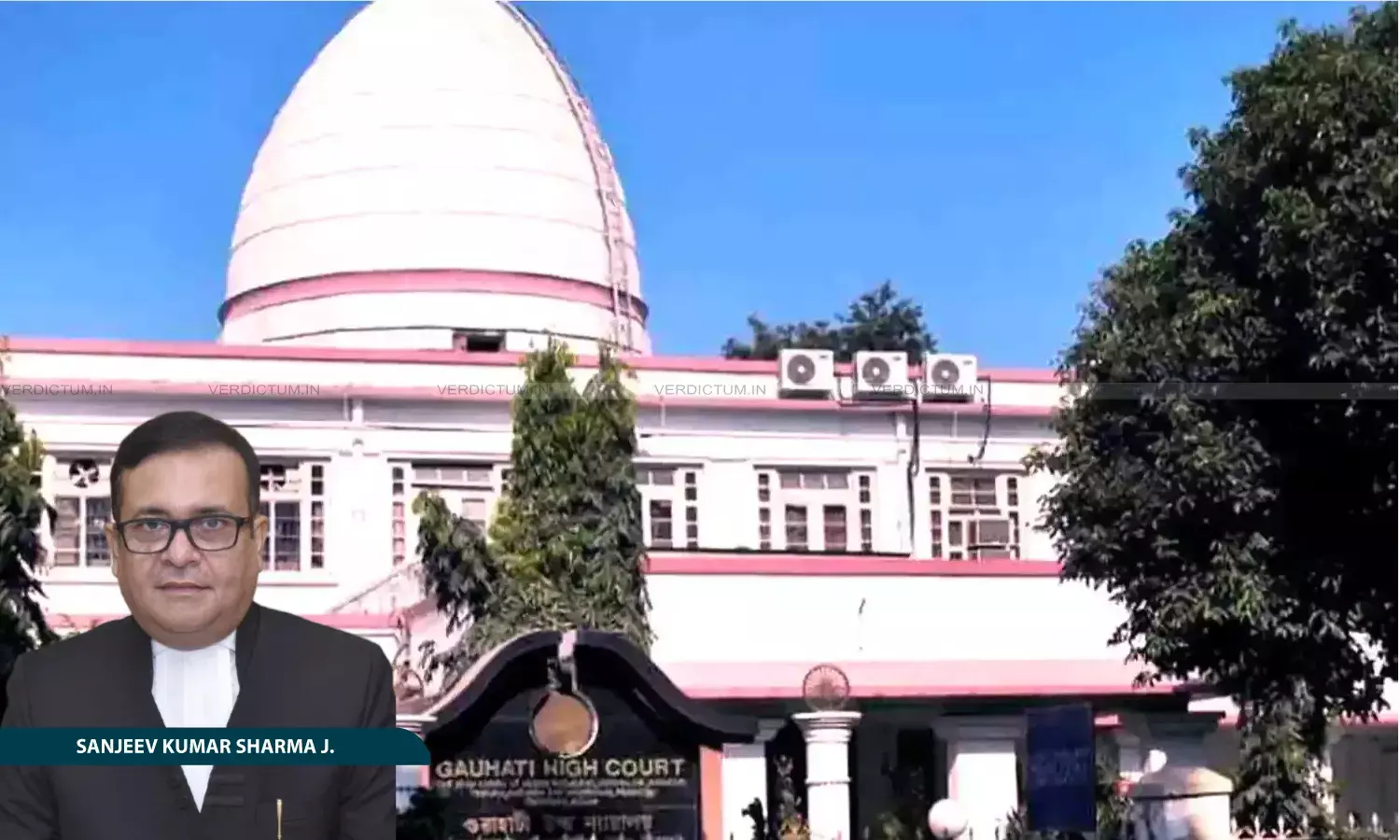
Justice Sanjeev Kumar Sharma, Gauhati High Court
The Gauhati High Court has held that when bail is granted on technical grounds arising from curable defects in the arrest procedure, and not on merits, the investigating agency is not necessarily required to first seek cancellation of bail before seeking a production warrant and re-arrest in accordance with law.
The Court was hearing a criminal petition challenging an order by which the Special Judge, CBI, allowed the investigating agency’s prayer for issuance of a production warrant and re-arrest of an accused in a CBI case.
A Bench of Justice Sanjeev Kumar Sharma observed: “… when the investigating agency seeks to re-arrest an accused granted bail on technical grounds, there being valid grounds for his initial arrest, by following all requirements of legal procedure, the earlier order of granting bail cannot stand in the way of such re-arrest and therefore, no requirement of cancellation of the said order can be said to arise. This is for the reason that a decision to grant bail on merits is fundamentally different from one based on technicalities or curable defects noticed in the prior arrest exercise or procedure adopted, leading to the arrest.”
Advocate M.G. Singh appeared for the petitioner, while Advocate M. Kumari appeared for the CBI.
Background
The petitioner had earlier been granted bail after the Special Judge accepted the contention that his arrest was procedurally defective, since the arrest memo recorded the time of arrest as preceding the order permitting such arrest.
However, while granting bail, the Special Judge had expressly observed that the CBI would not be precluded from again approaching the Court for issuance of a production warrant and seeking arrest by following the procedure established by law.
The CBI later made an application for a production warrant and permission to re-arrest. The petitioner argued that the agency ought to have first applied for cancellation of bail, and that re-arrest without such cancellation would indirectly nullify the bail order.
The CBI opposed the plea, contending that the bail order itself had kept open the agency’s liberty to seek a production warrant and re-arrest, and that the petitioner could not challenge the later order without challenging the earlier order granting such liberty.
Court’s Observations
The Court first noted that Sections 437(5) and 439(2) CrPC deal with persons who have been “released” on bail. It was observed that curtailment of liberty ordinarily arises where an accused has actually been released and is later sought to be taken back into custody.
The Court noted: “Both the aforesaid provisions concern accused persons who have been 'released' on bail and therefore, the question of curtailment of their liberty, for however short a period, arises when an order permitting re-arrest is passed. That was the issue that concerned the Hon’ble Apex Court in Pogadadabnda Revathi (Supra).”
In the present case, the Court found that the petitioner had not actually been released after the bail order, since the bail bond was defective or not submitted.
The Court stated: “In the instant case, the petitioner was never released, pursuant to the order granting bail due to non-submission or submission of bail bond that was found to be deficient. Nevertheless, even in such a scenario, an order for re-arrest would have the effect of curtailing his prospective liberty, which would have been his, immediately upon submission of satisfactory bail bonds and their acceptance, which bonds were otherwise ready for submission.”
The Court referred to Dolat Ram v. State of Haryana (1995), where the Supreme Court explained that bail once granted may be cancelled only for cogent reasons, such as interference with justice, evasion, abuse of concession, or possibility of absconding.
The Court quoted: “Rejection of bail in a non-bailable case at the initial stage and the cancellation of bail so granted, have to be considered and dealt with on different basis. Very cogent and overwhelming circumstances are necessary for an order directing the cancellation of the bail, already granted.”
The High Court then explained that such grounds ordinarily arise after bail is granted, based on the conduct of the accused, and operate to cancel an otherwise valid bail order.
The Court distinguished cases where police custody is sought after a bail order on merits from cases where bail is granted because of technical defects in the arrest process.
Relying on Rakesh Kumar Paul v. State of Assam (2017) and Mihir Rajesh Shah v. State of Maharashtra (2025), the Court held that it is not an absolute principle that every order of re-arrest must be preceded by cancellation of bail.
The Court observed: “As is discernable from the above, it is not a principle of law that in all cases, an order of re-arrest must necessarily be preceded by an order of cancellation of bail. Cases in which bail is granted on certain technicalities, such as the present one, belong to a category separate from the ones granted on considerations of merit and therefore, considering the decision of the Hon’ble Apex Court in Mihir Rajesh Shah (Supra), no separate order of cancellation of bail is required to be passed in order to enable the investigating agency to re-arrest the petitioner after being granted bail on technical grounds.”
The Court rejected the contention that “procedure established by law” necessarily meant filing an application for cancellation of bail and obtaining a formal cancellation order.
The Bench held: “In fact, Section 437(5)/ 439(2) Cr.P.C does not prescribe any requirement or procedure for cancellation of bail before direction is made to take the accused into custody. Therefore, the procedure established by law as mentioned in the order granting bail to the petitioner cannot be construed as a reference to the practice and procedure of filing of an application and passing of a formal order for cancellation of bail.”
The Court further stated: “The filing of an application for issuance of production warrant in respect of an accused in custody is itself a procedure established by law. All that is required is that while considering such an application, the principles of natural justice are to be adhered to by the Court concerned, which has been done in the present case.”
Conclusion
Finding no infirmity in the order permitting production warrant and re-arrest, the Gauhati High Court dismissed the criminal petition.
Cause Title: Asem Kanan Singh alias Ashem Kanan Singh v. Union of India (Neutral Citation: 2026:GAU-AS:9771)
Appearances
Petitioner: Advocates M.G. Singh, K. Barman and R. Sekhar
Respondent: Advocate M. Kumari for CBI
