

Mere Phone Call Between Advocate And Client Can't Establish Criminal Conspiracy: Gujarat High Court Quashes FIR Against Lawyer
The Court held that mere telephonic contact between an advocate and his client cannot, by itself, establish a criminal conspiracy, particularly where objective evidence collected during the investigation disproves the allegations forming the foundation of the prosecution's case.
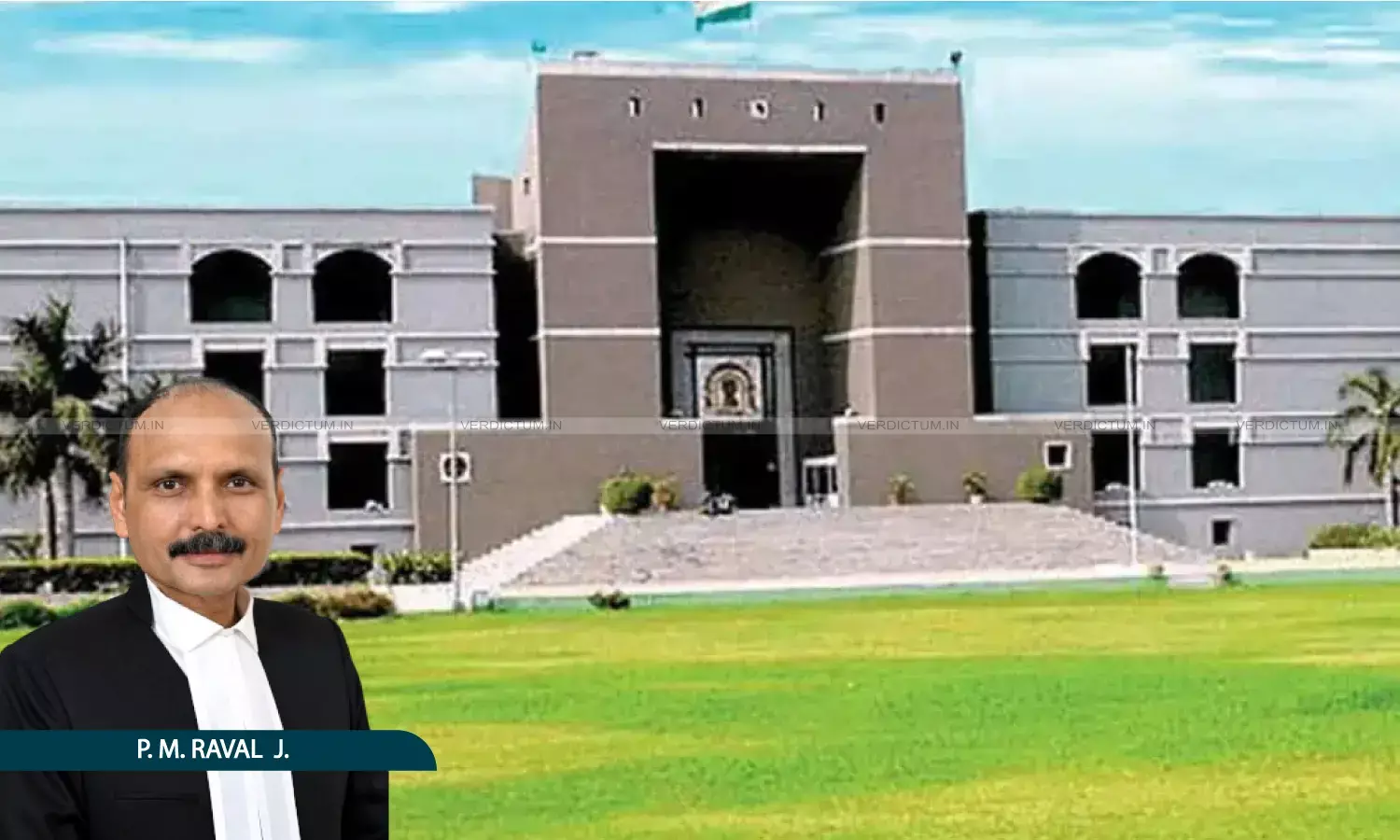
Justice P.M.Raval, Gujarat High Court
The Gujarat High Court has quashed an FIR registered against an advocate accused of participating in a criminal conspiracy to commit an assault, holding that the material collected during the investigation failed to establish any agreement to commit an offence and that CCTV footage contradicted the complainant's principal allegation against him.
The Court observed that criminal conspiracy requires proof of an agreement to commit an offence and that the mere fact that an advocate had spoken to a client over the phone could not be treated as evidence of participation in a conspiracy.
A Single Judge Bench of Justice P.M. Raval observed: "If the factum of telephonic conversation with Jamil Saiyed on his mobile phone at 13:34 is considered, the factum of applicant being advocate cannot be brushed aside inasmuch as he is representing him ‘with prosecution’ in one of the case and, therefore, contacting his client on phone, in no terms can be said that he had criminal conspiracy. As much as his absence and having threatened the complainant at 10:00 O’clock, as alleged in the FIR, is falsified from the CCTV footage collected”.
Advocate Gulammustufa M. Kapadiiya appeared for the applicant. Rohan Shah, APP, appeared for the State.
Background
An FIR was registered for offences punishable under Sections 307, 326, 325, 324, 143, 147, 148, 149, 506(2) and 120B IPC alleging that the complainant had been assaulted by multiple accused persons following an earlier dispute involving his father.
The prosecution's case alleged that, on the morning of the incident, the applicant-advocate approached the complainant at the District Court premises and threatened him with consequences if a pending criminal case was not withdrawn. The FIR further alleged that the subsequent assault was carried out pursuant to a criminal conspiracy involving the applicant and other accused persons.
The applicant approached the High Court under Section 482 Cr.P.C. seeking quashing of the FIR. He contended that he had been falsely implicated because he was representing one of the accused persons in another criminal case and that CCTV footage would establish that he was not present at the location where the alleged threat was said to have been made.
Court's Observations
The Court noted that immediately after learning that he had been named in the FIR, the applicant had approached both the Commissioner of Police and the Investigating Officer, asserting that he had been falsely implicated and requesting the collection of CCTV footage from the court premises. The Bench found significance in the fact that CCTV footage was eventually obtained during the investigation and did not show the applicant present at the location where the complainant claimed to have been threatened.
The Court observed: "The very initiation of the FIR on the ground that the present applicant threatened the complainant at 10:00 O’clock when he was present to meet his friend Vijay @ Abdul who was to be brought by the police party is falsified."
Examining the allegation of criminal conspiracy, the Court reiterated that the gravamen of the offence is an agreement to commit an unlawful act. While acknowledging that conspiracy is ordinarily proved through circumstantial evidence, the Court found that the prosecution had failed to place any material demonstrating the existence of such an agreement.
The Court noted that the applicant's alleged presence at the court premises and the allegation that he had threatened the complainant had both been disproved by the CCTV footage collected during the investigation. The Bench observed: "As much as his absence and having threatened the complainant at 10:00 O’clock, as alleged in the FIR, is falsified from the CCTV footage collected."
The Court also examined the material relied upon by the prosecution to establish conspiracy and found that, apart from statements of co-accused persons, there was no substantive evidence linking the applicant to the alleged offence. Referring to recent Supreme Court decisions, the Court observed that confessional statements made to police are inadmissible and cannot form the sole basis for implicating a co-accused.
The Bench observed that: "From the entire papers of charge-sheet except for the statement of the co-accused and allegation by the complainant, there is nothing to point out that the present applicant had entered into criminal conspiracy."
The Court further held that the applicant's presence in the locality, as reflected by tower location records, was insufficient to establish criminal conspiracy. The Bench observed: "Merely his presence till 16:08 Hrs as per tower location in Rander area would also not prove that the applicant had entered into criminal conspiracy."
After considering the material collected during investigation, the Court concluded that the CCTV footage demolished the very foundation of the allegations against the applicant and that continuation of the proceedings would amount to an abuse of process of law. The Court observed: "The material relied upon by the Investigating Agency itself falsifies the case of the prosecution qua the present applicant."
Conclusion
Holding that the allegations against the applicant were contradicted by CCTV footage collected during the investigation and that there was no material, apart from inadmissible statements of co-accused, to establish a criminal conspiracy, the Gujarat High Court allowed the quashing petition.
The Court consequently quashed the FIR and all consequential proceedings against the applicant while clarifying that the observations contained in the judgment were confined to the applicant alone and would not affect the investigation or trial against the remaining accused persons.
Cause Title: Mohammad Bilal Gulam Rasul Kagazi v. State of Gujarat & Anr. (Neutral Citation: 2026:GUJHC:37247)
Appearances
Applicant: Advocates Gulammustufa M. Kapadiiya and Kashyap R. Joshi.
Respondents: Rohan Shah, Additional Public Prosecutor for the State of Gujarat.
