

Onus On Plaintiff To Prove Continuous Readiness And Willingness U/S 16 Specific Relief Act; May Be Inferred From Conduct: Gujarat High Court
The Court held that readiness and willingness are continuous obligations to be inferred from conduct and surrounding circumstances, and cannot be established by mere assertions.
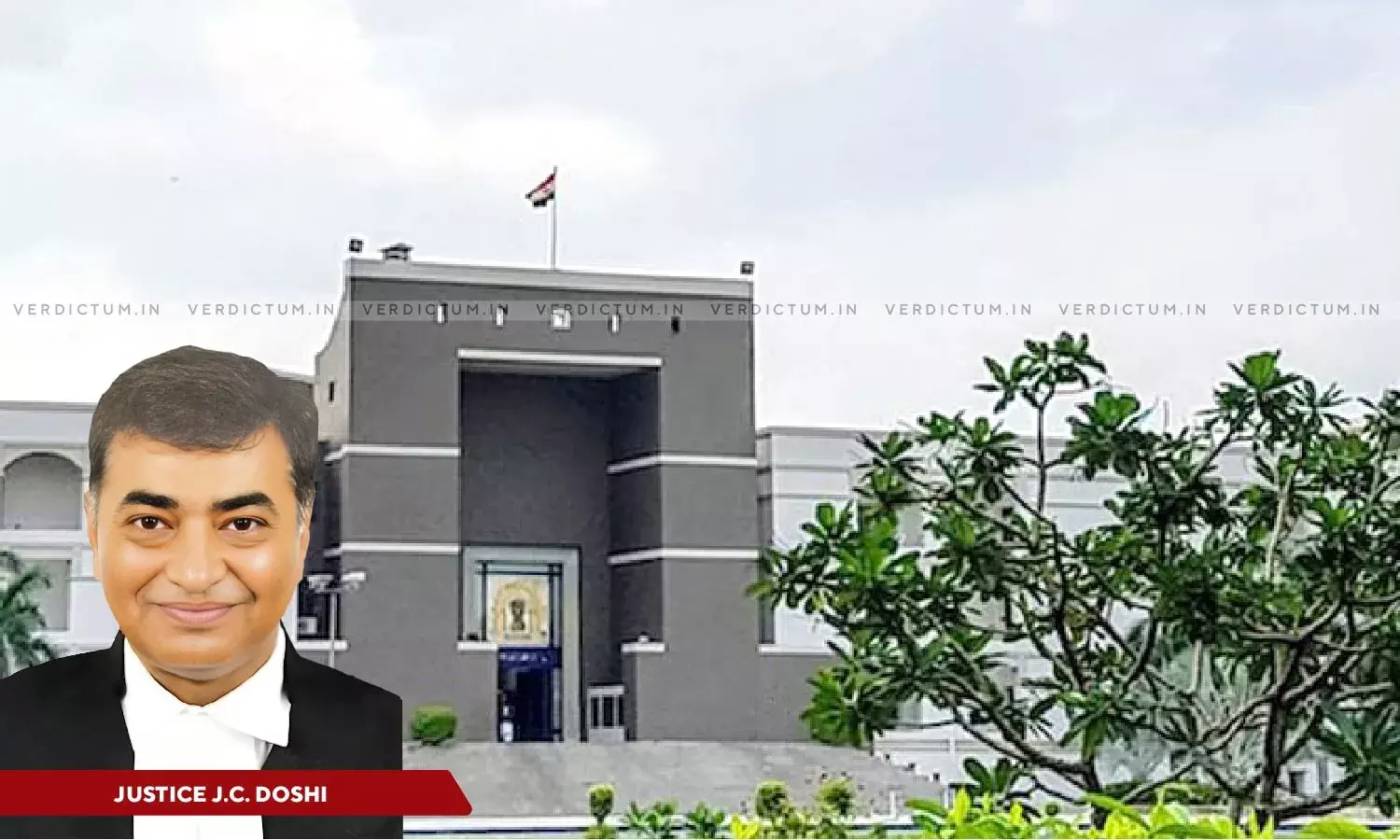
Justice J.C. Doshi, Gujarat High Court
The Gujarat High Court has held that the onus lies squarely upon the plaintiff to prove continuous readiness and willingness to perform the contract under Section 16(c) of the Specific Relief Act, 1963, and that such readiness must be inferred from the conduct of the parties and surrounding circumstances rather than mere assertions in pleadings.
The Court was hearing first appeals arising from a decree passed by the City Civil Court, Ahmedabad, directing specific performance of an agreement to sell dated 01.10.1985 and setting aside a subsequent sale executed during the pendency of the suit.
A Bench of Justice J. C. Doshi observed: “Section 16(c) of the Specific Relief Act, 1963 mandates that in a suit for specific performance of plaintiff must allege and prove continuous readiness and willingness to perform his contract on his part on the date of the contract, and the onus lies upon the plaintiff. The relief of specific performance under Section 20 of the Specific Relief Act, 1963 cannot be granted unless and until the plaintiff proves that he was ever ready and willing to perform his part of the contract”
“… Factum of readiness and willingness to perform the part of the contract is to be adjudged with reference to the conduct of the party and attending and surrounding circumstances, … The Court may infer from the facts and circumstances whether plaintiff was ready and always ready and willing to perform his part of the contract”, the Bench added.
Advocates Jenil M. Shah and Mehul S. Shah appeared for the Appellants; Advocates Aftabhusen Ansari and Mayur V. Dhotare appeared for the Respondents.
Background
The plaintiff instituted a suit for specific performance of an agreement to sell executed on 01.10.1985, contending that he had paid part consideration and was always ready and willing to perform his obligations under the contract.
The defendant resisted the suit, contending that time was the essence of the contract and that the plaintiff had failed to perform within the stipulated period, leading to termination of the agreement.
During the pendency of the suit, the defendant executed a sale deed in favour of a third party in violation of an injunction order, prompting the plaintiff to amend the plaint and seek cancellation of the subsequent sale. The trial court decreed the suit, which was challenged on appeal.
Court’s Observation
The Court examined the framework governing suits for specific performance under the Specific Relief Act, 1963, with particular emphasis on the interrelation between the question of whether time is the essence of the contract and the requirement of readiness and willingness on the part of the plaintiff.
It held that these issues cannot be examined in isolation, as the conduct of the plaintiff in adhering to contractual timelines directly bears upon the determination of readiness and willingness.
At the outset, the Court reiterated the statutory mandate under Section 16(c), holding that the burden lies squarely on the plaintiff to both plead and establish continuous readiness and willingness to perform his part of the contract. It emphasised that this obligation is not confined to the date of the agreement or filing of the suit, but must subsist throughout the entire period of the contract and till the adjudication of the suit.
In this context, the Court observed that the relief of specific performance cannot be granted unless and until the plaintiff proves that he was ever ready and willing to perform his part of the contract, thereby making such proof a condition precedent for the grant of relief.
The Court further clarified that readiness and willingness are not a matter of mere assertion in pleadings, but a substantive requirement to be established through credible evidence. It held that the determination of such readiness must necessarily be drawn from the conduct of the parties and the attending circumstances surrounding the transaction.
The Court emphasised that it is a settled principle of law that factum of readiness and willingness is to be adjudged with reference to the conduct of the party and attending and surrounding circumstances, thereby underscoring that the enquiry is factual and contextual in nature.
Proceeding further, the Court considered the evidentiary burden cast upon the plaintiff and held that the onus cannot be discharged by isolated acts or self-serving statements. Instead, the Court is required to examine the entirety of the circumstances, including payments made, steps taken towards performance, and responses to contractual obligations.
It observed that the Court is entitled to draw necessary inferences from such material, holding that the Court may infer from the facts and circumstances whether the plaintiff was ready and always ready and willing to perform his part of the contract.
The Court also addressed the scope of discretion under Section 20 of the Specific Relief Act and held that even where a contract is otherwise enforceable, the equitable relief of specific performance cannot be granted unless the statutory requirement of readiness and willingness is strictly satisfied. It clarified that such discretion is not arbitrary but is structured by statutory conditions, and failure to establish continuous readiness disentitles the plaintiff from relief.
On the facts of the case, the Court undertook an assessment of the conduct of the plaintiff and the surrounding circumstances of the case, including the sequence of events, the actions taken towards performance, and the overall consistency of the plaintiff’s stand. Upon such evaluation, the Court concluded that the plaintiff had satisfied the requirement of continuous readiness and willingness within the meaning of Section 16(c), thereby justifying the decree for specific performance.
Conclusion
The High Court, upon appreciation of the evidence and application of the settled principles, upheld the decree of specific performance, finding that the plaintiff had successfully established continuous readiness and willingness to perform the contract.
Accordingly, the appeals were dismissed, and the judgment and decree of the trial court were confirmed.
Cause Title: Miskinbanu Jahidkhan Pathan & Ors. v. Alisher Subhanali Ansari & Anr. (Neutral Citation: 2026:GUJHC:27194)
