

Stillborn Child Of Pregnant Passenger Killed In Railway Accident Entitled To Independent Compensation Under Railways Act: Gujarat High Court
The Court held that a stillborn child carried in the womb of a pregnant passenger who died in a railway accident must be treated as a “person” and a separate victim for compensation under the Railways Act.
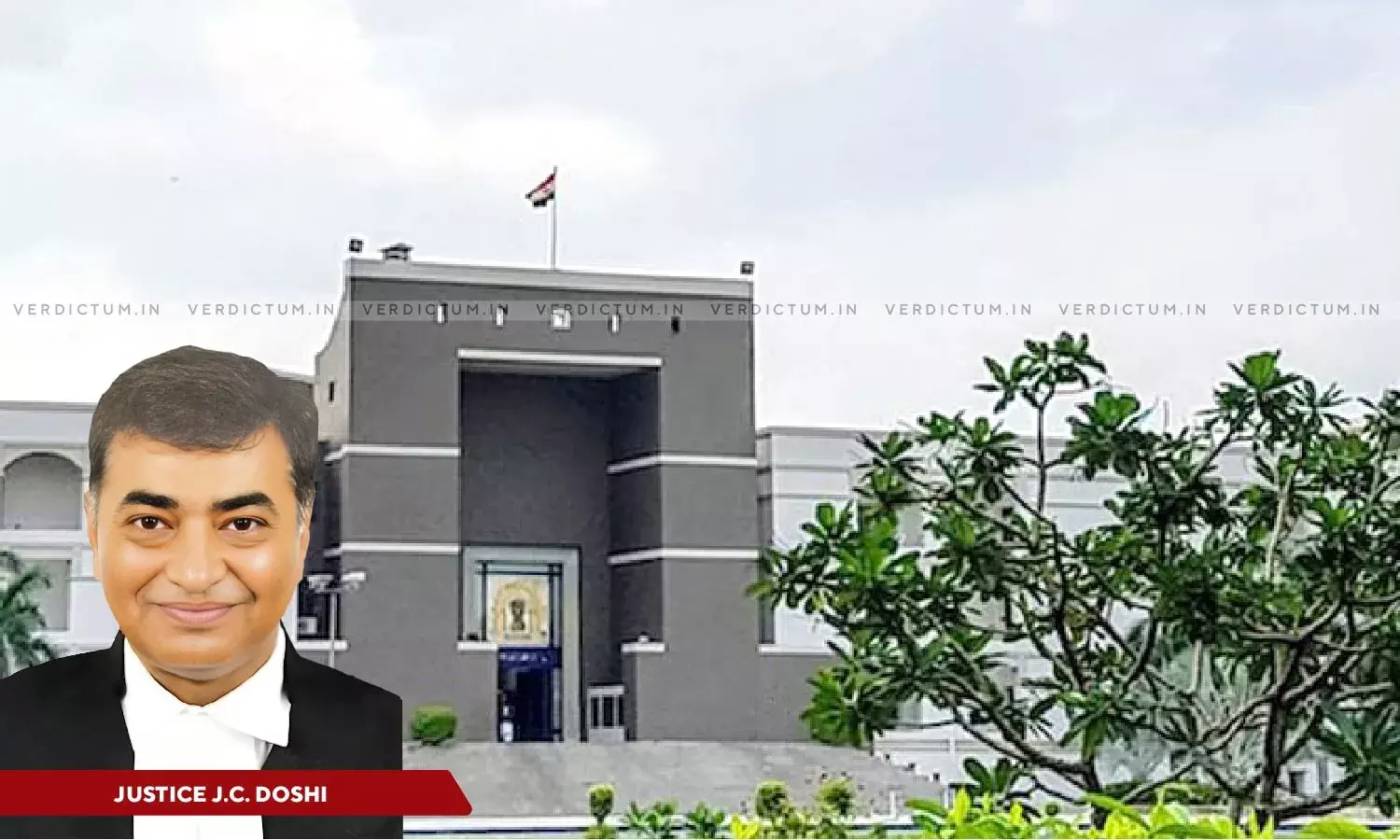
Justice J.C. Doshi, Gujarat High Court
The Gujarat High Court has held that a stillborn child of a pregnant passenger who died in a railway accident is entitled to independent compensation under the Railways Act, observing that a foetus in advanced pregnancy is to be treated as a child and a separate victim of the untoward incident distinct from the mother.
The Court was hearing a first appeal challenging an order of the Railway Claims Tribunal dismissing a claim petition filed by the father of a stillborn child seeking compensation arising out of the death of his wife and unborn child in a railway accident.
A bench of Justice J.C. Doshi observed: “Since the foetus is treated as a child, the death of a child would be treated as an independent accident apart from the death of the mother. Stillborn child for all purposes is a person and entitled to claim compensation under the Railways Act”.
Further, the Bench added: "... the impugned order passed by the learned Tribunal suffers from patent illegality and is unjustified. In the case at hand deceased at the time of the untoward incident was carrying 9 month pregnancy. A foetus of nine months for all purposes is a child in existence. Pragmatic and liberal interpretation of the definition of bona fide passenger shall also include a stillborn child".
Advocate Rathin P. Raval appeared for the appellant. Advocate Archana U. Amin appeared for the Railway Administration.
Background
According to the claim petition, the appellant and his wife, who was carrying a nine-month pregnancy, were travelling by train along with family members when the incident occurred. The claimant alleged that due to the heavy rush inside the compartment, the deceased was standing near the entrance door of the coach.
It was alleged that when the train started moving, the deceased fell from the running train due to a jerk and sustained fatal injuries. She later died while being shifted to the hospital. The unborn child also died in the incident.
The appellant thereafter sought compensation of ₹8 lakhs for the death of the stillborn child under the Railway Claims Tribunal Act, 1987, read with the Railways Act, 1989.
The Railway Administration opposed the claim, contending that the deceased had fallen while attempting to board a moving train and therefore the incident did not fall within the scope of an “untoward incident” under Section 123(c)(2) of the Railways Act. It was further contended that a stillborn child could not be treated as a bona fide passenger and hence no compensation was payable.
The Railway Claims Tribunal dismissed the claim petition on the preliminary issue of maintainability, holding that compensation could not be awarded for the death of an unborn child.
Court’s Observation
The High Court noted that the death of the pregnant passenger in the railway accident and the existence of a nine-month-old live foetus at the time of the accident were undisputed facts borne out from the inquest report, postmortem report and accident records.
The Court observed that the appellant had already been granted compensation for the death of his wife in separate proceedings, and the Railway Administration had not challenged that award.
Addressing the legal issue concerning maintainability of compensation claims relating to stillborn children, the Court extensively referred to the doctrine of “Nasciturus pro iam nato habetur”, which recognises that an unborn child is deemed to be born for its own benefit.
The Court observed that Indian jurisprudence has gradually evolved to recognise the rights of unborn and stillborn children in tort law and compensation claims.
The Bench referred to decisions including National Insurance Company Ltd. v. Kusuma (2011), S. Said-ud-Din v. Commissioner, Bhopal Gas Victims (1997), Divisional Controller, KSRTC v. Vidhya Shindhe (2003), and Shraddha v. Badresh (2005), wherein courts recognised entitlement of compensation for prenatal injuries or death of unborn children.
The High Court further referred to a recent judgment of the Allahabad High Court holding that an unborn child aged more than five months in the mother’s womb can be treated as equal to a child in existence and is entitled to compensation under the Railways Act.
The Court observed that a foetus of nine months “for all the purpose is a child in existence” and held that a pragmatic and liberal interpretation of the expression “bona fide passenger” would include a stillborn child carried by a ticket-holding pregnant passenger.
Referring to jurisprudence under the Motor Vehicles Act, the Court observed that loss of a foetus is effectively loss of another life and cannot merely be treated as bodily injury to the mother. The Bench concluded that a “foetus is another life in the woman and it comes as a baby in the course of time.”
Conclusion
The Gujarat High Court allowed the appeal and set aside the order of the Railway Claims Tribunal dismissing the claim petition.
The Court awarded compensation of ₹8 lakhs along with 9% interest per annum from the date of the accident till realisation for the death of the stillborn child.
The Railway Administration was directed to deposit the compensation amount before the Tribunal within twelve weeks.
Cause Title: Jayprakash Ghasitelal v. Union of India Through General Manager (Neutral Citation: 2026:GUJHC:31698)
