

Daughter Adopted Pre-1956 Cannot Claim Inheritance From Adoptive Father After Inheriting From Biological Family: Gujarat High Court
The Court also held that social acceptance of a child brought by a woman from an earlier union into a later household could not create the legal status of an adopted daughter where the alleged adoption preceded the Hindu Adoptions and Maintenance Act, 1956.
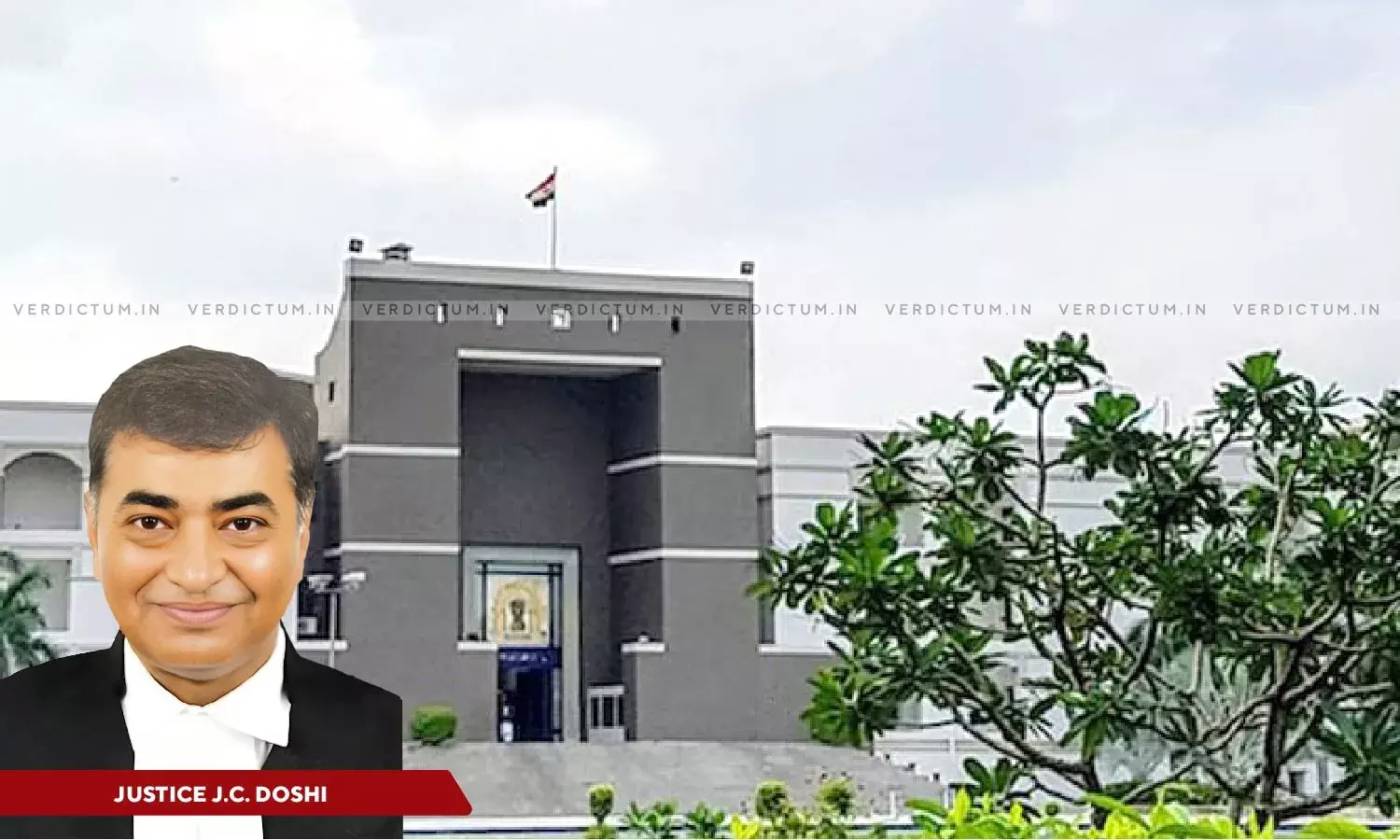
Justice J.C. Doshi, Gujarat High Court
The Gujarat High Court has held that a daughter allegedly adopted before the enactment of the Hindu Adoptions and Maintenance Act, 1956, could not claim inheritance from the alleged adoptive father where evidence showed that she had not renounced her biological family, having already inherited as the sole heir of her biological father.
The Court further held that the ancient Hindu law then prevailing did not recognise female child adoption.
The Court was hearing a first appeal under Section 96 CPC filed by the original plaintiff against the dismissal of her suit seeking declaration of ownership, possession, injunction and mesne profits over immovable properties on the claim that she was the adopted daughter of the deceased owner.
A Bench of Justice J.C. Doshi observed: “… as evaluated and discussed hereinabove, the customs, texts, and sources of Hindu Law prevailing prior to the enforcement of the Hindu Adoptions and Maintenance Act, 1956, demonstrate that the adoption of a female child was not legally recognized under ancient Hindu law. It is the specific case of the plaintiff that she was brought into the household as an Angaliyat by her mother in the year 1949. According to the Bhagavadgomandal Gujarati dictionary, the term Angaliyat signifies a son or daughter born out of a mother's previous wedlock who accompanies her to a subsequent union, carrying child by the finger or hand. This customary practice is predominantly prevalent among certain communities in Gujarat, such as the Patidars, Kanbis, and Dalit communities, among others”.
The Bench added: “The plaintiff entered into witness box at Exh.31. She has been cross examined. In cross-examination she has admitted that she is the only heir of deceased Chhaganbhai, her biological father and she received the inheritance as she is the sole survivor of Chhaganbhai. From the oral evidence, what could be inferred that the plaintiff has not renounced her family of her biological father. She cannot receive the inheritance from both biological as well as adoptive father. Once she is considered as adopted daughter, necessarily she renounces the biological family. But in the present case, cross-examination of the plaintiff proves that she has also received inheritance from biological family, thus it exclude her from claiming inheritance right, if any, in regard to immovable property of deceased Bhovanbhai, the so called adoptive father.”
Advocate Bhavesh P. Trivedi appeared for the appellant, while Advocate Jayant P. Bhatt appeared for the defendants.
Background
The plaintiff claimed that her mother had married the deceased after the death of her first husband, and that the marriage was solemnised on the condition that the plaintiff, who was then an infant, would be taken in adoption by the deceased.
The plaintiff asserted that she lived with the deceased and her mother throughout his lifetime, that the deceased maintained her and performed her marriage ceremonies as her adoptive father, and that after the death of the deceased and his wives, she became the sole legal heir entitled to inherit his properties.
The defendants opposed the suit by relying on a registered Will said to have been executed by the deceased, under which the properties were bequeathed in favour of one of them. They contended that the plaintiff may have been brought up by the deceased but was never legally adopted, and that in the absence of a Class-I heir, the defendant, being the son of the deceased’s brother, was entitled to inherit.
The Trial Court held that the long cohabitation of the plaintiff’s mother with the deceased established her status as his second wife, since polygamy was permissible before the Hindu Marriage Act, 1955. However, it refused to recognise the plaintiff as the legally adopted daughter of the deceased and held that her status was only that of a foster child.
Court’s Observations
The High Court identified the central issue as whether, before the enactment of the Hindu Adoptions and Maintenance Act, 1956, adoption of a daughter was legally permissible under ancient Hindu law.
The Court noted that the facts were largely undisputed: the deceased had married the plaintiff’s mother after she became a widow, and the plaintiff had entered the household with her mother. The Trial Court had proceeded on the footing that even if the plaintiff’s adoption was proved as a matter of fact, such adoption could not be sustained as legal and valid under ancient Hindu law.
The Court observed: “The root question which governs the decision in this appeal is whether adoption of daughter was permissible, prior to enactment of Hindu Adoption and Maintenance Act 1956?”
The Court examined N.R. Raghavachariar’s Hindu Law Principles and Precedents, Mulla’s Hindu Law and Hindu Nibandhan, and noted that the object of adoption under ancient Hindu law was both religious and secular, but the religious object was centred on securing a son for spiritual benefit and continuation of rites.
The Court stated: “Thus the object of adoption are twofold; the first is religious to secure spiritual benefit to the adopter and his ancestors by having a son for the purpose of offering funeral cakes and libations of water to the soul of the adopter and his ancestor. The other is secular object to secure an heir and perpetuate the adopter’s name. The substitution of son of deceased for spiritual reasons is the essence of the things and the consequent devolution of property a mere accessory to it, thereby even if person not in possession of property, he was permitted to adopt son.”
The Court further held that the legal position changed after the Hindu Adoptions and Maintenance Act, 1956, which permitted adoption of girls and gave independent statutory recognition to such adoption.
The Court accepted that the plaintiff had entered the household as an Angaliyat child and had been absorbed into the deceased’s family. However, it held that in the absence of any custom or source of ancient Hindu law recognising adoption of a female child, such status could not be elevated into legal adoption.
The Court held: “In the present case, learned counsel, Mr. Trivedi, contended that since the plaintiff was brought into the family as an Angaliyat and had been treated by the deceased, Bhovanbhai, as his own child, she should be held entitled to inherit his immovable properties. It is also submitted that learned Trial Court has wrongly applied the principal of factum valet. It is also proved that plaintiff was led by hand/finger of her mother from her earlier union and continued when her mother remarried and entered into the domestic union with deceased Bhovanbhai as second wife. It is also undisputed that she was absorbed in Bhovanbhai’s family and household, but in absence of any custom or any source of ancient Hindu Law concede adoption of a female child, she cannot be treated more than a foster child or Angaliyat daughter brought up as duty of stepfather.”
The Court added that the foundation of adoption under Shastric Hindu law required a son for spiritual benefit, and therefore only a male child could be validly adopted before the statutory change brought in 1956.
The plaintiff also relied on revenue entries in which her name had been mutated in respect of some survey numbers on the basis that she was the adopted daughter of the deceased.
The Court rejected that argument, holding that mutation based on an invalid theory of adoption could not create title.
The Court observed: “It was also case of the plaintiff that revenue authorities at some point of time have mutated her name in three different survey number on the basis that she is adopted girl of the deceased Bhovanbhai. This Court in the aforesaid terms and relying upon the various commentary of the various prominent authors as well as judgment of Privy Council believes that prior to enactment of Hindu Adoption and Maintenance Act 1956, adoption of the girl child was not permissible and therefore, based upon the theory of adoption if revenue entry has been mutated, it would not create any title in favor of the plaintiff.”
The Court also referred to The Special Secretary (Appeals), Revenue Department v. Boricha Ashokbhai Palabhai (2023), where a Division Bench had held that in the absence of valid adoption or any other legal document, mutation could not be made merely on the basis of an invalid claim of adoption.
The Court further noted that in cross-examination, the plaintiff admitted that she was the only heir of her biological father and had received inheritance from that family.
The Court found that if a person is treated as an adopted daughter, she necessarily renounces the biological family, but the plaintiff’s evidence showed that she had received inheritance from her biological family as well.
Conclusion
The High Court held that the plaintiff failed to establish any legal right as an adopted daughter in respect of an alleged adoption before the Hindu Adoptions and Maintenance Act, 1956.
The Court found no error in the Trial Court’s dismissal of the suit, dismissed the first appeal, vacated the interim relief granted earlier, and directed the record and proceedings to be sent back to the Trial Court.
Cause Title: Hiruben Pparbatbhai Satasiya v. Bhagwanjibhai Popatbhai Ranparia & Ors.
Appearances
Appellant: Bhavesh P. Trivedi, Advocate, with R.R. Trivedi, Advocate
Defendants: Jayant P. Bhatt, Advocate
