

Mechanism For Justice Turned Into Weapon Of Attrition: Gujarat High Court Holds Narsinhji Temple Is A "Public Trust" Ending Seven-Decade Dispute
The Court confirmed the status after litigation originated in 1952; dismissed appeals pending since 1979, holding four-decade prolongation denied fruits of a decision rendered in 1971 and was atrocious to the Rule of Law.

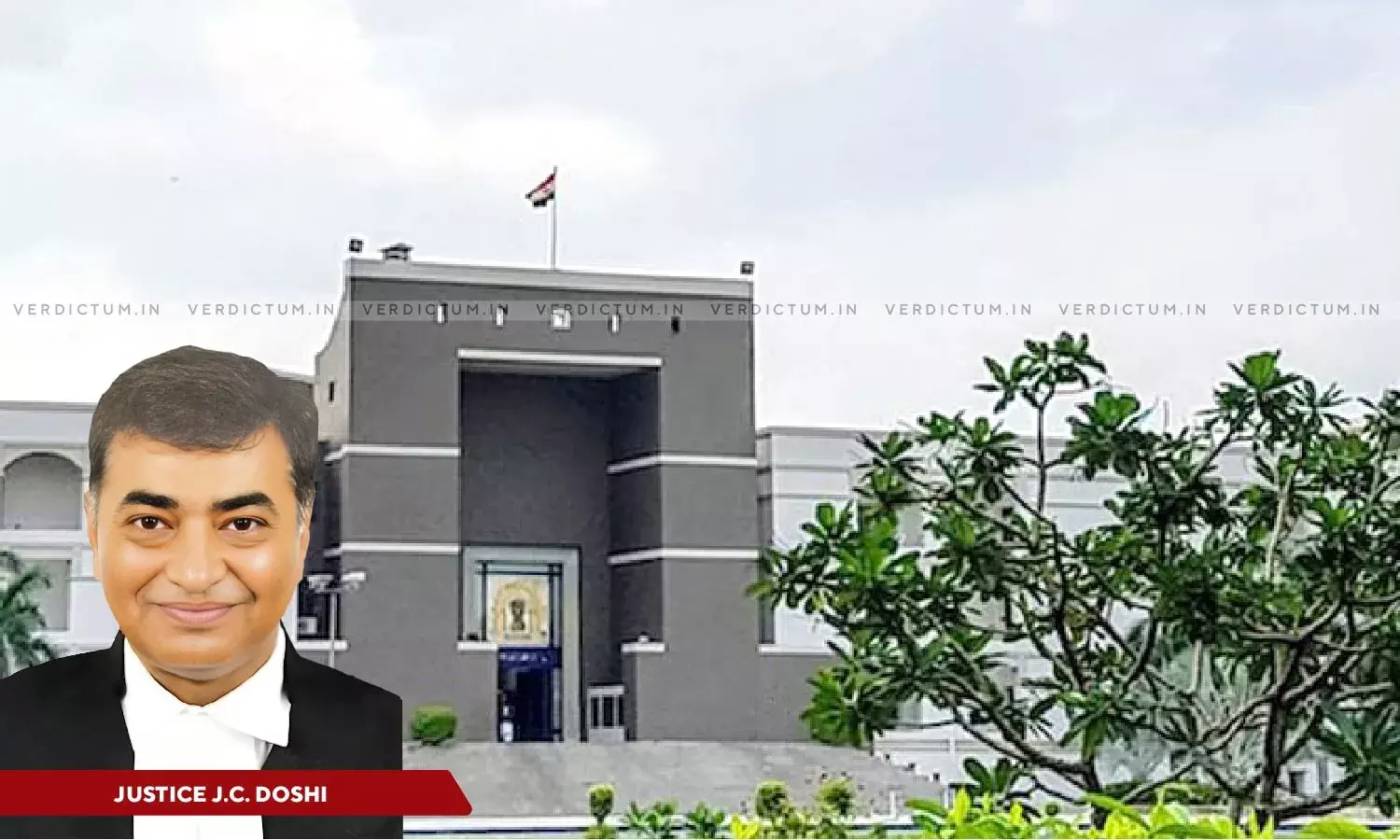
Justice J.C. Doshi, Gujarat High Court
The Gujarat High Court has dismissed three First Appeals arising out of a dispute that originated in 1952, finally confirming that the temple of Lord Narsinhji at Village Dhaman, Navsari, is a public trust under the Gujarat Public Trusts Act, 1950 and that all properties dedicated to it, including lands granted by the erstwhile State of Baroda, are public trust properties and not the personal properties of the Mahant's heirs.
The Court delivered sharp observations on deliberate prolongation of litigation, holding that strategic procrastination weaponizes judicial proceedings to exhaust the life, finance and patience, and that carrying out litigation for forty years turned legal redress into a travesty of justice.
The Court further held that the four-decade prolongation of appeals secured an unfair advantage to the appellants by denying the beneficiaries the fruits of a decision rendered as far back as 1971, and that such conduct was atrocious to the Rule of Law.
Justice J.C. Doshi observed, “…all the three appeals are arid of merits, rather it is an end result of deliberate stretching of appeals over more than four decades, which egregiously displays abuse of the judicial process. Probably it was a calculated approach that turns a mechanism for justice into a weapon of attrition, actively exploiting systematic backlogs to wear down the very purpose of declaring Lord Narsinhji’s temple as a public trust”.
“Even a private gift, though not executed by a mode recognized under the ‘TP Act’, are far from establishing that it is a private gift to the Mahant”, the Bench categorically said.
Senior Advocate Mehul S. Shah appeared for the appellants and Senior Advocate Percy Kavina appeared for the respondents.
“The four decade prolonging of proceedings secures an unfair advantage to appellant, denying the fruits of the decision rendered way back in 1971, is atrocious to the Rule of Law…The strategic procrastination weaponizes the judicial proceedings to exhaust the opponent's life, finance and patience. Continuously engineering the delays, actively denies the finality to justice and reduces the judicial proceedings to a tool for personal gain. Their carrying out litigation for forty years turned legal redress into a travesty of justice”, observing, the Bench concluded the judgment.
The dispute originated in 1952 when devotees of Lord Narsinhji filed an application before the Deputy Charity Commissioner, Baroda, claiming the temple was a public institution and its properties public trust properties.
The Mahant contested this, claiming the idol was a private deity installed by his ancestors and all properties were his personal estate. The Deputy Charity Commissioner and the Charity Commissioner both found in favour of the devotees.
Thereafter, the Mahant challenged these findings before the District Court, which in 1971 surprisingly reversed the findings and declared the temple a private deity and the properties private. That decision was appealed to the High Court, where a Division Bench in 1977 reversed the District Court and conclusively held the temple to be a public trust, remanding the matter for determination of which specific properties were public and which private.
Mahant withdrew his SLP before the Supreme Court in 1979, leaving the First Appeals now decided, filed in 1979, pending for over four decades.
Now, the Court found the appeals completely meritless, noting that two separate inquiries, one by the District Court and one by the Charity Commissioner pursuant to the High Court's own direction, had independently confirmed the same trustees as fit and proper persons.
On the reliance on Bihar State Board Religious Trust, Patna v. Mahant Sri Biseshwar Das, (1971) 1 SCC 574 to submit that merely the Mahant did not produce the copy of the Sanad, it cannot be held that the properties are of a public nature for a religious and charitable trust, the Bench noted, “…This judgment can be factually distinguished as this Court has examined the gift given by the devotees or villagers to Bawa respecting them as a Manager or Pujari of the Lord Narsinhji temple in the words that his successor would be entitled to enjoy the properties, where succession runs in as per Guru-Chela tradition and not under the personal succession. Therefore, once a Guru-Chela tradition is established for a mode of succession and the properties are transferred from Guru to Chela, it is to be presumed that it was a dedication to the deity and the property has a charitable purpose and in that event, the Mahant was to establish that the properties were his personal gain, otherwise it is implied that it is the properties of the public trust”.
“…it is also established fact that the temple of Lord Narsinhji is held to be a public trust. It is true that descendant of private properties of the Mahant to the Chela may not warrant its nature as religious, but in the case on hand, several parcels of the land were granted by the erstwhile State of Baroda in the tenure of Barkhali land and these lands admittedly were the land granted for the purpose of maintaining the temple of Lord Narsinhji. Later on, these lands were converted for the private purpose and sold to third parties by the Mahant as an Administrator of the temple, clearly gives the idea that all these are the dedication to the temple and not to the Mahant”, the Bench noted.
The Civil Applications filed alleging breach of order were also dismissed as part of a designed tactic to prolong litigation further.
All three appeals were dismissed with direction to draw the decree forthwith. The newly added respondents-trustees undertook not to execute the judgment for six weeks at the request of the appellants' counsel.
Cause Title: Heirs of Mahant Dayaramdas v. Charity Commissioner and Others C/FA/77/1979
Appearances:
Appellants: Mehul S. Shah, Senior Advocate, with Arpit A. Kapadia, Advocate.
Respondents: Percy Kavina, Senior Advocate, with Bhagirath N. Patel and Tejas P. Satta, Advocates, Dhwani R. Tripathi, AGP.
Click here to read/download the Judgment