

Delhi High Court Grants Dynamic Injunction To Protect Zee's FIFA World Cup 2026 Broadcasting Rights Against Rogue Websites & Mobile Apps
The Court ruled that real-time blocking is essential to prevent digital pirates from rendering intellectual property rights otiose through instant mirror variants and rogue applications.

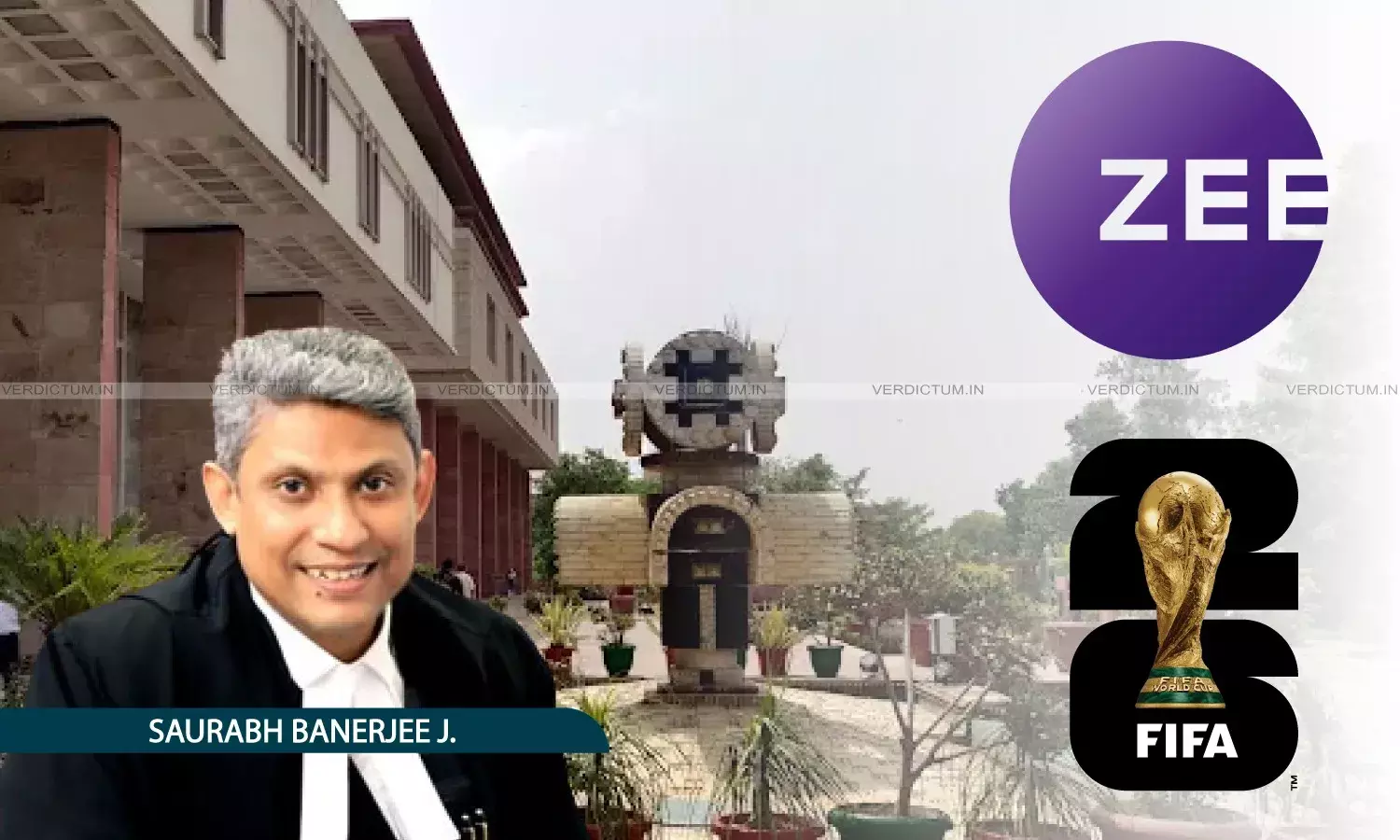
In a commercial suit instituted by Zee Entertainment Enterprises Limited, the Delhi High Court granted an ex-parte ad-interim dynamic injunction to safeguard the exclusive media and broadcasting rights of the FIFA World Cup 2026 within India.
The Court took note of the modern realities of digital piracy, noting that masked players increasingly use advanced technology to circumvent standard blocking orders by instantly generating alphanumeric, mirror, and redirect variants of infringing websites and rogue mobile applications.
Observing that traditional post-infringement remedies would be rendered completely otiose during a fast-paced live sporting event, the Bench directed Domain Name Registrars (DNRs), Internet Service Providers (ISPs), and central government authorities like DoT and MeitY to suspend and block access to the arrayed rogue platforms, as well as any future mirror variants, on a real-time basis upon notification by the plaintiff.
The Bench of Justice Saurabh Banerjee observed, "Today, it has become increasingly convenient for such illegal players to circumvent the processes qua protection of the rights of such plaintiffs and blocking mechanisms imposed through Court orders by instantly creating alpha-numeric/ mirror/ redirect variants of infringing websites, leading to a scenario wherein if real-time blocking is not granted, by the time such reliefs for each and every future rogue website individually is obtained from the Court, the intellectual property rights of the plaintiff would already be rendered otiose. It is also an unfortunate reality that similar infringing activities are also carried out via rogue mobile applications, hence it has become essential for such plaintiff(s) to obtain protections also against the associated domains/ URLs/ UIs of such rogue mobile applications in order to give any meaningful effect to orders granting them protection against infringement."
Advocate Siddharth Chopra appeared for the Plaintiff.
Brief Facts of the Case
The plaintiff is engaged in the business of production, acquisition, marketing, and distribution of cinematographic films, and operator of a digital streaming platform, filed a commercial suit seeking a permanent injunction, damages, and other ancillary reliefs.
The suit was instituted against several rogue websites, domain name registrars, Internet Service Providers (ISPs), the Department of Telecommunications (DoT), the Ministry of Electronics and Information Technology (MeitY), and unknown defendants (John Doe) to restrain the unauthorized broadcasting and streaming of the upcoming FIFA World Cup. Along with the plaint, the plaintiff moved an application for temporary injunction under Order XXXIX Rules 1 and 2 of the Code of Civil Procedure, 1956, seeking ad-interim ex-parte reliefs to block access to the infringing websites and mobile applications on a real-time basis.
Contentions of the Plaintiff
It was contended by the plaintiff that it had acquired exclusive media and broadcasting rights for the FIFA World Cup within India across various transmission systems, including cable, satellite, broadband, and mobile technologies.
The plaintiff argued that by virtue of Section 37 of the Copyright Act, 1957, it held exclusive broadcast reproduction rights and was statutorily entitled to seek protection against any unauthorized communication or streaming of the tournament to the public. It was submitted that the arrayed rogue websites were chronically engaged in piracy, having previously streamed matches of the Indian Premier League (IPL) illegally, and had already announced the future availability of the FIFA World Cup matches on their platforms.
The plaintiff contended that a fresh cause of action arose every time these rogue platforms illegally hosted or streamed its content. It was further submitted that since the operators of these websites masked their physical addresses to evade detection, it was necessary to implead the Domain Name Registrars, ISPs, and government authorities to effectively block access to the pirated content.
Observations of the Court
The Court observed that a perusal of the pleadings and documents on record established a prima facie case of widespread copyright infringement regarding the upcoming sporting tournament. It was noted that masked players were using advanced technology to conceal their identities, thereby unjustly enriching themselves by infringing upon the legitimate intellectual property rights of the plaintiff.
The Court took judicial notice of the fact that illegal operators conveniently circumvented standard blocking mechanisms by instantaneously creating alphanumeric, mirror, and redirect variants of the infringing websites. The Court observed that if real-time blocking were not granted, the intellectual property rights of the plaintiff would be rendered otiose by the time individual reliefs were sought and obtained for each subsequent rogue website.
It was further observed that similar infringing activities were being actively carried out via rogue mobile applications. The Court opined that it was essential to extend protection to the associated domains, Uniform Resource Locators (URLs), and User Interfaces (UIs) of such rogue mobile applications to give any meaningful effect to the ad-interim injunction.
The Court held that since the rogue websites operated without any permission, authorization, right, title, or interest from the rightful owner, the plaintiff successfully made out a prima facie case in its favour. It was observed that the balance of convenience heavily tilted toward the grant of relief, and the plaintiff would suffer irreparable loss and injury if an ex-parte ad-interim injunction were denied.
Directions of the Court
The Court granted an ex-parte ad-interim injunction restraining the rogue websites, their owners, partners, officers, or anyone acting on their behalf from unauthorizedly communicating, hosting, streaming, or making available for viewing and downloading any works, exclusive broadcasts, streams, or content related to the tournament.
The DNRs were directed to lock and suspend the domain name registrations of the arrayed rogue websites on a real-time basis. This direction was also extended to any further rogue websites, associated domains, URLs, or UIs of rogue mobile applications subsequently discovered and notified by the plaintiff. Additionally, the DNRs were directed to disclose the identities, email addresses, and IP addresses of the respective registrants. The ISPs were directed to immediately block access to the rogue websites, as well as all subsequently discovered alphanumeric, mirror, or redirect variants and associated mobile application domains on a real-time basis upon notification by the plaintiff.
The Department of Telecommunications (DoT) and the Ministry of Electronics and Information Technology (MeitY) were directed to ensure strict compliance with the blocking orders by the ISPs operating under their regulatory purview. To check the use of the dynamic injunction, the Court directed the plaintiff to continuously file affidavits before the Court apprising it of all instances where further rogue websites or mobile applications were identified and notified to the DNRs and ISPs for suspension and blocking.
Cause Title: Zee Entertainment Enterprises Limited v. Https://Soccerbox.me/ & Ors.[CS(COMM) 657/2026]
Appearances:
Plaintiff: Advocates Siddharth Chopra, Yatinder Garg, Suhasini Raina, Siddharth Chopra, Vivek Ayyagari, Priyansh Kohli, Abhay Aren
Click here to read/download the Order