

Habeas Corpus Cannot Be Used For Transnational Child Custody Issues Requiring Detailed Inquiry: Delhi High Court
Noting that the child had been residing in the USA for eight years, it held that summary writ proceedings are unsuitable for determining complex welfare issues.

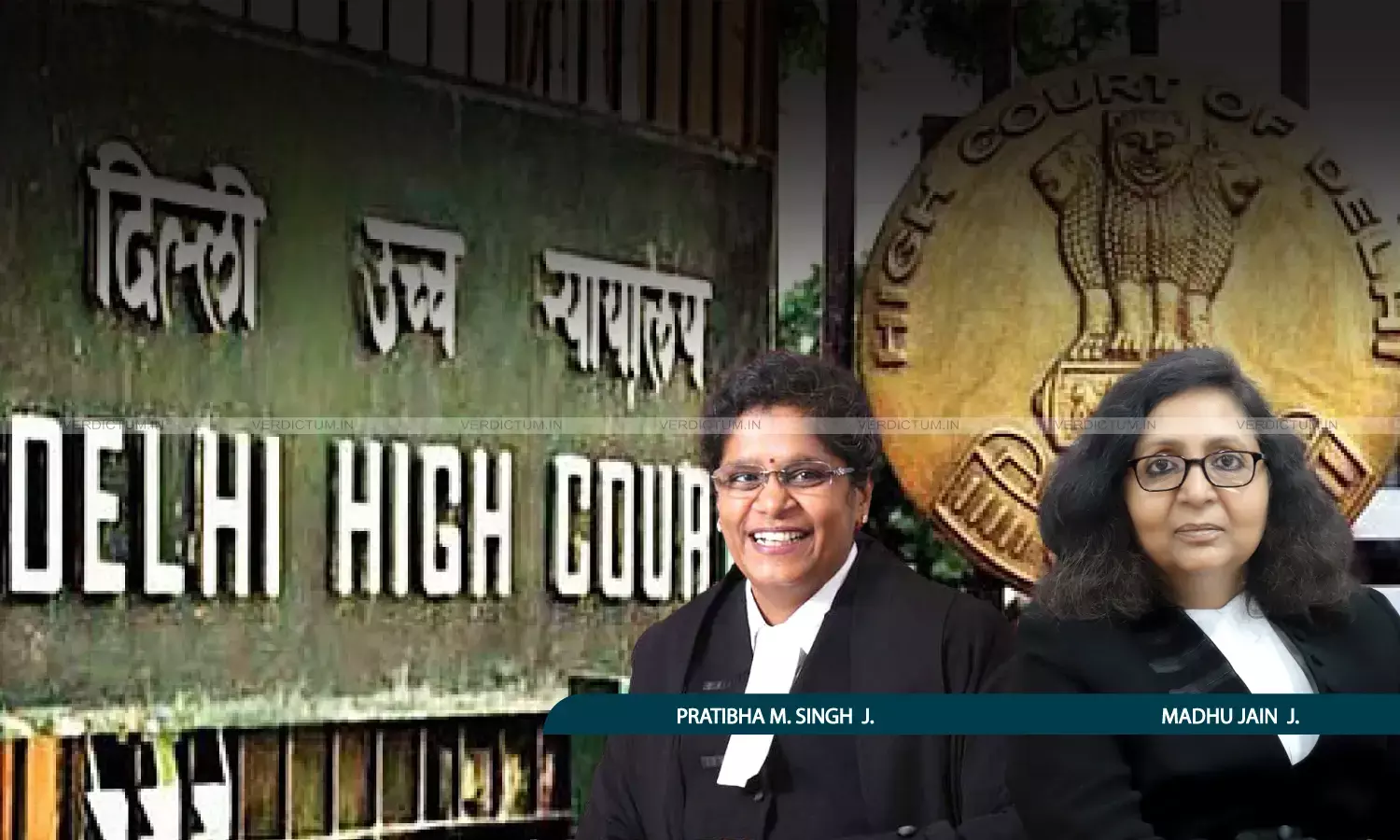
The Delhi High Court has held that extraordinary writ remedies cannot be invoked to decide child custody issues involving transnational disputes, particularly when the resolution requires a detailed inquiry into the child's welfare. The Court noted that habeas corpus proceedings are summary in nature and cannot be converted into prolonged custody battles.
Consequently, the Court highlighted the availability of the National Commission for Protection of Child Rights (NCPCR) as the appropriate forum for mediation and the development of a parental plan.
Justice Prathiba M. Singh and Justice Madhu Jain observed, “…writ jurisdiction would not ordinarily be exercised by High Courts, for deciding custody issues, especially where a detailed inquiry would be required to ascertain the welfare of the child…The minor child was born in USA and is an American Citizen, similar to the Petitioner No. 1 and Respondent No. 5. They also have Overseas Citizens of India card. The minor child has now been living in the USA for almost close to 8 years and hence, it would be necessary to consider all the facts and circumstances by conducting a detail inquiry as to whether the minor child’s best interest lies in living in India or the USA”.
Advocate Chand Chopra appeared for the petitioner and Radhika Bishwajit Dubey, CGSC appeared for the respondent.
As per the facts, the matter involved a habeas corpus petition filed by the father and grandmother of a minor boy who had been residing in Berkeley, California, with his mother since August 2018.
The petitioner alleged that the mother had taken the child from India without intimation, while the mother contended that the move was mutual and that she had informed the petitioner via email. The parties, all of whom hold American citizenship and Overseas Citizens of India (OCI) cards, had been involved in previous domestic violence and divorce proceedings in the USA.
The couple had their son through a surrogate mother in the USA, where the case of the Petitioner was that the Respondent No. 5, his ex-wife was not the biological mother or the legal mother of the son as per the law in India.
The petitioners sought a writ of habeas corpus for the physical production of the child in India, along with directions to the Ministry of External Affairs and the CBI to facilitate the return.
The father had already approached the NCPCR on January 12, 2026, for mediation of the transnational custody issue, and a criminal revision petition regarding the initial missing person report was also pending before the court.
Citing Supreme Court precedents, the Bench noted that where the welfare of the child is the paramount concern and requires a detailed inquiry, the High Court should decline extraordinary jurisdiction and direct parties to civil courts or statutory authorities.
The Court found that because the mother who was the recorded legal guardian in all official documents, and the child was well-settled in the USA, there was no "illegal detention" warranting a writ.
“In addition to the above, the NCPCR may engage and take assistance of one practicing child psychologist, one representative from National Legal Services Authority working in the field of child custody or any other expert whose services are necessary for participating the proceedings of the Mediation Cell. The local mission of the country where one of the spouses is residing may also be engaged by the Mediation Cell”, the Bench directed.
The Court disposed of the petition, directing the petitioner to pursue his remedy before the NCPCR. The Court noted that the NCPCR's Mediation Cell is specifically constituted to resolve cases of children moved across borders without parental consent and to prepare mutual parental plans. The petitioner was also permitted to continue his criminal revision petition in accordance with the law.
Cause Title: X & Anr v. Union of India Through Ministry of Home Affairs & Ors. (Neutral Citation: 2026:DHC:3632-DB)
Appearances:
Petitioners: Chand Chopra and Punishk Handa, Advocates.
Respondents: Radhika Bishwajit Dubey, CGSC, Gurleen Kaur Waraich, Kritarth Upadhyay, Vivek Sharma, Amulya Dev Mishra, Anubha Bhardwaj, SPP, Ananya Shamshery, Muskan Chawla, Priya Singh, GP, Attin Shankar Rastogi, Rajesh Ranjan, Archit Chauhan, Shivkant Arora, Adil Vasudeva, Jigyasa Prashaer, Advocates.