

Can’t Rewrite Eligibility Conditions Framed by Tendering Authority: Delhi High Court Dismisses Writ Petition Against MCD Tender
The Delhi High Court was considering a Petition seeking the quashing of a Notice Inviting Tender (NIT) issued by the respondent MCD.

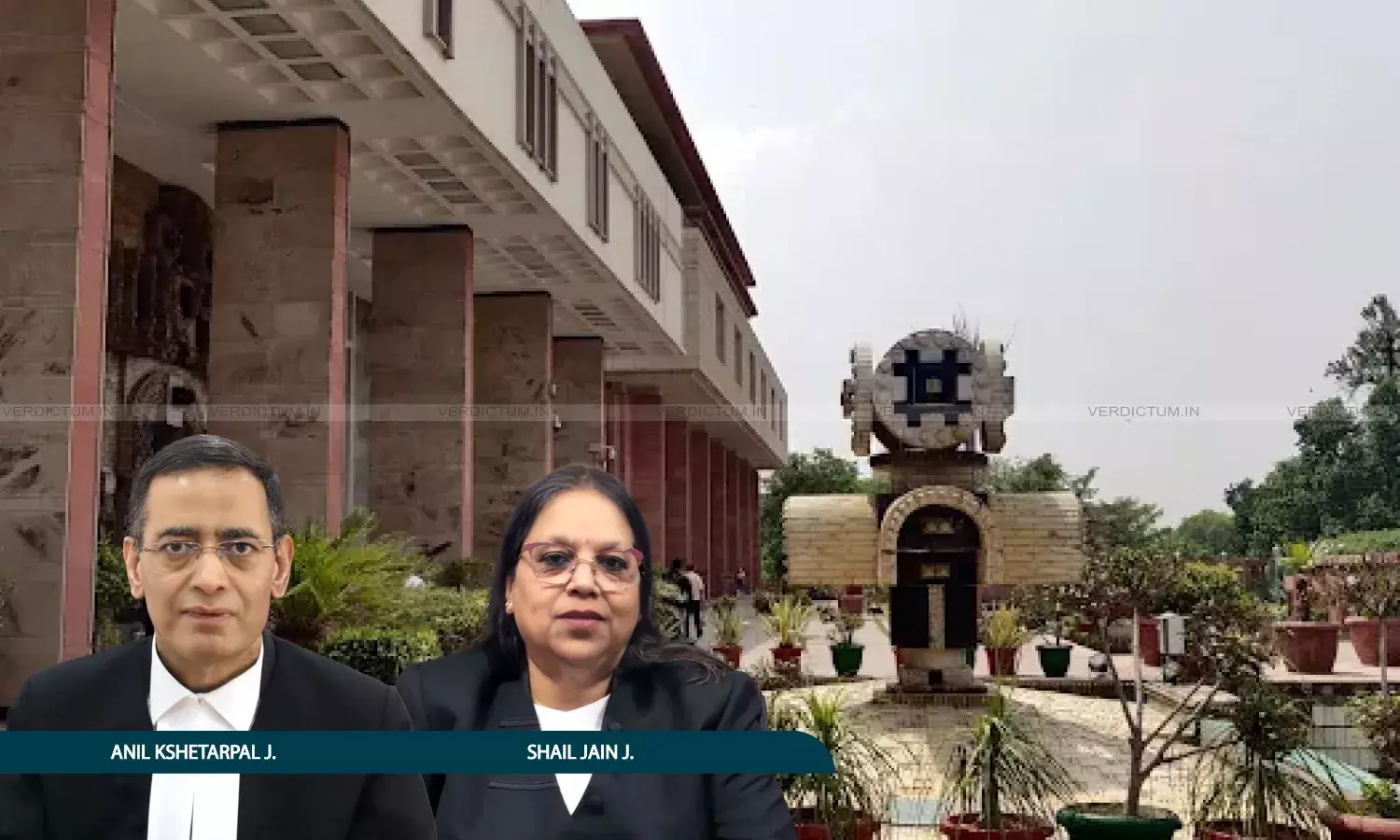
Justice Anil Kshetarpal, Justice Shail Jain, Delhi High Court
While dismissing a petition challenging a Notice Inviting Tender issued by the Municipal Corporation of Delhi, the Delhi High Court has held that the Court cannot substitute the specific experience requirement prescribed under the Impugned NIT and it cannot rewrite the eligibility conditions framed by the tendering authority under the writ jurisdiction.
The High Court was considering a Petition filed under Article 226 of the Constitution seeking issuance of an appropriate writ quashing a Notice Inviting Tender (NIT) issued by the respondent and directing the Respondent to consider/accept the petitioner’s bid. The challenge before the High Court was centered around the requirement of a minimum of 122 lanes under a single contract for a minimum period of two years (24 months), with each contract having a minimum duration of one year.
The Division Bench of Justice Anil Kshetarpal and Justice Shail Jain held, “Similarly, the challenge founded upon Article 19(1)(g) of the Constitution is equally untenable. The Impugned NIT merely prescribes eligibility for participation in a public tender and does not prohibit the Petitioner from carrying on its business. Such a stipulation cannot be regarded as an unreasonable restriction merely because the Petitioner is unable to satisfy it.”
“The Petitioner’s financial strength and its Category-I prequalification by the NHAI undoubtedly establish its credentials. However, they cannot substitute the specific experience requirement prescribed under the Impugned NIT. This Court in exercise of its writ jurisdiction cannot rewrite the eligibility conditions framed by the tendering authority”, it added.
Senior Advocate Amit Sibbal represented the Petitioner while Senior Advocate Mukul Rohtagi represented the Respondent.
Factual Background
It was the case of the Petitioner that the restrictive condition requiring experience of a minimum of 122 lanes was previously introduced by the Respondent for the first time vide the NIT dated February 7, 2024, for a similar scope of work involving Radio Frequency Identification (RFID) ecosystem, wherein the Petitioner’s Joint Venture (JV) was declared as the H-1 bidder. A writ petition came to be filed pursuant to which a fresh NIT was issued excluding the restrictive condition. However, before any bidding could be initiated, the same was withdrawn by the Respondent. Pursuant thereto, the Respondent passed the Corporate Resolution, expressly omitting the prescribed eligibility condition of having experience of minimum 122 lanes.
Thereafter, the Respondent issued NIT by way of a two-tier bid system, for engagement of a Contractor by MCD for Toll Tax & Environment Compensation Charge (ECC) Collection at border points from specified commercial vehicles entering Delhi and to upgrade the existing RFID system to the Multi Lane Free Flow (MLFF) based collection. Aggrieved by the criteria that the Applicant/bidding Firm must have prior relevant experience of toll/entry tax collection, operation through manual and semi-automated/electronic toll collection technologies in the last five financial years ending March 2026, the petitioner approached the High Court.
Reasoning
Highlighting the law about interference of a Writ Court in tender matters, the Bench emphasized how the Courts do not sit in appeal over the merits of tender conditions, but merely examine the legality of the decision-making process, to identify whether such process is vitiated by arbitrariness, mala fides, discrimination or irrationality of the Wednesbury standard.
Referring to various judgments of the Apex Court, the Bench stated, “From a perusal of the aforementioned precedents, it is sufficiently clear that the scope of judicial review is limited only to examination of whether or not the tender process is vitiated by arbitrariness, mala fides, irrationality, discrimination or is contrary to public interest.”
Taking note of the fact that more than 4.12 crore commercial vehicles entered Delhi during 2025, the Bench held that the Respondent was justified in prescribing experience commensurate with the scale and complexity of the project.
Holding that the Respondent had demonstrated a rational basis for prescribing the impugned eligibility criteria, which bears a direct nexus with the object of ensuring timely implementation of the MLFF system within the timeline mandated by the Supreme Court, the Bench held, “Hence, the Impugned Eligibility Criteria is not violative of Article 14 and 19(1)(g) of the Constitution nor is it vitiated by arbitrariness, mala fides, discrimination or irrationality.”
The Bench, thus, dismissed the Petition.
Cause Title: Skylark Infra Engineering Pvt Ltd v. Municipal Corporation of Delhi (Neutral Citation: 2026:DHC:5745-DB)
Appearance
Petitioner: Senior Advocates Amit Sibbal, Rajiv Nayar, Advocates Priyanka Dagar, Ajay Dabas, Deepanshu Yadav, Manjarika Das
Respondent: Senior Advocates Mukul Rohtagi, Shailesh Madiyal, Balbir Singh, Standing Counsel Sanjay Vashishtha, Advocates Shankey Agarwal, Toshiv Goyal, Siddhartha Goswami, Siddharth Agrawal