

Delhi High Court Flags "Chaos" In GNCTD OBC Recruitment Notifications, Says Ambiguous Conditions Leave Candidates And Courts In Uncertainty
The Court expressed concern over the manner in which the Government of NCT of Delhi has regulated OBC reservations, observing that multiple notifications, circulars and ambiguously worded advertisements have created uncertainty for candidates as well as courts.
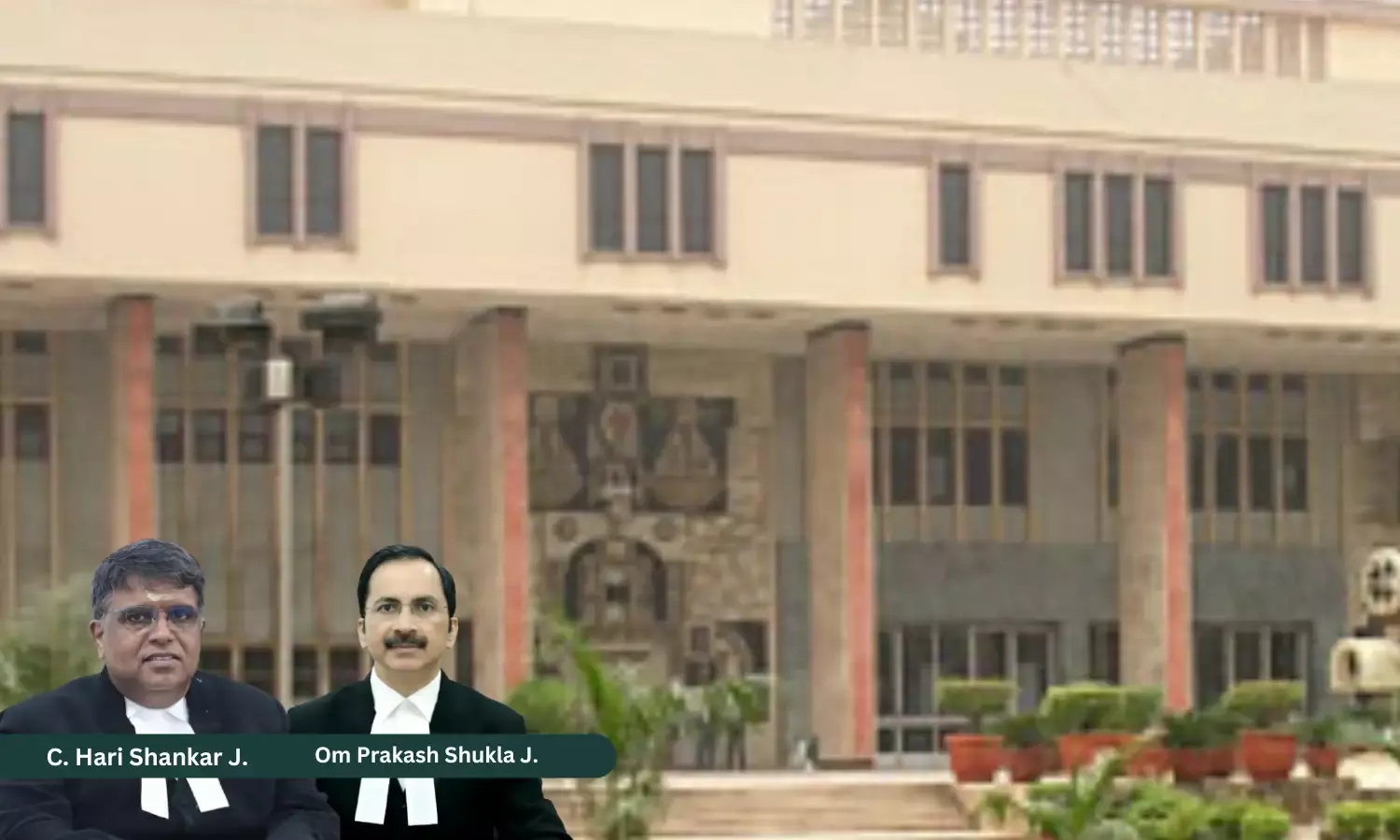
Justice C. Hari Shankar, Justice Om Prakash Shukla, Delhi High Court
The Delhi High Court has observed that the Government of NCT of Delhi (GNCTD) has created considerable confusion in matters relating to OBC reservation by issuing multiple notifications, circulars and letters over time, coupled with ambiguously worded recruitment advertisements.
The Court remarked that this has resulted in uncertainty regarding eligibility for reservation, affecting both candidates and the judiciary.
The Court, however, dismissed a challenge to the rejection of an OBC candidate's candidature for recruitment as a Special Educator, holding that although the candidate's caste was included in the relevant OBC list, the OBC certificate produced by him did not satisfy the specific certificate requirements prescribed in the recruitment advertisement.
A Division Bench of Justice C. Hari Shankar and Justice Om Prakash Shukla observed: "We are constrained to observe, with some sense of dismay, that the GNCTD has, at least in the case of OBC reservations, created utter chaos, by issuing one Notification/Circular/Letter after another, and wording the advertisements delightfully ambiguously, resulting in not only the candidates, but even the Court never being certain of whether a case of entitlement is, or is not, made out. Several such cases have come before us even within the past one year, and our attention has been drawn to one instruction in one case and another instruction in another. Such chaos and uncertainty leaves the legal situation in a state of flux, which is undesirable especially when the matter relates to reservation for OBCs."
Advocate Anuj Aggarwal represented the petitioner, while Avnish Ahlawat, Standing Counsel, appeared on behalf of the respondents.
Background
The petitioner applied for recruitment under the OBC category pursuant to an advertisement issued for the post of Special Educator. Although he successfully cleared the written examination and reached the stage of document verification, his candidature was rejected on the grounds that he was an "OBC (Outsider)" since the OBC certificate produced by him had been issued based on his father's certificate from Bihar rather than a certificate issued by the Government of NCT of Delhi. His challenge before the Central Administrative Tribunal also failed, leading to the writ petition before the High Court.
The petitioner contended that his caste formed part of the Central List of OBCs applicable to Delhi and that the recruitment advertisement entitled him to reservation benefits. The respondents, on the other hand, argued that the advertisement expressly required the OBC certificate to satisfy specific conditions, which the petitioner's certificate admittedly did not fulfil.
Court's Observations
At the outset, the Court strongly criticised the manner in which the GNCTD had framed and implemented its policy governing OBC reservations. It noted that multiple circulars and notifications had created avoidable confusion, making it difficult even for courts to ascertain the applicable legal position.
The Bench observed: "Clause 5(i) states that OBC reservation would be available 'in accordance with the instructions/orders/circulars issued from time to time by the Government of Delhi'. No reference is made to any circular number or order number. Candidates cannot be expected to be scouring the internet to find out all the circulars and orders issued by the GNCTD in the matter of OBC reservation. Even if a candidate comes across a particular circular or order, she, or he, can never be certain as to whether there is any subsequent circular or order which has modified it."
Expressing its disapproval, the Court further stated: "This is completely unacceptable. A clause such as Clause 5(i) is unfair to candidates who apply and may even be, to some extent, unsustainable in law. It places candidates in a state of utter uncertainty as to whether they are, or are not, eligible to apply as EWS/SC/ST/OBC/PwD."
The Bench then examined the various clauses of the recruitment advertisement and found that they were capable of generating confusion. While one clause extended reservation benefits in accordance with all government instructions issued from time to time, another restricted eligibility to candidates covered by two specific government communications. Yet another clause imposed additional certificate-related conditions which did not expressly find place in the earlier government communications.
The Court noted: "Clause 5(iii) immediately creates confusion, as it states that 'only OBC (Delhi) candidates notified by government of NCT of Delhi vide letter/order … dated 27/07/2007 and … dated 28/07/2016 will be given the benefit of reservation/age relaxation under OBC category'. Thus, while Clause (i) extends the benefit of OBC reservation to candidates covered by any instruction/order/circular issued by the GNCTD, Clause 5(iii) restricts the benefit of reservation to candidates covered by letters/orders dated 27 July 2007 and 28 July 2016."
It further observed: "Clause 5(iv) makes things worse. Read in isolation, Clause 5(iv) provides, in cases in which the OBC certificate produced by the candidate has been issued by the Revenue Department in the GNCTD, that the certificate must have been issued 'on the basis of a old certificate issued to any member of individual's family from GNCTD'. No such condition is to be found in either of the letters/orders dated 27 July 2007 and 28 July 2016 issued by the GNCTD, to which Clause 5 (iii) of the Advertisement makes reference."
After analysing the advertisement harmoniously, however, the Court held that the apparent inconsistency could be resolved by treating the government communications as determining whether the caste qualified for reservation, while the advertisement separately prescribed the nature of the certificate that an applicant was required to produce.
The Bench explained: "Clause 5(iii) states that only candidates who are covered by the letters/orders dated 27 July 2007 and 28 July 2016 would be eligible for OBC reservation. The clause is therefore, a delimiting condition, which makes coverage under the 27 July 2007 and 28 July 2016 letters/orders mandatory for being entitled to OBC reservation. It does not, however, ipso facto make every candidate who is covered by the said letters/orders eligible, even if she, or he, does not fulfil other conditions in Clause 5."
The Court further clarified: "The letters dated 27 July 2007 and 28 July 2016 are caste specific, whereas Clause 5(iv) in the Advertisement is certificate specific. In other words, while the caste to which the candidate belongs must qualify as an OBC in terms of the letters/orders dated 27 July 2007 and/or 28 July 2016 by virtue of Clause 5(iii), the certificate must satisfy the requirement specified in Clause 5(iv)."
Applying these principles, the Court found that although the petitioner's caste was included in the Central List of OBCs applicable to Delhi, the certificate produced by him had admittedly been issued based on an earlier certificate issued by Bihar Bhawan rather than the Delhi Government, thereby failing to satisfy the advertisement.
The Bench held: "While the 'Yadav' caste to which the petitioner belongs undoubtedly satisfies the requirement of the letter dated 27 July 2007 as it is included in the Central List of OBCs for appointment to civil posts in the GNCTD, the OBC certificate produced by the petitioner, unfortunately, does not satisfy Clause 5(iv)(a) of the Advertisement."
It concluded: "Having applied pursuant to the said Advertisement, without challenging it, the petitioner cannot wish away its covenants."
Conclusion
Holding that the petitioner's OBC certificate failed to satisfy the certificate requirements prescribed under the recruitment advertisement and that he had also failed to qualify under the unreserved category, the High Court upheld the rejection of his candidature and dismissed the writ petition.
Cause Title: Shashi v. Delhi Subordinate Services Selection Board & Ors. (Neutral Citation: 2026:DHC:5291-DB)
Appearances
Petitioner: Anuj Aggarwal, Nikhil Pawar, Tanya Rose, Kritika Matta, Pradeep Kumar, Shubham Bahl and Bhumica Kundra, Advocates.
Respondents: Avnish Ahlawat, Standing Counsel, with Uday Singh Ahlawat, Tania Ahlawat and Nitesh Kumar Singh, Advocates.
