

Merely Stating That HUF Is Existing, Without Material Facts, Not Sufficient: Delhi High Court Rejects Plaint In Partition Suit
The Delhi High Court was considering an application filed under Order VII Rule 11 read with Section 151 of the Code of Civil Procedure, 1908.

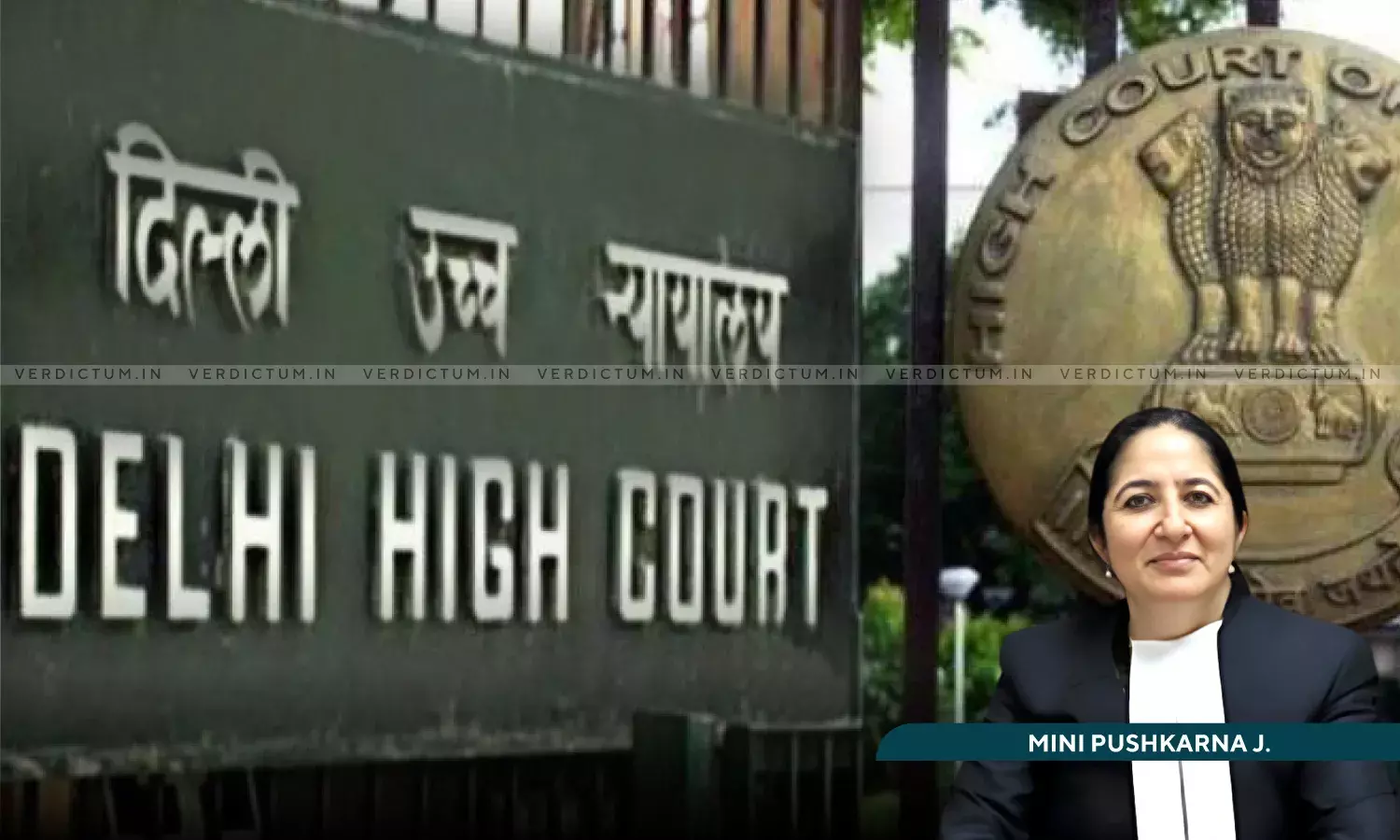
Justice Mini Pushkarna, Delhi High Court
The Delhi High Court observed that a party by merely stating that an HUF exists, without providing any material facts towards the same, would amount to a party attempting to circumvent the provisions of Order VII Rule 11 of CPC, by way of clever drafting.
The High Court was considering an application filed under Order VII Rule 11 read with Section 151 of the Code of Civil Procedure, 1908 (CPC), by the defendants seeking rejection of the plaint, on various grounds. The suit in this case was filed for partition, declaration and permanent injunction in relation to the property owned by one Late Brahm Dutt.
The Single Bench of Justice Mini Pushkarna stated, “It is settled law that under Order VII Rule 11 of CPC, it is to be seen, whether the plaint discloses any cause of action, and whether, there is any cause of action in favour of the plaintiff. In the present case, even when the plaint is read as a whole, apart from the mere averment of existence of an HUF, there is nothing which indicates that the HUF actually existed, or the suit land was part of an HUF. Thus, the plaint itself does not provide for a cause of action."
"It is noted that a party by merely stating that an HUF is existing, without providing any material facts towards the same, would clearly tantamount to a party attempting to create an illusory cause of action in view to circumvent the provisions of Order VII Rule 11 of CPC, by way of clever drafting", it added.
Advocate Vikas Kumar represented the Plaintiff, while Advocates N.S. Dalal represented the Defendant.
Arguments
It was the case of the applicants/defendants that the suit was barred by provisions of the Delhi Land Reforms Act, 1954 (DLR Act), as the right in the property in question had accrued in favour of the male lineal descendants on the basis of the DLR Act, in the year 2002, upon the death of the erstwhile Bhumidhar, i.e., Late Brahm Dutt. Further, at the time of the death of Brahm Dutt, the DLR Act was in force, and as per Section 50 of the said Act, the succession had to happen only in favour of the male descendants, i.e., Ram Kumar and Raj Kumar, whose legal representatives were the defendants.
It was the case of the plaintiff that she is a Class-I legal heir of Late Brahm Dutt, who had died intestate in 2002. On account of the suit property being under an HUF, the plaintiff, as a member of the said HUF, was entitled to her share in the suit property.
Reasoning
On a perusal of the facts of the case, the Bench noted that the provisions of the DLR Act were applicable at the time of death of the father of the parties in the year 2002 and in view of the provisions of the Act, upon the death of Brahm Dutt, the succession of the said land, being an agricultural land, was governed in terms of Section 50 of DLR Act. The Bench explained that upon the death of a Bhumidhar, his interest in the holding would devolve in order of succession as given in Section 50 of the DLR Act. As per Clause (a) of Section 50 of the DLR Act, the agricultural land would be inherited by the male lineal descendants in the male line of descent. “Therefore, once the male lineal descendants are available, then the land will devolve only as per Clause (a) of the said Section”, it added.
The Bench noted that the suit property was inherited by the said two sons of Late Brahm Dutt, i.e., the brothers of the plaintiff. As per the Bench, upon such inheritance, the said two sons of Late Brahm Dutt became the absolute Bhumidhars of the said land. The Bench further held that any succession opening on September 9, 2005 or afterwards, would be governed only by the provisions of HSA, and not by the provisions of the Delhi Land Reforms Act. However, considering that the succession had already opened on November 30, 2002, when Late Brahm Dutt died, the Bench stated that the governing provision then for the law of succession for an agricultural land was the DLR Act. As succession had already taken place on November 30, 2002, the Bench noted that as per Section 50 of the DLR Act, bhumidhari rights came to be possessed only by his two sons, being the only two male lineal descendants.
The Bench also clarified that since the suit land was not an HUF property, Section 6 of the HSA, as amended in the year 2005, was not applicable. The Bench further held that the fact that the suit land was subsequently acquired by DMRC in the year 2016, or if the village in which the suit land was situated was urbanised in the year 2017, would have no effect and would not confer any rights in favour of the plaintiff. “A settled position in law on the basis of law operating at the material time, cannot be unsettled by subsequent events”, it added.
Thus, allowing the application, the Bench rejected the plaint under the provisions of Order VII Rule 11 of the CPC.
Cause Title: Santra Devi v. Santosh Kaushik (Neutral Citation: 2026:DHC:4990)
Appearance
Plaintiff: Advocates Vikas Kumar, Lakshita Bansal
Defendant: Advocates N.S. Dalal, Nidhi Dalal, Alok Kumar, Rachana Dalal, Karan Mann