

Breaking: Delhi High Court Proposes To Shift Sonam Wangchuk To Medanta Hospital; To Pass Order Today
Hearing the appeal against a Single Judge’s order, the Division Bench examined medical records and doctors' opinions regarding Wangchuk’s health following his prolonged hunger strike.

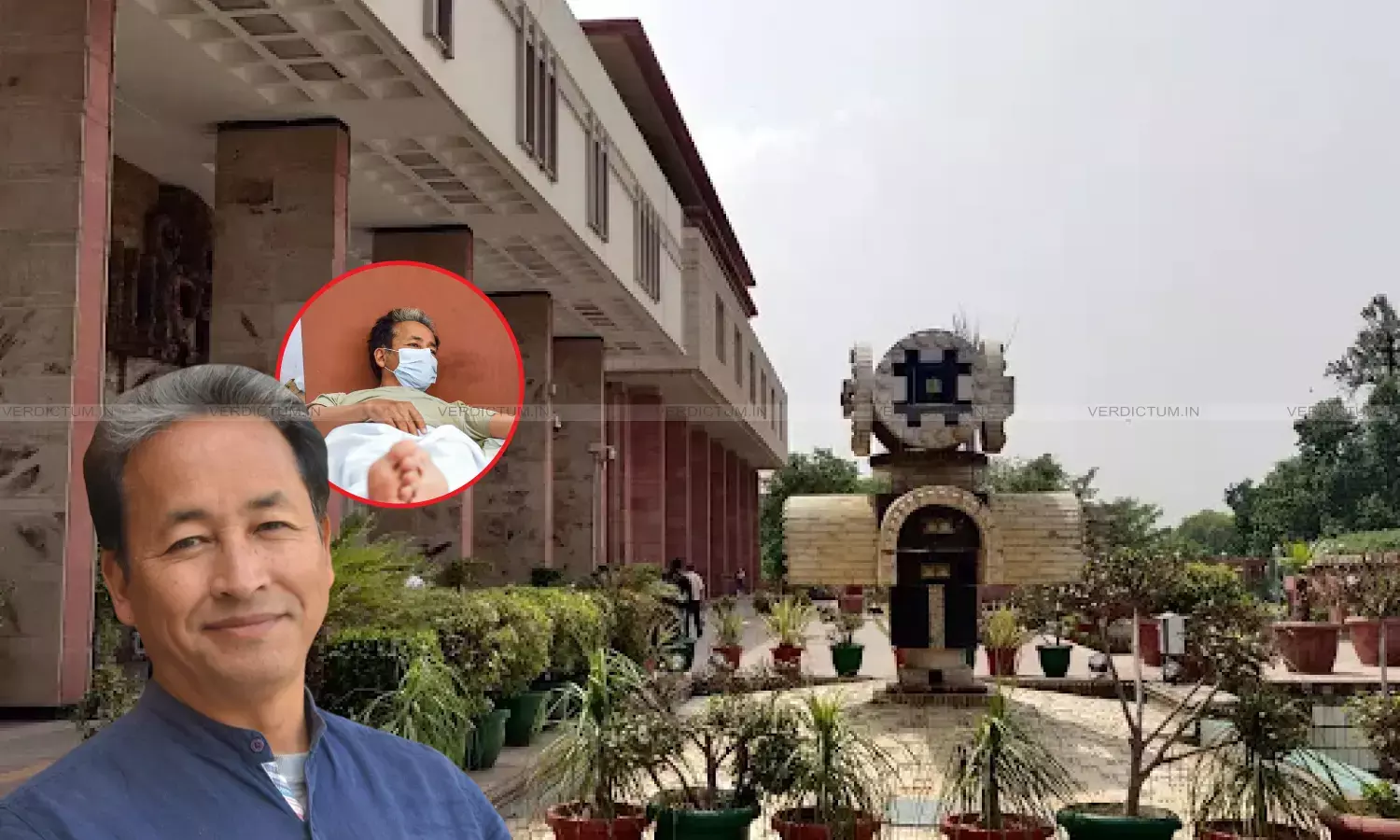
The Delhi High Court has proposed to allow activist Sonam Wangchuk to be shifted from Safdarjung Hospital to Medanta Hospital and stated that the Court will pass its order after lunch hours.
Hearing the appeal against the refusal of interim relief yesterday, the Division Bench issued directions to verify conflicting medical claims regarding activist Sonam Wangchuk.
The Court had ordered the Director of Safdarjung Hospital to file an affidavit placing on record all pathological reports from Safdarjung, AIIMS, and private labs, alongside all health bulletins. The appellant was similarly directed to submit private test reports, including recent blood and urine analyses.
The Division Bench of Chief Justice Devendra Kumar Upadhyay and Justice Tejas Karia said, "What we propose to do is get him shifted to the hospital of his choice, that is Medanta. He will be treated by the Medanta's doctor and all the treatment details, not the treatment details, not just discharge summary, everything which has been done at Safdarjung hospital will be supplied to Medanta immediately, and he will be treated there in accordance with the panel of doctors to be formed by the director Medanta...We will pass the order after lunch."
Senior Advocate Akhil Sibal appeared for the Appellant, while Solicitor General Tushar Mehta appeared for the Respondents.
The entire legal dispute originated when authorities shifted Wangchuk from his hunger strike site to Safdarjung Hospital in New Delhi, citing grave concerns over his health following a prolonged fast of approximately 17 to 18 days. His wife subsequently approached the Delhi High Court to challenge his confinement and seek his transfer to a private hospital.
During the hearing, Senior Advocate Akhil Sibal, appearing for Angmo, submitted an affidavit containing medical reports and a medical opinion, including a letter from the doctor who had treated activist Sonam Wangchuk during his hunger strike.
Responding to Justice Karia's query about a sample submitted the previous night, Sibal confirmed the submission, while Solicitor General (SG) Tushar Mehta informed the bench that the required medical team was present in court as instructed. Justice Karia noted that Wangchuk’s potassium levels had dipped again, following which the Chief Justice requested the government's affidavit, which was handed over by the Additional Solicitor General (ASG). The Court then reviewed the submitted documents in the physical presence of the appellant, Gitanjali Angmo.
Addressing the clinical details, SG Mehta argued that clinical observation generally carries more weight than test reports alone. Chief Justice Upadhyaya examined Sibal's report and questioned the attending doctors about elevated urea and uric acid levels, asking if they indicated organ malfunction. A doctor explained that in the absence of glucose intake, the body breaks down fat as an energy source, leading to ketones in the urine and resulting in changes that are natural after prolonged fasting.
When Sibal highlighted that two private doctors had continuously treated and consulted Wangchuk during his fast, one of the doctors began detailing his professional credentials, prompting SG Mehta to interject that the doctor was present strictly to assist the Court on medical facts rather than advocate for the petitioner.
In response to the Bench questioning whether private doctors are permitted to visit patients in government hospitals, the doctor confirmed it was allowed, and Sibal added that it could be done with the patient's consent.
The ASG subsequently pointed out an alarming finding in the private report, noting that a critical total leukocyte count (TLC) could trigger shock. The Chief Justice then called upon the expert doctor from AIIMS who had been attending to Wangchuk alongside the Safdarjung Hospital team to review the report.
Examining the findings, the AIIMS doctor informed the Court that the white blood cell (WBC) count was low, which was abnormal and indicated reduced immunity, adding that his hemoglobin, WBC, and platelet levels were all outside the normal range.
Addressing the specific blood parameters, a treating doctor explained that a hemoglobin level of 11 g/dL for an adult male was low, leaving the patient significantly more susceptible to infection due to weakened immunity. The doctor highlighted that for someone residing in Ladakh, normal hemoglobin levels were expected to be substantially higher.
During the proceedings, the Director of AIIMS appeared in person following the Court's earlier request. Chief Justice Upadhyaya inquired if the Director had reviewed the test findings and the medical opinion submitted by Dr. Khakkar, who had been attending to Sonam Wangchuk. Solicitor General Tushar Mehta interjected, arguing that any medical opinion formed without a direct clinical examination might not be fully accurate.
The AIIMS Director confirmed that Wangchuk’s potassium levels were indeed on the lower side, but noted that active medical intervention was underway as the patient was taking oral potassium replacements. The Director emphasized that Wangchuk’s ability to mount an immune response against potential infections was severely impaired. Consequently, the hospital had enforced strict infection control protocols, requiring anyone visiting him to be fully gowned, capped, and masked.
Responding to these medical concerns, Senior Advocate Akhil Sibal reiterated that Wangchuk’s vital signs remained stable despite the observed parameter fluctuations. Sibal stated that ongoing medical monitoring was acceptable and could continue without objection from the petitioner.
Earlier, on July 19, 2026, the Single Judge bench of Justice Mini Pushkarna considered the writ petition filed by Wangchuk’s wife under Article 226 of the Constitution, which sought his transfer from Safdarjung Hospital to Medanta Hospital in Gurugram or another facility of his choice.
Declining to grant interim relief to transfer him, Justice Pushkarna observed prima facie that the state’s intervention did not constitute arbitrary action, unlawful detention, or a violation of personal liberty, as it was carried out in good faith to protect his life. The Single Judge held that the attending medical team at Safdarjung Hospital would retain final decision-making authority under strict medical protocols, noted the state’s assurance to share medical reports with the family, and scheduled the main petition for July 24, 2026.
Prior to the Single Judge's hearing, a Division Bench observed on July 16, 2026, that every citizen's life is precious and directed the government to ensure Wangchuk's health parameters were monitored clinically on a daily basis, instructing authorities to take whatever medical steps were necessary to check his deteriorating condition.
Cause Title: Gitanjali J Angmo v. Union of India & Ors. [LPA 539/2026]