

Intention To Provoke Suicide Cannot Be Inferred From Deceased’s Attribution Of Responsibility Alone: Delhi High Court Discharges Husband In Anissia Batra Case
The Bench noted that Section 113A presumption cannot supply the foundation of the offence; affirmed discharge of husband under Section 304B and of in-laws, citing absence of dowry nexus and particulars.

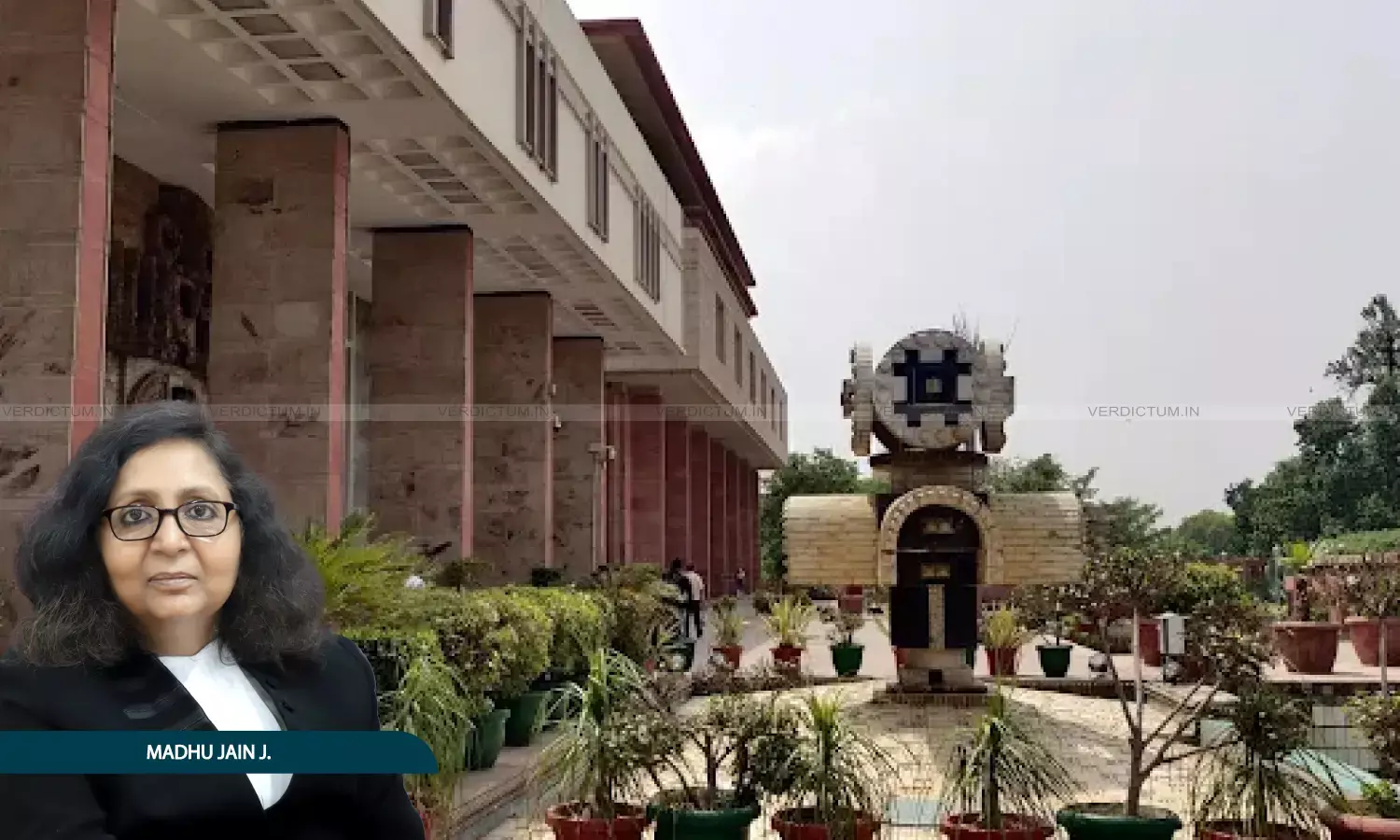
Justice Madhu Jain, Delhi High Court
The Delhi High Court has held that the final message of Anissia Batra, who died on July 13, 2018 after a fall from the terrace of her matrimonial home in Panchsheel Park, holding her husband responsible for her decision to die cannot, by itself, show that he intended to provoke her suicide. The Court observed that her blame is relevant but does not substitute for the ingredients of abetment.
The case, which has been before the courts since an FIR was registered on July 14, 2018, drew revision petitions from her mother, the State and the husband, and tested how far a deceased’s last message can sustain a charge of abetment of suicide.
The Bench held that the presumption under Section 113A of the Evidence Act cannot supply the foundation of the offence. She affirmed the discharge of Mayank Singhvi under Section 304B IPC and of his parents under Sections 304B and 498A, and set aside the charges against him under Sections 306 and 498A of the IPC. The Court stressed that it was testing only whether the material raised grave suspicion at the charge stage.
A Bench of Justice Madhu Jain observed, “…the confinement in question might have been a source of distress on her account and its proximity to the death also gives it evidentiary significance, but it does not automatically establish that the restraint was imposed to instigate or facilitate suicide of the deceased by Mayank Singhvi. Had there been an express exhortation to such effect, the case would have been at a position to be assessed differently, but presently as the material exists, nothing of the kind has been brought to the attention of this Court. The message establishes at best, that the deceased blamed Mayank for her decision to end her life, but it does not provide a sufficient basis to infer that, he intended to provoke her into committing suicide. Such an intention cannot be inferred from her attribution of responsibility alone”.
“…The allegations arising from the email therefore do not sustain the charge under Section 306 IPC merely because they describe conduct which caused distress or may otherwise attract scrutiny under the law relating to matrimonial cruelty”, it noted.
Senior Advocates Rebecca M. John and Vishal Gosain appeared for the petitioner and Senior Advocates Siddharth Aggarwal and Amit Chadha appeared for the respondent.
Anissia Batra married Mayank Singhvi on February 23, 2016 and died on July 13, 2018 after falling from the terrace of the matrimonial home. An FIR was registered at Police Station Hauz Khas under Section 304B on her mother’s statement, and a charge-sheet under Sections 304B and 498A read with Section 34 followed.
On December 18, 2019, the Additional Sessions Judge, Saket Courts, discharged the husband under Section 304B and directed charges under Sections 498A and 306. The parents-in-law were discharged under Sections 304B and 498A. The mother, the State and the husband filed revision petitions.
On Section 306, the Court said the final message of July 13, 2018 established at best that she blamed her husband. The Bench had held that attribution cannot replace instigation or intentional aid. It also noted the deceased’s messages on her finances, her treatment for depression, and the record of reciprocal conflict. It added that the possibility of an accidental fall could not be ruled out, but treated this only as an additional circumstance.
On dowry, the Court found that her detailed email of June 23, 2018 and the property communications disclosed no dowry demand or nexus. It held that cruelty must be independently disclosed before Section 113A can operate. For the parents-in-law, it found the allegations collective and cautioned against omnibus allegations against relatives.
“Section 113A of the Evidence Act does not supply an automatic answer in favour of the prosecution either. Even assuming the allegations of cruelty only for the purpose of considering that provision, the inference of abetment must be drawn with regard to all the circumstances. Here, the financial allegations, the earlier disputes and the events of the last day have each been examined, and their cumulative effect has also been considered. They disclose the deceased’s distress and her attribution of responsibility, but do not provide sufficient grounds to infer abetment. The permissive presumption cannot be used to dispense with that assessment, merely because the suicide occurred within seven years of marriage”, the Bench noted.
“So considered cumulatively, the record discloses a deeply distressed matrimonial relationship, allegations and counter-allegations, harsh exchanges, prior allegations of assault and an unresolved dispute shortly before the fall. It also records reciprocal conflict, contemporaneous efforts at treatment and counselling, discussions concerning separate accommodation and property, and repeated attempts at reconciliation. Applying the distinction between suspicion simpliciter and grave suspicion explained by the Supreme Court in Union of India v. Prafulla Kumar Samal (supra) and Sajjan Kumar v. CBI (supra), and considering these circumstances together, without treating the latter as disproving the former or the final attribution as conclusive of statutory cruelty, this Court is of the opinion that the material does not raise grave suspicion of the particular offence contemplated by Explanation (a)”, it noted further.
The petitions by the mother and the State were dismissed, and the husband’s petition was allowed, and the charges framed on February 5, 2020 were set aside.
Cause Title: Nillum Batra v. State & Ors. (Neutral Citation: 2026:DHC:9804)
Appearances:
Petitioner: Senior Advocates Rebecca M. John and Vishal Gosain, with Anushka Baruah, Pranav Das and Pravir Singh, Advocates.
Respondent: Meenakshi Dahiya, APP, Senior Advocates Siddharth Aggarwal and Amit Chadha, with Pankaj Baghla, Vismita Diwam, Gurpreet Singh, Siddhant Saraswat, Manjit Walia and Harjas Singh.