

NCTE Recognition Applications Cannot Bypass Preliminary Scrutiny And Proceed Directly To Inspection: Delhi High Court
The Court modified orders requiring immediate inspection of teacher-training institutions and directed the Western Regional Committee to first reconsider their transition applications under Regulation 7(1), with an opportunity to cure document-related deficiencies.
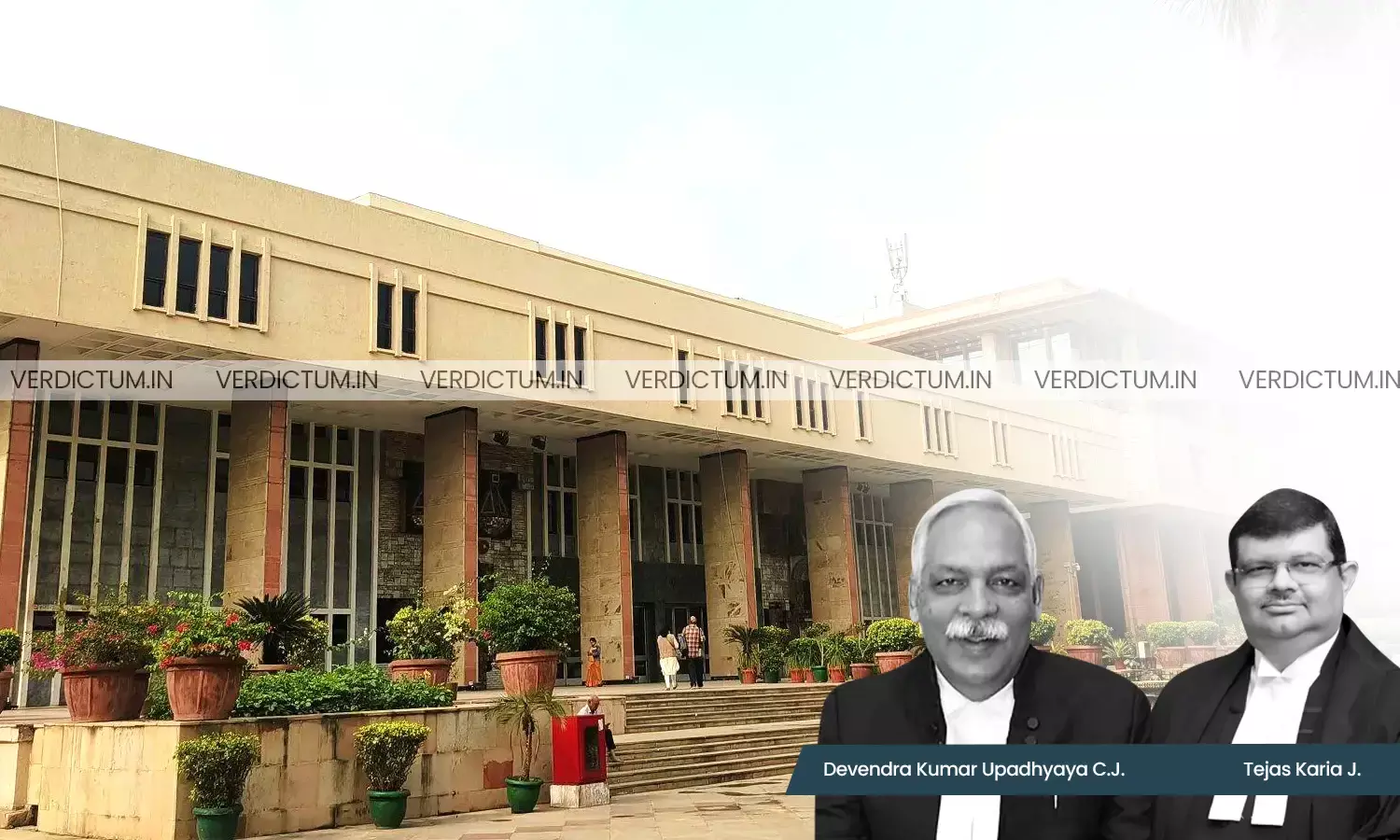
Chief Justice Devendra Kumar Upadhyaya, Justice Tejas Karia, Delhi High Court
The Delhi High Court has held that an application for recognition under the National Council for Teacher Education regulatory framework cannot proceed directly to inspection without first undergoing preliminary scrutiny for completeness and the requisite documents.
The Court clarified that scrutiny under Regulation 7(1) of the National Council for Teacher Education (Recognition Norms and Procedure) Regulations, 2014, and inspection under Regulation 7(7) operate at distinct stages.
The Court was hearing a batch of intra-court appeals filed by the National Council for Teacher Education and its Western Regional Committee against Single Judge orders setting aside the refusal of applications submitted by teacher-training institutions seeking transition to the Integrated Teacher Education Programme. The Single Judge had directed the NCTE to inspect the institutions and complete the adjudication process.
A Division Bench of Chief Justice Devendra Kumar Upadhyaya and Justice Tejas Karia observed:
“Regulation 7(1) cannot be construed to mean that every application, irrespective of whether it is complete and accompanied by the requisite documents, must necessarily proceed to an inspection. Such an interpretation would render the scrutiny contemplated under Regulation 7(1) otiose. Accordingly, where a document required to accompany an application has not been furnished, or where the application is otherwise incomplete, the concerned Regional Committee is required to deal with the application in accordance with Regulation 7(1).”
Advocate Anuj Kapoor appeared for the NCTE. Senior Advocate Sanjay Sharawat appeared for the respondent institutions.
Background
The respondent institutions were recognised by the NCTE’s Western Regional Committee to conduct four-year integrated B.A. B.Ed. or B.Sc. B.Ed. programmes.
Following the National Education Policy, 2020, the NCTE initiated the transition of existing integrated teacher-education courses into the Integrated Teacher Education Programme. The institutions submitted online applications seeking transition for the 2026–27 academic session.
After scrutiny under Regulation 7 and the applicable standard operating procedure, the Western Regional Committee issued preliminary and final show-cause notices identifying deficiencies. Upon considering the replies and uploaded documents, it concluded that the institutions had failed to satisfy multiple statutory and regulatory prerequisites and refused their applications.
The Single Judge set aside the refusal orders and directed the NCTE to inspect the institutions before completing the show-cause and adjudication process.
The NCTE argued that the identified deficiencies included both threshold documentary deficiencies under Regulation 7(1) and matters requiring inspection under Regulation 7(7). It contended that the Single Judge’s reliance on Vision College of Teachers Training v. NCTE (2026) could not dispense with preliminary scrutiny. It further submitted that multidisciplinary-institution status was a mandatory preliminary requirement and sought reconsideration under Regulation 7(1) within the time-bound framework referred to in Maa Vaishno Devi Mahila Mahavidyalaya v. State of Uttar Pradesh (2013).
The institutions contended that some grounds appearing in the refusal orders had not been communicated in the show-cause notices, thereby denying them a meaningful opportunity to respond. They submitted that deficiencies concerning infrastructure could not be conclusively determined without inspection and that further delay would prejudice their applications for the approaching academic session.
Court’s Observations
The Court examined the scope of scrutiny permissible under Regulation 7(1) before an application reaches the inspection stage contemplated under Regulation 7(7).
The Court explained that Regulation 7(1) requires an application to be treated as incomplete and rejected when it is incomplete or is not accompanied by the requisite documents. Regulation 7(7), by contrast, provides for an inspection by a team of experts through virtual mode to assess an institution’s preparedness to commence the course.
The Court observed: “The two provisions, therefore, operate at distinct stages of the process.”
The Court held that requiring every application to proceed to inspection, irrespective of its completeness, would render Regulation 7(1) scrutiny meaningless. It therefore concluded that the Regional Committee must first examine whether an application is complete and supported by the required documents.
The Court clarified that documentary scrutiny cannot conclusively determine every type of deficiency. Where a deficiency concerns physical infrastructure or another aspect of institutional preparedness requiring verification, Regulation 7(7) expressly contemplates an inspection.
The Court observed: “Insofar as deficiencies relating to the physical infrastructure or other aspects of an institution’s preparedness are concerned, and where such deficiencies, by their nature, require verification, Regulation 7(7) expressly contemplates an inspection ‘with a view to assess the level of preparedness of the institution to commence the course’.”
The Court found that the show-cause notices and refusal orders in the present cases contained deficiencies of different kinds. Some concerned documents required to establish the institutions’ eligibility, while others related to infrastructure and preparedness ordinarily requiring verification through inspection.
The Court noted that in Vision College of Teachers Training v. NCTE (2026), the Single Judge had treated deficiencies concerning teaching staff and physical infrastructure as matters determinable only through inspection.
The Court, however, clarified that a direction for inspection on such grounds does not dispense with the independent scrutiny required under Regulation 7(1). It noted that the decision in Vision College itself construed Regulation 7(1) as permitting rejection where an application was incomplete or was not accompanied by the requisite documents.
The Court held: “Accordingly, the setting aside of Refusal Orders on the ground that they included deficiencies capable of determination only upon inspection would not result in the Transition Applications proceeding directly to inspection, bypassing Regulation 7(1).”
The Court added that the transition applications must first be considered under Regulation 7(1). Only applications found complete and accompanied by the necessary documents could proceed further under Regulation 7.
The Court directed the Western Regional Committee to scrutinise the transition applications under Regulation 7(1) within two weeks.
The Court held that if an application was incomplete or deficient concerning a document required to accompany it, the Committee must identify and communicate the specific deficiency to the institution and provide a reasonable opportunity to rectify it.
The Court further directed that applications found complete must thereafter be processed under the NCTE Regulations, including Regulation 7(7), wherever applicable.
The Court stated: “If the WRC proposes to take an adverse decision on a ground not previously communicated to the concerned Respondent-Institution, it shall afford that institution a reasonable opportunity to respond.”
The Court also directed that the institutions would not be required to deposit a fresh application fee for reconsideration pursuant to the judgment.
Conclusion
The Court modified the Single Judge’s direction requiring the institutions to be inspected immediately and prescribed a phased schedule for processing the applications.
The Court directed the Western Regional Committee to complete preliminary scrutiny within two weeks and give the institutions one week to rectify communicated documentary deficiencies. It granted the Committee three further weeks to consider the replies, decide whether each application should proceed to inspection and, where inspection was considered necessary, complete it.
The Court also fixed timelines for communicating deficiencies found after inspection, receiving the institutions’ replies, deciding whether to issue letters of intent, assessing compliance with the prescribed conditions and taking a final decision on recognition. The entire process was directed to culminate in a final recognition or refusal decision by February 10, 2027.
The Court clarified that these timelines would operate as outer limits. Where any stage was completed earlier, the Committee was directed to proceed immediately to the next applicable stage without waiting for the prescribed period to expire.
The Court directed strict adherence to the prescribed schedule, prohibited the demand for any fresh application fee and ordered the NCTE to complete the final recognition process by February 10, 2027.
The appeals and pending applications were disposed of without costs.
Cause Title: National Council for Teacher Education and Another v. Shri Taijal B.A. B.Ed. Integrated College and Connected Matters (Neutral Citation: 2026:DHC:8548-DB)
Appearances
Appellants: Anuj Kapoor, Nandeesh Nanda, Puneet Kumar and Asra H. Rashid, Advocates
Respondents: Sanjay Sharawat, Senior Advocate; Akhilesh Kumar Srivastav, Gaurav Arora, Mayank Manish, Ravi Kant, Vineet Upadhyay, Amitesh Kumar, Priti Kumari, Vipasha Jain and Shubhanshu Mishra, Advocates
