Post-Incident Conduct Relevant To Assess Intention: Delhi High Court Acquits Husband Accused Of Attempting To Murder Wife
The Court found that the medical and forensic material did not conclusively support the prosecution's case of forcible administration of insecticide, and that the evidence was too shaky to sustain conviction.
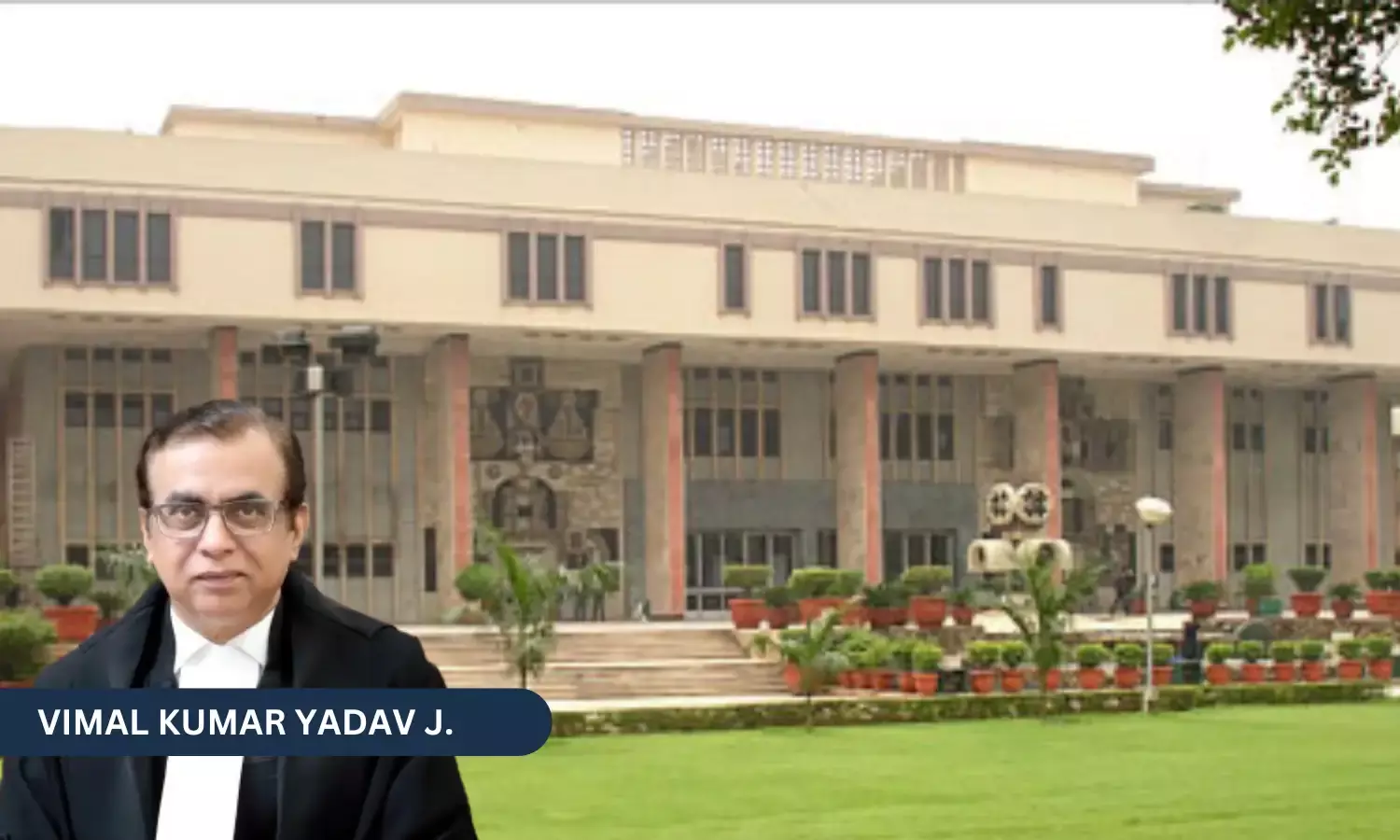
Justice Vimal Kumar Yadav, Delhi High Court
The Delhi High Court, while stating that the conduct of the accused immediately after the incident is a relevant circumstance while assessing intention or knowledge under Section 307 of the IPC, acquitted a husband accused of attempting to murder his wife by allegedly forcing her to consume Baygon insecticide.
The Court was hearing a criminal appeal challenging the Trial Court’s judgment convicting the appellant under Section 307 IPC and sentencing him to rigorous imprisonment for three years with fine, after he and his mother had been acquitted of the charge under Section 498A of the IPC.
A Bench of Justice Vimal Kumar Yadav observed: “Another circumstance which cannot be ignored is the conduct attributed to the Appellant immediately after the occurrence. The material available on record indicates that the victim was promptly taken to Sunder Lal Jain Hospital where medical treatment was arranged. Such conduct, though not by itself determinative of innocence, is nevertheless a relevant circumstance while examining the ingredients of Section 307 IPC. Criminal liability under Section 307 IPC is to be determined from the intention of the accompanying act, and post-occurrence conduct, which cannot be ignored while appreciating such intention.”
Advocate Sanjay Suri appeared for the appellant. Additional Public Prosecutor Satinder Singh Bawa appeared for the State.
Background
The prosecution case was that, during matrimonial discord, the appellant first tried to administer Baygon spray to his wife through a tumbler and, after she resisted, allegedly poured the substance directly from its container into her mouth.
The victim was taken to Sunder Lal Jain Hospital in a PCR vehicle. Her statement before the Sub-Divisional Magistrate led to registration of the case under Sections 498A and 307 of the IPC. After trial, the appellant and his mother were acquitted of the cruelty charge, but the appellant was convicted for attempt to murder.
The appellant argued that the case arose out of matrimonial discord, that the medical record did not support poisoning, that the gastric lavage did not reveal poison, and that he had informed the police and arranged for the victim’s treatment. The State supported the conviction, relying on the victim’s testimony and the circumstance that she had vomited in casualty.
Court’s Observations
The Court found that the medical and forensic evidence did not give complete assurance to the prosecution version.
The Court observed: “From the contentions raised by the rival sides and the material on record, one thing which very distinctively emerges on record is that the medical and forensic evidence is not available as it ought to have been. The victim was taken to the hospital by PCR vehicle where, on her initial examination, her parameters were all normal having no symptoms of any kind of poisoning.”
It further noted: “The gastric lavage of the victim was taken and sent for the forensic examination where no trace of any poisonous substances was found, as can be seen in the FSL Report.”
Referring to Hari Singh v. Sukhbir Singh and Others (1988), the Court said the central question under Section 307 IPC was whether the act was accompanied by the requisite intention or knowledge.
The Court observed: “It can be seen that it is the intention and the requisite knowledge, which is of utmost importance irrespective of the injury. Bare reading of Section 307 IPC clearly indicates that injury is not necessary but some act should be there.”
It added: “As such, it is to be ascertained that the act was accompanied by the requisite intention or knowledge. Intention or knowledge is something which is intangible and abstract confined within the realm of human mind, wrapped in invisible drapes and therefore, it is difficult to ascertain, as to what exactly was playing in the mind of a person.”
The Court said the victim’s testimony, though important as that of an injured witness, still had to be examined with the surrounding circumstances.
The Court held: “Being the injured witness, her testimony undoubtedly commands due weight. At the same time, it is equally well settled that the testimony of an injured witness, though entitled to great evidentiary value, is not immune from Judicial scrutiny and has to be tested on the anvil of the surrounding circumstances and the medical and scientific evidence available on record.”
The Court also noticed a discrepancy regarding the alleged Baygon container.
The Court observed: “The Investigating Officer has deposed that the container recovered from the place of occurrence was empty. However, the FSL report records that the container examined by it contained approximately 4 ml of Baygon insecticide. The prosecution has offered no explanation as to how a container described as empty at the time of seizure was found to contain residue when examined by the forensic laboratory.”
It further noted that the Trial Court had itself found inconsistencies in the cruelty and dowry allegations while acquitting the appellant under Section 498A of the IPC.
On cumulative appreciation, the Court held that the prosecution had not proved the ingredients of Section 307 of the IPC beyond reasonable doubt.
The Court held: “Upon a cumulative appreciation of the evidence, this Court finds that the prosecution has undoubtedly established that an altercation had taken place between the parties. However, the evidence falls short of establishing beyond reasonable doubt that the Appellant had forcibly administered Baygon insecticide with the intention or knowledge necessary to attract Section 307 IPC.”
The Court concluded on the evidence: “In view of the foregoing, it is evident that the case of the prosecution lacks cogent evidence about the intention and knowledge as contemplated in Section 307 IPC and for that matter the corroborative evidence is also not forthcoming to support the proposition floated by the prosecution. It is highly unsafe to act upon the kind of shaky evidence brought on record. Appellant is certainly entitled to the benefit of doubt.”
Conclusion
The High Court allowed the appeal and acquitted the appellant of the charge under Section 307 of the IPC. The bail bonds were discharged, pending applications were disposed of, and a copy of the judgment was directed to be transmitted to the Trial Court and prison authorities.
Cause Title: Nafe Singh v. State (Neutral Citation: 2026:DHC:7091)
Appearances
Appellant: Advocates Sanjay Suri, Vinny Shangloo and Rishabh Ratan
Respondent: Additional Public Prosecutor Satinder Singh Bawa
Click here to read/download Judgment