

Children Naturally Attracted To Open Spaces, Can't Be Expected To Recognise Unguarded Manmade Dangers: Delhi High Court Awards ₹16.92L Compensation To Parents Of Drowned 10-Year-Old
The Court held that GNCTD & DJB vicariously liable for contractor's negligence 12 years after child's death, rejected pleas of delay and contributory negligence.

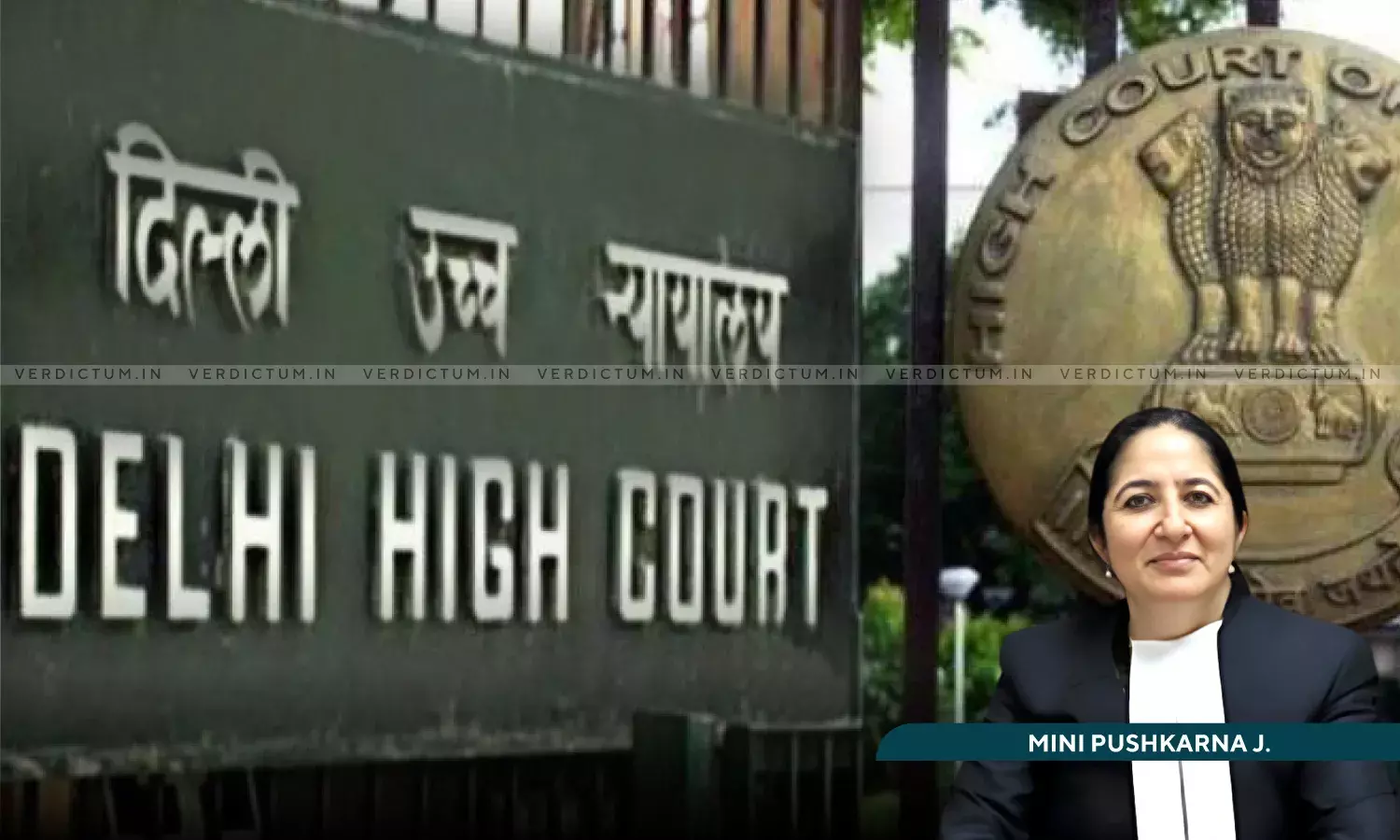
Justice Mini Pushkarna, Delhi High Court
The Delhi High Court has held that public authorities and their contractors owe a higher duty of care to the public, particularly to children who are naturally attracted to open spaces and cannot be expected to recognise manmade dangers left unguarded, while awarding compensation of Rs. 16,92,511.6, together with 9% simple interest from the date of filing of the writ petition, to the parents of a 10-year-old boy who drowned after falling into an uncovered pit at a sewer construction site in 2014.
The Court held that the Government of NCT of Delhi and the Delhi Jal Board are liable to pay the compensation, while leaving open their right to recover the amount from the private contractors and consultants actually executing the project, and rejected the respondents' pleas of delay and laches, disputed questions of fact, and contributory negligence on the part of the child.
The judgment came in a writ petition filed by the parents of the boy under Article 226 of the Constitution of India, seeking compensation for his death by drowning in a pit dug as part of an interceptor sewer project along the Najafgarh, Supplementary and Shahdara drains, undertaken for abatement of pollution in the Yamuna river.
A Bench of Justice Mini Pushkarna observed, “…there is clear negligence on part of the respondents. Standard of care expected from a child is entirely different from that expected from an adult. A ten years’ old child cannot be expected to appreciate the dangers of an uncovered pit or well, in the same manner as an adult. The respondents, who are public authorities and their Contractor, owed a higher duty of care to the public, especially, to children who are naturally attracted to open spaces and who cannot be expected to recognise manmade dangers left unguarded. Hence, the respondents failed to take measures which could have prevented such a mishap and have been clearly negligent”.
Advocate Kartik Venu appeared for the petitioner and Advocate Raghvendra Upadhyay appeared for the respondent.
The deceased child fell into a deep pit storing dirty water at the site of the project, being executed by a contracting consortium (DSCL-Fengshun-Wabag) under a tripartite agreement between the Delhi Jal Board, Engineers India Limited as project management consultant, and the contractor.
An FIR was registered under Section 304A IPC, and a chargesheet was subsequently filed, with charges eventually framed against the contractor. The petitioners contended that the site had no adequate safety measures, no barricading, warning signs, or effective security presence, and that the pit had been left uncovered, notwithstanding that it was situated within an area under the exclusive possession and control of the respondents.
The respondents raised multiple objections: that the petition was barred by delay and laches, having been filed five years after the incident; that it involved disputed questions of fact not amenable to writ jurisdiction; that private respondents such as EIL and the contractor were not amenable to writ jurisdiction; that the individual engineer-respondents were mere employees who could not be personally proceeded against; that the site was private and the deceased had trespassed; and that there was contributory negligence on the part of the child.
Rejecting each of these contentions, the Court held that the criminal proceedings arising from the same incident had continued right up to 2025, and that the petitioners, coming from a poor background, could not be faulted for the delay in invoking the writ jurisdiction, relying on Tukaram Kana Joshi v. Maharashtra Industrial Development Corporation and Others, (2013) 1 SCC 353 and Munni Devi Versus Government of NCT of Delhi and Another, 2021 SCC OnLine Del 46.
On the merits, the Court held that the absence of adequate safety measures, a single security guard posted 250 metres from the site, an uncovered pit, and no barricading or signage, squarely established negligence, and that the respondents were vicariously liable for the failure of their contractors and agencies to maintain the site.
The plea of contributory negligence on the part of the ten-year-old victim was rejected, the Court holding that children of tender years cannot be imputed with contributory negligence and that the standard of care owed to them by public authorities is correspondingly higher.
“…the petitioners’ child had fallen into an uncovered well/shaft and not directly into an open canal/wide drain. Further, in the present case, criminal investigation has been carried out and charges have been framed against the respondents. Additionally, the District Authority Quick Response Team has observed that there were no precautions/warning signs placed near any of the wells, nor were they covered or surrounded by a safety tape. Admittedly, the respondents themselves have stated that ordinarily, the wells/holes/pits used to be covered by them, but at the relevant time they were stolen by locals. Furthermore, in the present case, there is no evidence as to the condition of the boundary wall, but the recording of the FIR clearly suggests the presence of a crowd as well as police officers moving freely at the site in question, thus, suggesting that the boundary wall was either non-existent or broken in various places”, the Bench said.
Applying the two-part compensation methodology of standard compensation and pecuniary loss of dependency laid down in Kamla Devi Versus Government of NCT of Delhi & Anr., 2004 SCC OnLine Del 721, as further refined for minor victims in Kishan Lal and Ors. v. Govt. NCT of Delhi & Ors., the Court computed standard compensation at Rs. 3,42,511.6 after adjusting for inflation using the Consumer Price Index, and pecuniary loss of dependency at Rs. 13,50,000 based on the father's income and a multiplier of 15, arriving at a total of Rs. 16,92,511.6.
The writ petition was accordingly disposed of, with GNCTD and DJB directed to pay the awarded amount with 9% simple interest from the date of filing of the petition, while their right to recover the amount from the other respondents was left open to be agitated in appropriate proceedings.
Cause Title: Mohd. Neejam and Anr. v. The State, Govt. of NCT of Delhi and Ors. (Neutral Citation: 2026:DHC:5986)
Appearances:
Petitioners: Kartik Venu, R Jude Rohit and Arjan Ajai Singh, Advocates
Respondent: Raghvendra Upadhyay, Panel Counsel, Purnima Jain, Shilpa Taneja, Madhur Yadav, Hilal Haider, Neha Tiwari, Abhimanyu Garg, Preety Makkar, Vishal Yadav, Vineet Tayal, Monalika Chaudhary, Advocates.