

Delhi High Court Grants Bail To Alleged Pro-IS Terror Module Member In UAPA Case After 8 Years in Custody
The Court considered the evidence recorded after the trial court rejected bail, finding that it would be unjust to remit the accused for filing a fresh application after his appeal had remained pending for a prolonged period.
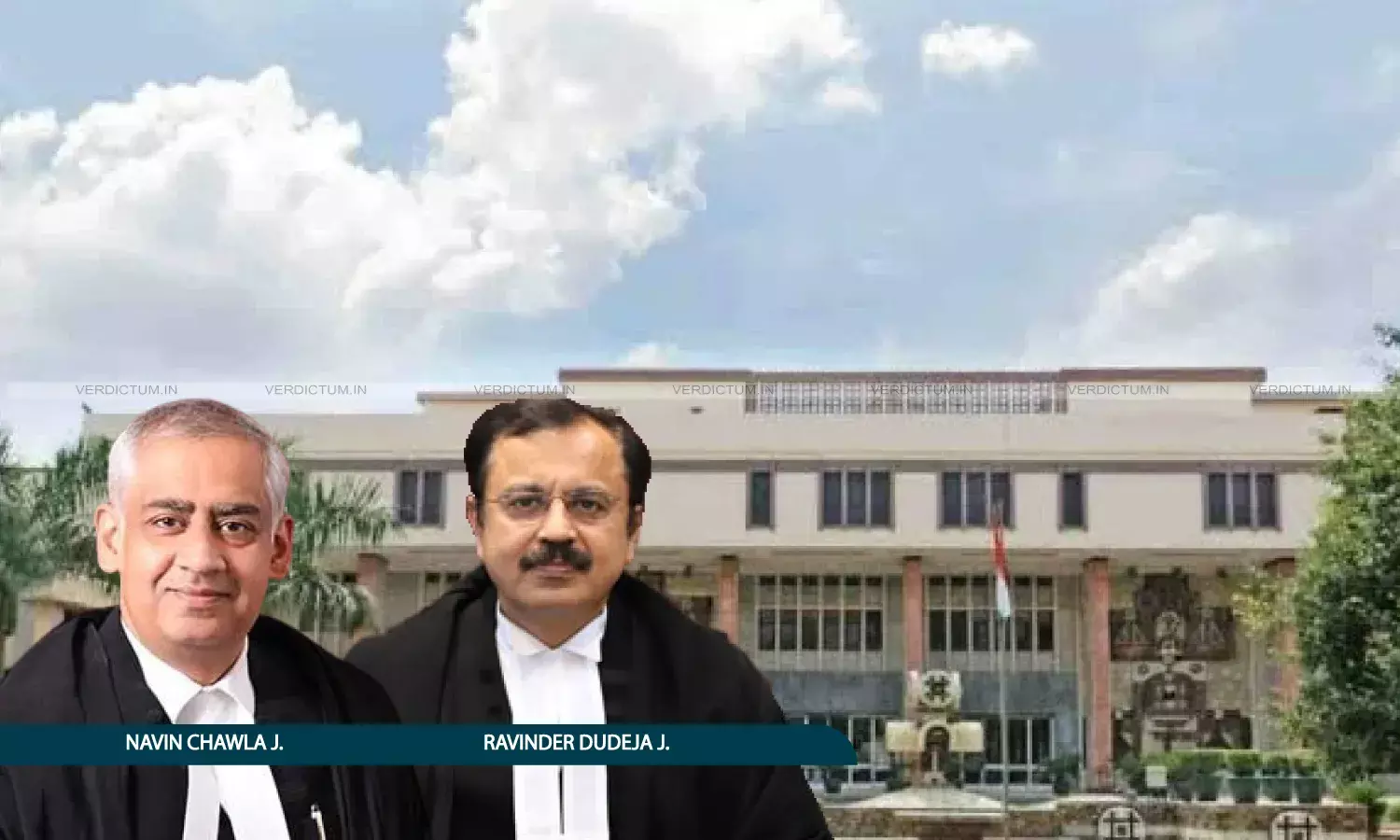
The Delhi High Court has granted bail to a man accused of being a member of the alleged pro-IS group Harkat-ul-Harb-E-Islam after he spent almost eight years in custody while only 40 of the 120 prosecution witnesses had been examined.
The Court found that the trial was unlikely to conclude soon and that the testimony relevant to his alleged role was not grave enough to justify prolonging his pre-trial detention.
The Court was hearing an appeal under Section 21(4) of the National Investigation Agency Act, 2008 challenging an Additional Sessions Judge’s refusal to grant bail in an NIA case involving alleged offences under the Indian Penal Code, 1860, the Unlawful Activities (Prevention) Act, 1967 and the Explosive Substances Act, 1908.
A Bench of Justice Navin Chawla and Justice Ravinder Dudeja observed: “In the present case, the appellant had been taken in custody on 26.12.2018 and has, therefore, remained in jail for almost 8 years. Presently, out of 120 witnesses cited by the prosecution, statements of only 40 witnesses have been recorded. The learned SPP has submitted that the respondent shall be dropping 39 witnesses. Even if that be so, the trial is not likely to end any time soon.”
Advocate Sarim Naved appeared for the appellant; Special Public Prosecutor Rahul Tyagi appeared for the NIA.
Background
The NIA alleged that the appellant was a member of Harkat-ul-Harb-E-Islam, a group stated to support the ideology of ISIS and Jaish-e-Mohammed. He was accused of facilitating contacts for procuring weapons in western Uttar Pradesh and establishing links in Jammu and Kashmir for arranging meetings with militants, training and weapons.
The investigation alleged that the appellant had travelled to Jammu and Kashmir twice with a co-accused and stayed with a previous acquaintance. It also relied upon electronic material and chats allegedly recovered from his mobile devices, besides disclosure statements, pointing-out memoranda and witness testimony.
The appellant submitted that he was not a member of the core module and, at most, had a peripheral role. He contended that the three principal witnesses concerning the Kashmir visits had already testified and that their statements did not establish that he had requested or shown interest in meeting militants.
Seeking bail on account of prolonged incarceration, he submitted that the trial was unlikely to conclude soon. The NIA opposed the appeal by alleging that he had introduced principal members of the module to a person who facilitated procurement of arms, attempted to contact militants for training and possessed incriminating material.
The NIA further contended that the High Court should not consider testimony recorded after the trial court had rejected bail. It submitted that the appellant could instead be given liberty to approach the trial court again on the basis of the subsequent material.
Court’s Observations
The Court referred to its decision in Khuram Parvez v. National Investigation Agency (2026), which examined the balance between the right to a speedy trial under Article 21 of the Constitution and the restrictions on bail under Section 43D(5) of the Unlawful Activities (Prevention) Act, 1967.
It noted that Union of India v. K.A. Najeeb (2021) recognised the power of constitutional courts to grant bail where prolonged incarceration and an unlikely conclusion of trial resulted in a violation of fundamental rights, notwithstanding statutory bail restrictions.
The Court also considered Gulfisha Fatima v. State (Government of NCT of Delhi) (2026), which required the delay inquiry to account for the nature of the allegations, statutory field, stage and realistic trajectory of the trial, causes of delay and risks associated with release.
The Supreme Court had observed: “The constitutional inquiry into delay is not an inquiry into guilt. It is an inquiry into whether continued detention remains constitutionally permissible in the circumstances of the case. That inquiry is necessarily contextual. Context includes the nature of the allegation, the statutory field, the stage of the proceedings, the realistic trajectory of the trial, the causes contributing to delay, and the risks attendant upon release. Delay cannot be detached from these considerations and treated as a solitary determinant.”
The Bench noted that the inquiry under Section 43D(5) must also be specific to the individual accused and examine whether the attributed role demonstrated a real nexus with the alleged unlawful or terrorist activity, as distinguished from peripheral presence or mere association.
The Court recorded that the interplay between Article 21 and Section 43D(5) had been referred to a larger Bench of the Supreme Court in Tasleem Ahmed v. State Government of NCT of Delhi (2026). The order of reference stated that delay could not operate as the sole determinant and had to be assessed contextually.
However, the Court noted that the Supreme Court had granted the accused in that case interim bail after considering the substantial incarceration already undergone.
Relying on Union Territory of Ladakh v. Jammu and Kashmir National Conference (2024), the Court held that a pending reference did not permit the High Court to defer adjudication or disregard the law presently binding upon it. The Supreme Court had clarified: “We make it absolutely clear that the High Courts will proceed to decide matters on the basis of the law as it stands. It is not open, unless specifically directed by this Court, to await an outcome of a reference or a review petition, as the case may be.”
The Court accordingly proceeded to examine the appellant’s bail claim by applying the existing principles governing prolonged incarceration and accused-specific scrutiny.
The Court rejected the NIA’s submission that it should disregard the testimony recorded after the trial court’s refusal of bail and require the appellant to approach the trial court again.
It noted that the appellant had undergone lengthy incarceration and that the appeal itself had remained pending for a considerable period. The appellate proceedings had also been adjourned to facilitate the recording of testimony from witnesses relevant to the appellant.
The Court observed: “In the peculiar facts of the present appeal, we are unable to accept the said submission. We are of the opinion that, given the long period of incarceration of the appellant and the long pendency of the present appeal, wherein, its hearing was in fact adjourned for the learned Trial Court to record the testimony of the witnesses relevant to the appellant (Refer Order dated 08.01.2026 and 07.04.2026), it would not be just and proper for us to not consider the said material and to remand the appellant back to the learned Trial Court.”
The Court therefore examined the testimony of the three principal witnesses relied upon in connection with the appellant’s Kashmir visits.
The Court found no reason to deny bail on the basis of the testimony of the witnesses concerning the Kashmir visits. It deliberately refrained from undertaking a detailed analysis that could prejudice the pending trial.
The Bench observed: “We have intentionally refrained ourselves from giving a detailed analysis of the statements of the witnesses already recorded, as it is likely to prejudice the trial. We may only state that prima facie we do not find them grave enough to prolong the period of detention of the appellant during trial.”
Regarding the allegation that the appellant introduced a principal accused to the person allegedly involved in procuring arms, the Court noted that the prosecution’s case was founded on that person’s alleged disclosure and pointing-out statement.
The Court acknowledged that the electronic chats allegedly recovered from the appellant’s phone were grave. It nevertheless held that, considering the period already spent in custody, they did not justify continued denial of bail.
The Bench concluded: “Having considered the statements of the witnesses and the allegations against the appellant, and being moved particularly by the long period of incarceration of the appellant, we are of the opinion that the appellant has been able to make out a case for being released on bail.”
Conclusion
The Delhi High Court set aside the order rejecting bail and directed the appellant’s release upon furnishing a personal bond of ₹50,000 with two sureties of the same amount.
The appellant was directed to surrender his passport, remain in the country without prior permission and not leave his native district except to attend the trial in Delhi or report to the NIA. He must keep one disclosed telephone number operational, attend the trial unless exempted and report to the NIA’s Lucknow Branch once every fortnight.
The Court restrained him from contacting witnesses, the complainant, co-accused or their family members; tampering with evidence; delaying the trial; making public statements concerning the case; or circulating anti-national material. The prosecution was granted liberty to seek cancellation of bail upon breach of any condition.
The Court clarified that its observations were confined to deciding bail and would not be treated as findings on the merits of the pending trial.
Cause Title: Mohammad Saqib @ Saqib Iftekar v. National Investigation Agency (Neutral Citation: 2026:DHC:7763-DB)
Appearances
Appellant: Advocate Sarim Naved
Respondents: Special Public Prosecutor Rahul Tyagi with Advocates Priya Rai, Avinash Kumar Singh, Priyansh Raj Singh and Amit Rohila
