Suspension Of BCI Enrolment Not Necessary For Advocates Acting As Insolvency Professionals; But Liable To GST Under Forward Charge Mechanism: Delhi High Court
The High Court held that GST liability depends on the nature of the service rendered, not merely on the professional identity of the person rendering it.
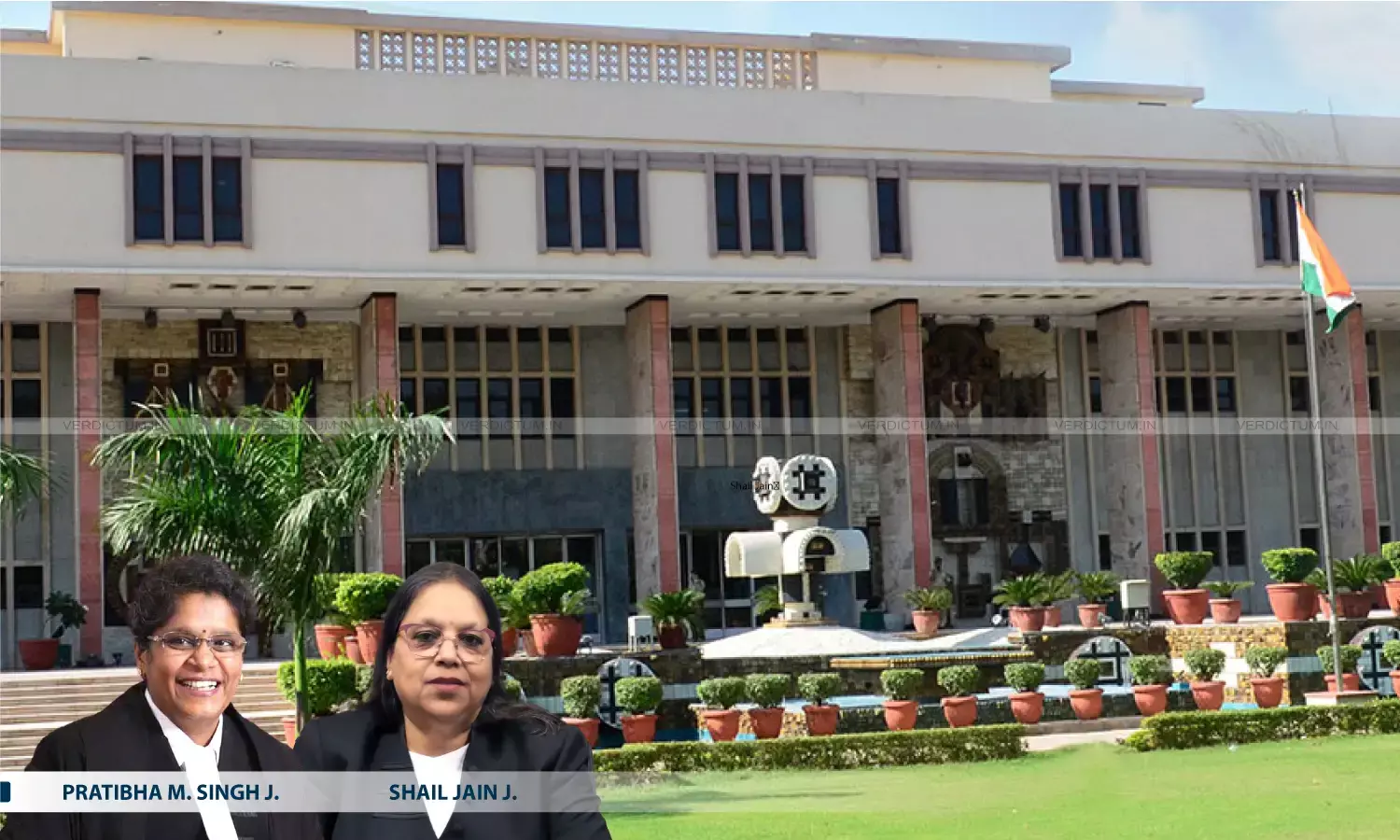
The Delhi High Court, Justice Pratibha M. Singh and Justice Shail Jain
The Delhi High Court has held that advocates enrolled with the Bar Council need not have their enrolment suspended merely because they act as Insolvency Professionals under the Insolvency and Bankruptcy Code, 2016.
The High Court further clarified that such advocates would be liable to GST under the forward charge mechanism for services rendered in that capacity.
The Court was hearing a writ petition filed by an advocate enrolled with the Bar Council of Delhi, who had also registered as an Insolvency Professional and was appointed as an Interim Resolution Professional by the National Company Law Tribunal.
A Bench of Justice Prathiba M. Singh and Justice Shail Jain observed: “… when the IBBI Regulations themselves recognise that an Advocate enrolled with the Bar Council is eligible to be registered as an Insolvency Professional. Far from restricting or disqualifying Advocates from undertaking such registration, the said regulation expressly contemplates and facilitates Advocates to take up this role. The Petitioner’s apprehension, that treating insolvency and receivership services as distinct from legal services would jeopardise an Advocate’s enrolment, cannot be sustained where the legislative and regulatory intent, as reflected in said regulation, is to permit and enable Advocates to render services as Insolvency professionals.”
The Bench added: “…Advocates enrolled with the Bar Council, who act as Insolvency Professionals under the IBC, shall be governed by the ‘forward charge mechanism’. Accordingly, they shall be liable to obtain GST registration, and comply with all consequential requirements under the CGST Act, 2017 and the rules and notifications framed thereunder, in the same manner as is applicable to Insolvency Professionals, as a class.”
Advocate Rajat Navet appeared for IBBI. Advocate Pulkit Deora appeared for the respondents. Senior Standing Counsel Ruchesh Sinha appeared for CGST. Advocate Preetpal Singh appeared for the Bar Council of India.
Background
The petitioner, an advocate practising since 1995, qualified the Limited Insolvency Examination after the enactment of the IBC and was registered as an Insolvency Professional. He was later appointed as an Interim Resolution Professional in a corporate insolvency resolution process.
After certain professional fee invoices remained unpaid, the Resolution Professional informed the NCLT that ₹49,04,988 was payable to the petitioner, but raised the issue of GST-compliant invoices. The petitioner maintained that he was not required to obtain GST registration and that GST, if payable, had to be paid by the Corporate Debtor on a reverse charge basis.
The NCLT sought a clarification from the IBBI on who was liable to deposit GST. The IBBI stated that insolvency and receivership services were not covered under the reverse charge mechanism and required the petitioner to submit GST-compliant invoices. This led to the writ petition before the High Court.
The petitioner argued that advocates are governed by the reverse charge mechanism under the GST regime, that “legal service” includes services in any branch of law, and that an advocate acting as an Insolvency Professional continues to render legal services. He also contended that if insolvency services were treated as distinct from legal services, it could affect an advocate’s enrolment under the Advocates Act and Bar Council of India Rules.
The GST Department, IBBI and Bar Council of India opposed the plea. Their stand was that the tax treatment must depend on the nature of the service and not on the professional status of the person rendering it. They submitted that an Insolvency Professional performs managerial, administrative and regulatory functions under the IBC, and that such services fall under “insolvency and receivership services”, not legal services.
Court’s Observations
The Court first noted that advocates rendering legal services are ordinarily governed by the reverse charge mechanism. However, Insolvency Professionals, as a class, are not covered by the specific categories notified for reverse charge under Notification No. 13/2017-Central Tax (Rate).
The Court observed: “Accordingly, insofar as Insolvency Professionals are concerned, services rendered by them are not separately stipulated under the specific categories of services mentioned in Notification No. 13/2017-Central Tax (Rate). Thereby, the default rule under Section 9(1) of the CGST Act applies. Thus, services rendered by an Insolvency Professional is governed by the ‘forward charge mechanism’.”
The Court held that the Scheme of Classification of Services separately recognises “legal services” and “insolvency and receivership services”. It found that insolvency services cannot be absorbed into legal services merely because the professional rendering them is an advocate.
The Court remarked: “The Scheme of Classification, therefore, itself demonstrates that ‘insolvency and receivership services’ are treated as a distinct category of service, separate from ‘legal services’. This classification, further indicates that the nature of the service rendered by an Insolvency Professional is not, for the purposes of GST, to be equated with or subsumed within ‘legal service’ merely because the person rendering it happens to be enrolled as an Advocate.”
The Bench further underscored that when an advocate acts as an Insolvency Professional, the determinative factor is the role being performed under the IBC.
The Court held: “Applying the aforesaid principles, when an Advocate renders services as an Insolvency Professional, the role in which he acts is that of an Insolvency Professional, and not that of an Advocate. It is this role– that of a provider of ‘insolvency and receivership’ services –that is determinative of the nature of services rendered for the purpose of classification, and NOT the underlying professional qualification or the registration of the individual concerned.”
Rejecting the petitioner’s apprehension that treating insolvency services as distinct would imperil an advocate’s enrolment, the Court held that the IBC and the Advocates Act operate in their respective fields.
The Court observed: “Where another statute, such as the IBC and IBBI regulations permits Advocates to additionally qualify as Insolvency Professionals, it does not derogate from the Advocates Act, 1961. It merely offers another stream or opportunity for Advocates to render more specialised and niche services. Such services may be connected with law, however, this would not mean that Advocates shall, for that reason, always be governed by the Advocates Act, 1961 and the Bar Council of India rules, since there is a separate regulatory mechanism for Insolvency Professionals as a class.”
The Court added that the two statutes must be read harmoniously so that advocates are not prevented from expanding into other legally recognised professional areas. However, while rendering insolvency services, they are governed by the IBC and IBBI Regulations.
The Bench also relied on the stand of the Bar Council of India, which stated that an advocate functioning as an IRP performs services different from conventional legal practice and is liable under forward charge.
The Court recorded that the BCI had affirmed that such services were managerial and professional in nature and did not attract reverse charge mechanism. It concluded that Insolvency Professionals form a distinct class and cannot be treated differently merely because some of them are advocates.
The Court held: “There cannot be any distinction in the manner in which Insolvency Professionals as a class are treated. Thus, even where the Insolvency Professional happens to be an Advocate, the tax regime applicable to services rendered as an Insolvency Professional would be that which applies to Insolvency Professionals, and not that which applies to Advocates.”
It further held: “Thus, the ‘reverse charge mechanism’ applicable to Advocates would not be applicable to services rendered by Advocates as Insolvency Professionals. An Advocate acting as an Insolvency Professional would, therefore, be governed by the ‘forward charge mechanism’, which is applicable to Insolvency Professionals, as a class, and not by the ‘reverse charge mechanism’, which is otherwise applicable to Advocates rendering legal services.”
Conclusion
The High Court held that the IBBI’s clarification reflected the correct position in law and that the challenge to it was not tenable.
The Court concluded that advocates enrolled with the Bar Council who act as Insolvency Professionals under the IBC are governed by the forward charge mechanism and are liable to obtain GST registration and comply with the CGST Act, 2017.
It clarified that this applies only to services rendered by an advocate in the capacity of an Insolvency Professional, and does not alter the GST mechanism applicable to legal services rendered by advocates, which will continue to be governed by the reverse charge mechanism.
The petitioner was directed to furnish GST-compliant invoices for the professional fee charged by him as an Interim Resolution Professional. The petition was disposed of accordingly.
Cause Title: Kanwal Chaudhary v. Insolvency And Bankruptcy Board Of India & Ors. (Neutral Citation: 2026:DHC:6587-DB)
Appearances
Petitioner: Advocates Rajat Navet, Kushagra Pandit and Rajat Rana
Respondents: Advocates Ashish Verma, Nikhil Thakur and Kriti for R-1; Advocates Pulkit Deora, Sagar Pathak and Vinamra Kothari for R-2; Advocate Ajay Kumar Agarwal for R-3; Senior Standing Counsel Ruchesh Sinha, CGST with Advocate Upasna Vashistha; Advocates Preetpal Singh, Simran Kumari and Pooja for BCI; K.V. Jain, Resolution Professional