

Mere Trademark Registration Not Enough To Establish "First Owner" Status Of Copyright In Artistic Work: Delhi High Court
The Court dismissed Japan Tobacco's petition against 'CAMEL COLLECTION' copyright registration; Section 40 and International Copyright Order cannot substitute for proof of first ownership.

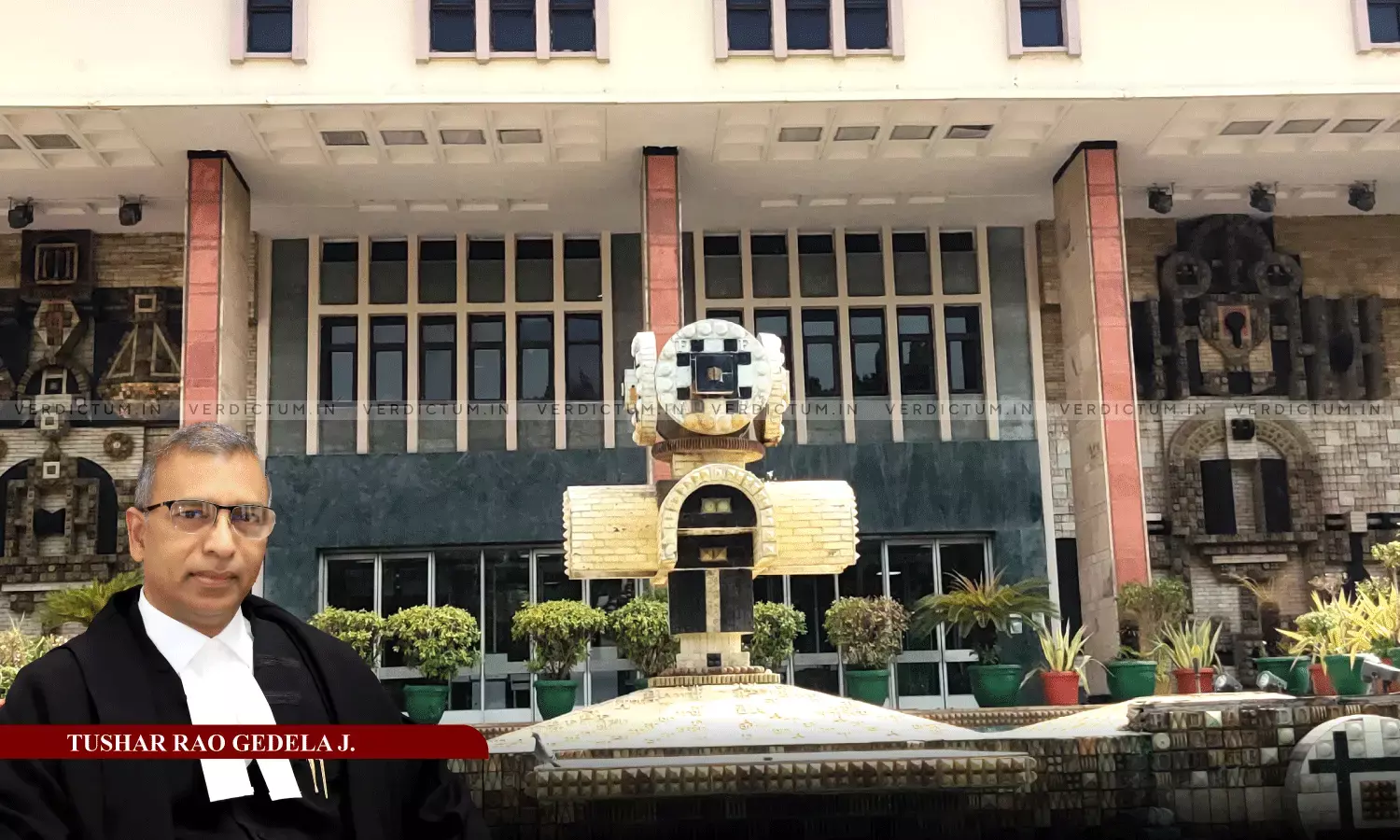
Justice Tushar Rao Gedela, Delhi High Court
The Delhi High Court has held that a party seeking to expunge a copyright registration under Section 50 of the Copyright Act, 1957 must first establish that it is the "First Owner" of the original artistic work by virtue of first publication. Noting that Section 17 of the Act contains no deeming fiction, the Court observed that mere registration of a trademark is not enough to establish its owner as the 'First Owner' of the copyright in the artistic work embodied therein.
Dismissing the rectification petition filed by Japan Tobacco Inc. and Worldwide Brands Inc., the Court held that Section 40 and the International Copyright Order, 1999 deem copyright to be exercisable across borders but cannot help a petitioner overcome the initial burden of proving first ownership. Mere registration of a mark under the Trade Marks Act, while lending some credibility, is not sufficient.
A Bench of Justice Tushar Rao Gedela observed, “…it is unambiguous that an individual or an entity claiming copyrights in an ‘Original Artistic Work’ has to necessarily establish the fact of being the ‘First Owner’ in such copyright. Mere registration of a mark under the Trade Marks Act, 1999, while may lend some credibility, yet, that by itself would not be sufficient to establish the owner of the trademark as the ‘First Owner’ of the copyrights in the artistic work embodied therein. Section 17 of the Act, does not postulate any deeming fiction. Meaning thereby, the assertion has to be established as a fact”.
“While the statutory law, as it stands today read with the International Copyright Order, 1999, do deem that Copyrights are exercisable, sans border, yet, whether the artistic work claimed, is in fact an original artistic work entitled to be vested with copyright, is altogether a different matter. In that, an individual or an entity claiming to be the ‘First Owner’, as postulated under Section 17 of the Act, must, necessarily, establish the assertion as a fact, which would be relevant to the issue at hand. In other words, before the petitioner can seek removal of the registered copyright of respondent no.1 from the Register of Copyrights, it necessarily has to establish that it is the ‘First Owner’ by virtue of ‘First Publication’ of the ‘Original Artistic Work’…”, the Bench said.
Advocate Peeyoosh Kalra appeared for the petitioner and Advocate Navroop Singh appeared for the respondent.
The petitioners claimed ownership of 'CAMEL' artworks, used since 1913 for tobacco and since the late 1970s for non-tobacco goods, through predecessor R.J. Reynolds. They sought to expunge Copyright Registration No. A-54242/97 dated October 22, 1997, in the name of Veena R. Hinduja, claiming first publication in 1992.
They alleged the work was copied from their earlier artworks and trademarks, lacked originality and was registered without compliance with Section 45(1) and the Copyright Rules. The respondent, the proprietor of the 'CAMEL COLLECTION' label, denied copying and contended that the petitioners had no locus, had not sold garments in India and had exited the Indian market.
The petition was filed under Section 50 and was heard along with the connected suit, Japan Tobacco v. D. Jhamnadas, CS(COMM) 644/2018, from which the parties relied on written statements and cross-examination. Counsel for the petitioners relied on Sections 2(d)(iii), 13, 40 and 45(1), Rule 16(3) of the 1958 Rules and Rule 70(a) of the 2013 Rules. The respondent's first-owner defence rested on sales invoices, advertisements and its own trademark registrations.
The Court noted that the petitioners relied solely on three books about the CAMEL brand, whose photocopied pages were neither brought to the Court's attention nor proved in accordance with law, and which the respondent had denied in its affidavit of admission and denial. The burden under Sections 101 to 106 of the Evidence Act therefore never shifted, and Section 48 of the Copyright Act presumes in the respondent's favour. On the respondent's written-statement paragraphs in the suit, the Court held the admissions were not unequivocal, arose in a trademark infringement suit where territoriality applies strictly, and supported only an inference that cannot establish first ownership. The Section 45(1) argument was held academic.
The petition was dismissed. The Court clarified that its observations on the suit do not amount to an expression on its merits.
Cause Title: Japan Tobacco Inc & Anr. v. The Central Warehouse & Anr. (Neutral Citation: 2026:DHC:8713)
Appearances:
Petitioners: Advocates Peeyoosh Kalra, Gaurav Mukerjee, Saumya Tripathi, Meghana Nair and Rohan Kapoor.
Respondent: Advocates Navroop Singh and H.P. Singh.