Order Extending UAPA Investigation Time Is Interlocutory And Not Appealable Under Section 21 NIA Act: Delhi High Court
The Court clarified that while refusal to extend investigation time may carry final consequences for the prosecution, grant of extension under Section 43D(2) of the UAPA merely postpones the accused’s statutory claim to default bail and remains subject to judicial review under Section 482 CrPC or Section 528 BNSS.
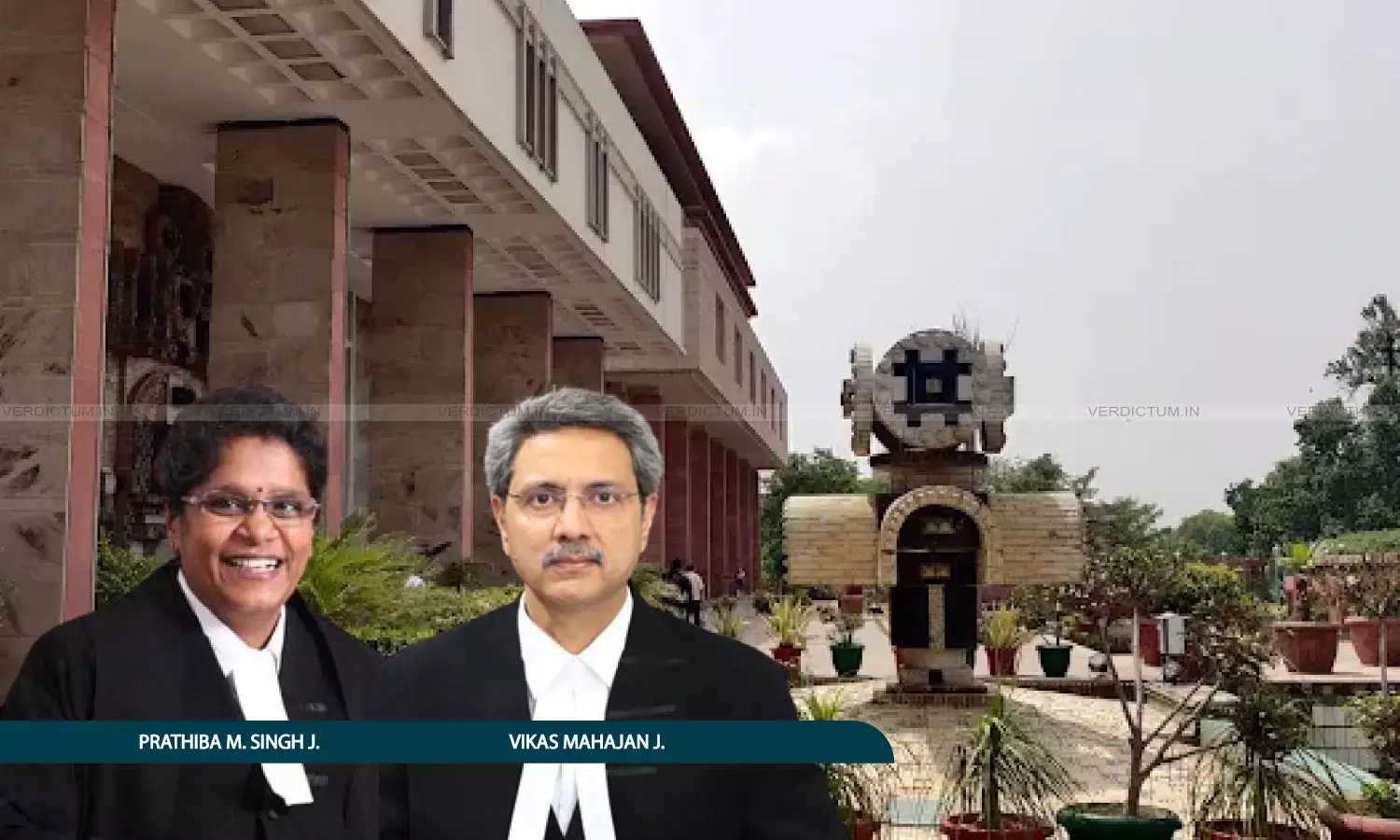
Justice Prathiba M. Singh, Justice Vikas Mahajan, Delhi High Court
The Delhi High Court has held that an order granting extension of time for investigation under Section 43D(2) of the Unlawful Activities (Prevention) Act is an interlocutory order and would not be appealable under Section 21 of the National Investigation Agency Act.
The Court was hearing an appeal filed under Section 21 of the NIA Act challenging an order of the Special Judge, NIA Court, by which the investigation period and detention of the accused persons in a UAPA case were extended beyond 90 days and up to 180 days. The NIA raised a preliminary objection that the order was interlocutory and, therefore, not appealable.
A Bench of Justice Prathiba M. Singh and Justice Vikas Mahajan, while examining the nature of an order granting extension of time under Section 43D(2)(b) of the UAPA, held: “The grant of extension has a clear consequence for the accused i.e., that at the expiry of 90 days the Appellant would not be entitled to default bail. However, this right to default bail is a right which is governed by the statute itself i.e., Section 43D(2) of UAPA. It is not an absolute right but a consequence which may be deferred or postponed by the Trial Court if it is satisfied as to the progress of investigation and specific reasons for continued detention of the accused.”
The Bench added: “If the extension is granted, the right to default bail is not rejected but merely the availment of default bail is postponed to the 181st day, instead of the 91st day. The nature of such an order is, therefore, merely interlocutory and does not have finality attached to it”.
Senior Advocate Nithya Ramakrishnan appeared for the appellants, while SPP Rahul Tyagi appeared for the NIA.
Background
The case arose from an FIR registered by the NIA for offences punishable under Section 18 of the UAPA. The allegation against the appellants, who were Ukrainian nationals, was that they were conspiring with local ethnic armed groups in India to hamper national security and carry out attacks in Myanmar.
The accused were arrested at airports in Lucknow and Delhi, produced before the Magistrate, and remanded first to police custody and later to judicial custody. Before the expiry of the 90-day period, the NIA moved an application under Section 43D(2)(b) of the UAPA read with Section 187 BNSS seeking extension of investigation time up to 180 days.
The Special Court allowed the application after considering the Public Prosecutor’s report, the case diaries, and the reasons cited for further investigation, including the need to analyse seized digital devices and examine various facets of the alleged conspiracy.
The appellants argued that the extension order defeated their right to default bail and, therefore, carried finality. They relied on State NCT of Delhi v. Anamul Ansari (2024), where refusal to extend investigation time was treated as appealable. The NIA contended that grant of extension was an interlocutory order and that the appellants could seek judicial review under Section 482 CrPC.
Court’s Observations
The Court first examined Section 21 of the NIA Act, noting that an appeal lies from any judgment, sentence or order of a Special Court, except an interlocutory order. It also noted that Section 21(4) separately provides for appeal against an order granting or refusing bail.
The Bench then considered Section 43D(2) of the UAPA, which modifies Section 167 CrPC and permits extension of the investigation period beyond 90 days up to 180 days, provided the Public Prosecutor submits a report indicating the progress of investigation and specific reasons for continued detention.
The Court noted: “In terms of sub-clause (b) of Section 43D(2) the maximum period of investigation under CrPC of 90 days can be extended till 180 days provided a report is given by the Public Prosecutor to satisfy the Trial Court as to the progress of the investigation and the reasons for the extended detention of the accused.”
The Court distinguished between an order refusing extension of time and an order granting extension. It observed that in Anamul Ansari (2024), the Coordinate Bench was dealing with refusal of extension, which had irreversible consequences for the prosecution because the accused became entitled to default bail.
However, the Court found that the same reasoning could not automatically apply to an order granting extension. In such a case, the accused’s statutory right to default bail is not extinguished but deferred until the extended period expires.
Referring to Madhu Limaye v. The State of Maharashtra (1977), the Court noted the distinction between final, interlocutory and intermediate orders. It held that an order granting extension of time for investigation does not fall even within the category of intermediate orders because it does not carry irretrievable consequences.
The Court stated: “An order granting further extension would not even be an intermediate order as the order granting extension does not even have trappings of irretrievable consequences. They are not orders which are in between but are orders wherein the Trial Court has merely exercised discretion to grant extension subject to satisfaction of certain conditions.”
The Bench further held that the legislative intention was not to make such an order appealable under Section 21 of the NIA Act, since the order is based on the Public Prosecutor’s report and is assessed by the Trial Court only for the limited purpose of granting extension.
The Court relied on Syed Shahid Yousuf v. National Investigation Agency (2018), where it was held that although an appeal against an order extending investigation time may not be maintainable, such an order can be judicially reviewed under Section 482 CrPC.
The Bench also referred to Jai Kishan Sharma v. Union of India (2019) and National Investigation Agency v. Akhil Gogoi (2022), where the Guwahati High Court had taken the view that an order allowing extension of detention for investigation is interlocutory.
The Court concluded: “This Court agrees with the above decisions that an order granting extension of time for investigation under Section 43D(2) of the UAPA being an interlocutory order would not be an appealable order under Section 21 of the NIA Act.”
It further reiterated that such an order would be amenable to judicial review under Section 482 CrPC or Section 528 BNSS.
Conclusion
The High Court disposed of the appeal by holding that it was not maintainable under Section 21 of the NIA Act. However, considering the appellants’ concern that filing a fresh proceeding could cause delay because they were in custody, the Court directed that the appeal be renumbered as a petition under Section 482 CrPC or Section 528 BNSS and placed before the concerned roster bench.
Cause Title: Hurba Petro And Others v. Union Of India And Others (Neutral Citation: 2026:DHC:6261-DB)
Appearances
Appellants: Senior Advocate Nithya Ramakrishnan with Advocates Nitin Saluja, Shivani Luthra Lohiya, Anubhav Singh, Garima Singh, Ishita Soni, Pranya Madan and Ishit Patel
Respondents: CGSC Amit Tiwari with Advocates Ayushi Srivastava, Arpan Narwal, Kushagra Malik and Ujjwal Tyagi for Union of India; Government Pleader Urvashi Basak; SPP Rahul Tyagi with Advocates Jatin Khatri, Amit Rohilla, Shubham and Aniket Kr. Singh, with DSP Ritesh Sharma, CIO, NIA