

Prima Facie Defamatory Passages Cannot Justify Ban On Entire Book: Delhi High Court Lifts Blanket Injunction Against HarperCollins’ “Yes Man” Book On Rana Kapoor
The Court upheld the trial court’s prima facie findings on four statements about the Yes Bank co-founder, but held that an interim injunction against publication must be no wider than necessary.

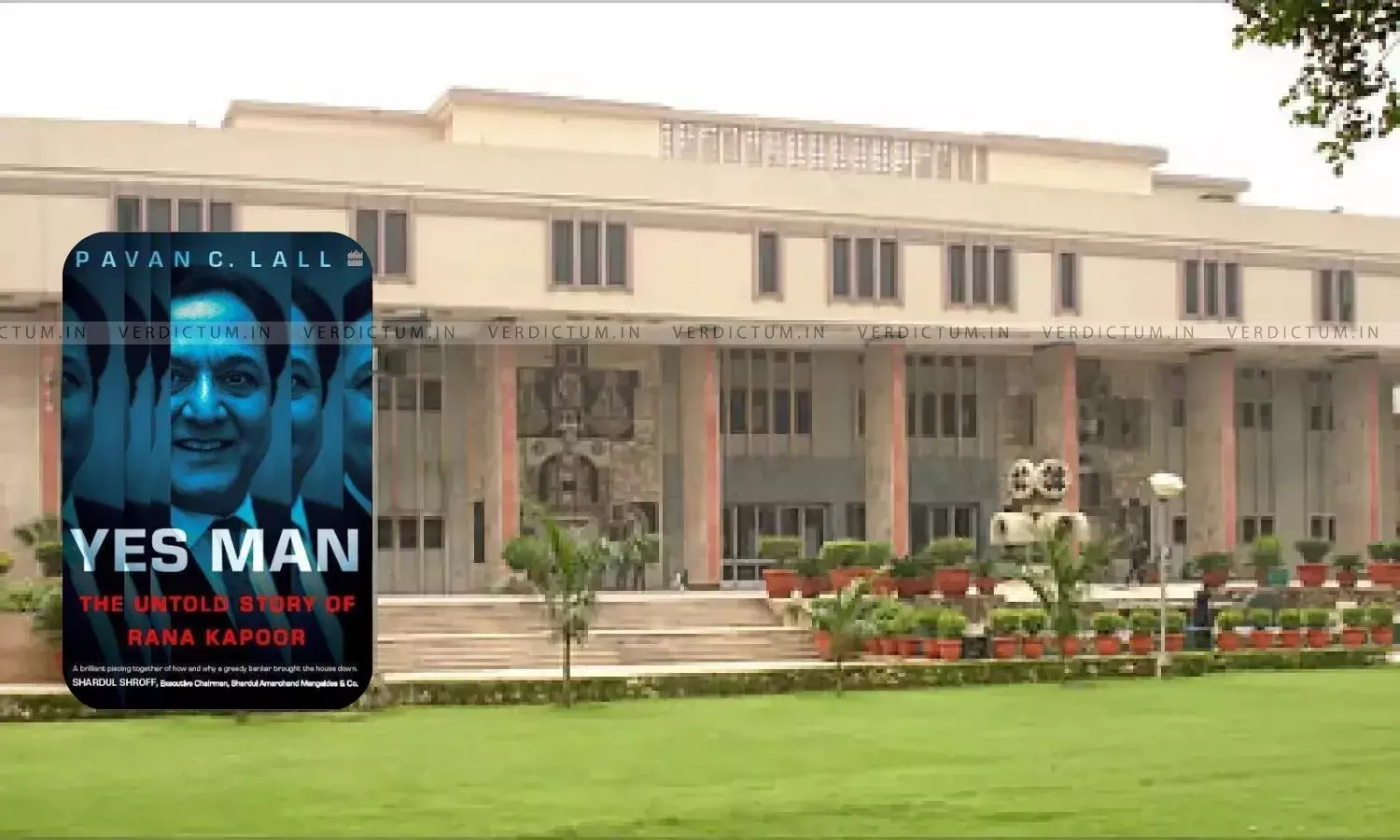
The Delhi High Court has held that a finding that certain passages in a literary work are prima facie defamatory does not mean that publication of the work as a whole must be interdicted. It held that interim relief must bear a reasonable relationship to the nature and extent of the prima facie injury. It added that a total ban pending trial tilts the balance towards the right to reputation without addressing the right to freedom of speech and expression.
The Court modified the trial court’s order restraining HarperCollins and author Pavan Chand Lall from selling, distributing or circulating “Yes Man: The Untold Story of Rana Kapoor”. It confined the restraint to the portions containing the four statements found prima facie defamatory or derogatory. It declined to interfere with those findings, holding that the defences of justification and fair comment were not so clearly established as to render Kapoor’s claim bound to fail at trial.
A Single Bench of Justice Harish Vaidyanathan Shankar observed, “The conclusion that the aforesaid statements disclose a prima facie case of defamation, however, does not by itself answer the further question as to the nature and extent of the interim relief which and connected matter ought to follow. The fact that certain passages in a literary work may, at the interlocutory stage, be found to be prima facie objectionable does not necessarily mean that the publication of the work as a whole must be interdicted. The relief has necessarily to bear a reasonable relationship with the nature and extent of the prima facie injury or prejudice found to warrant protection”.
Advocate Essenese Obhan appeared for the appellant and Senior Advocate Percival Billimoria appeared for the respondent.
“…This Court is of the opinion that, pending trial, the ban on the publication of the book is clearly not warranted. A total ban on the publication of the book, to the mind of this Court, tilts the balance in the favour of one category of rights asserted, namely that of the right to social reputation, without addressing the right to freedom of speech and expression which is guaranteed by the Constitution. Cleary, an order that effectively takes away one right in preference for the other, that too at a stage before the rival contentions can be analysed and appreciated in detail, is a bit extreme and unwarranted. The learned Trial Court appears to have lost sight of the need for maintaining a balance of the rights asserted on behalf of the rival parties. The right way forward, therefore, at this stage, would be to calibrate the relief in a manner such that neither right is unduly stifled or given precedence over the other. This Court is consequently of the view that the protection which is warranted can be secured without necessarily bringing the entire Subject Book within the scope of the injunction”, the Bench noted further.
The book was published on December 22, 2020 and concerns the life and career of Rana Kapoor, co-founder and former MD and CEO of Yes Bank, in the context of the bank’s rise and subsequent crisis. The Directorate of Enforcement and CBI had initiated proceedings against him in March 2020. Kapoor sued for permanent injunction, alleging that the book and two related articles and an interview were defamatory and infringed his reputation, privacy, personality and fair trial rights.
Lall was proceeded against ex parte. By order dated July 10, 2024, the District Judge, Tis Hazari Courts found Statements (iv), (vii) and (x) defamatory and Statement (ii) derogatory, and did not find the remaining statements objectionable. It nonetheless restrained the book in its entirety during the pendency of the suit, and directed removal of the articles and interview. It found that the book would not prejudice the criminal proceedings against Kapoor. HarperCollins and Lall appealed.
On the limited scope of appellate interference under Wander Ltd. v. Antox India (P) Ltd. (1990), the Bench held that the findings on the four statements were not arbitrary, capricious or perverse.
Agreeing that Bloomberg Television Production Services (P) Ltd. v. Zee Entertainment Enterprises Ltd (2024) requires caution in pre-trial injunctions against publication, it held that material in the public domain cannot by itself conclude whether the particular imputations are justified. It held that innuendo need not be pleaded where a statement is defamatory in its natural and ordinary meaning. It noted that the book had remained in circulation since December 2020 and that Kapoor was attributed knowledge of it in January 2022, while holding that his incarceration did not disentitle him from relief. Relying on Swami Ramdev v. Juggernaut Books Pvt. Ltd. (2018), it held that the trial court had lost sight of the need to balance the rival rights.
The Court also observed that Lall, having chosen not to appear before the trial court, could not have factual matters examined for the first time in appeal. It held, however, that his non-appearance could not convert findings on four statements into a finding that the whole book was defamatory. It clarified that the modification is confined to interim relief and the trial court shall decide the suit uninfluenced by its observations.
Cause Title: HarperCollins Publishers India Pvt. Ltd. v. Rana Kapoor & Ors. (Neutral Citation: 2026:DHC:9973)
Appearances:
Appellant: Advocates Essenese Obhan, Ashima Obhan, Yogita Rathore and Tushar Chauhan.
Respondent: Advocates Naman Joshi, Guneet Sidhu and Aakash Deep Singh, Senior Advocate Percival Billimoria, with Advocates Nattasha Garg, Anubhav Dubey, Thakur Ankit Singh, Rachita Sood, Priyamvada Paneru, Liza Arora and Anandi Katiyar