

Caste-Based Remarks Made Inside Office Chambers: Delhi High Court Quashes SC/ST Act Charges Against Management Officials
The Court said that the complete absence of a foundational statutory ingredient from the complaint disentitles the prosecution from proceeding under the Act.

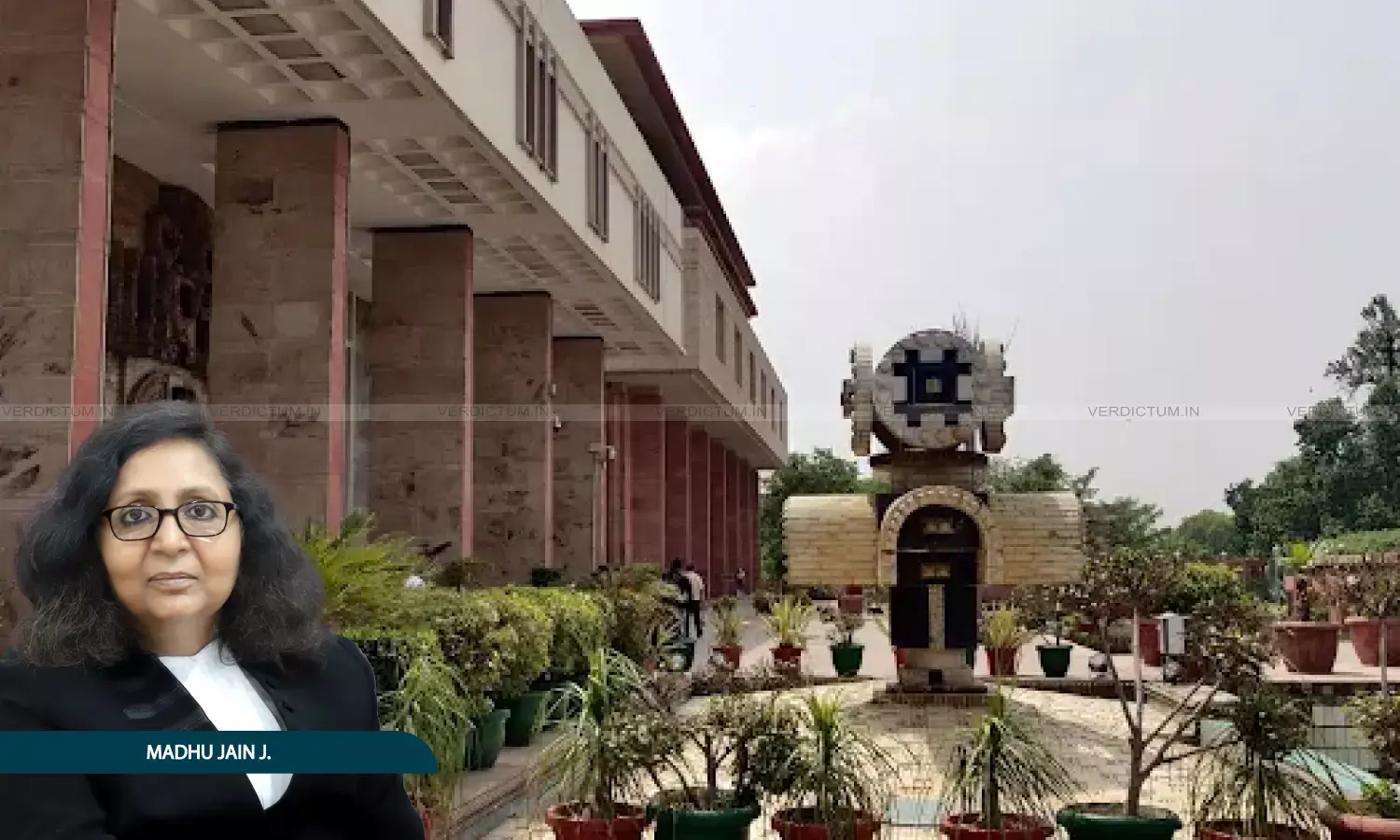
Justice Madhu Jain, Delhi High Court
The Delhi High Court has observed that alleged casteist remarks uttered within private office premises, in the absence of any member of the public, fail to satisfy the mandatory statutory threshold of occurring "in any place within public view" under Section 3(1)(x) of the Scheduled Castes and Scheduled Tribes (Prevention of Atrocities) Act, 1989.
The Bench held that while disputed factual questions are matters for trial, the complete absence of a foundational statutory ingredient from the complaint disentitles the prosecution from proceeding under the Act.
A Single Judge Bench comprising Justice Madhu Jain while adjudicating a petition under Section 482 CrPC, observed, “…this Court is of the considered opinion that even if the allegations contained in the complaint dated 29.02.2008 are accepted in their entirety, the essential statutory requirement that the alleged insult or intimidation should have taken place ‘in any place within public view’ is not prima facie disclosed. Consequently, the charge framed against the petitioners under Section 3(1)(x) of the Scheduled Castes and Scheduled Tribes (Prevention of Atrocities) Act, 1989 cannot be sustained”, it noted.
“…the complaint, on its own showing, does not prima facie disclose that the alleged insult or intimidation occurred ‘in any place within public view’, which is an essential ingredient of the offence under Section 3(1)(x) of the Act”, it noted further.
Senior Advocate Rebecca M. John appeared for the petitioners and Digam Singh Dagar, Additional Public Prosecutor appeared for the respondents.
The dispute originated from complaints filed by former safai karamcharis against four senior management executives of Trans World Radio India. Following disciplinary proceedings and the eventual dismissal of one employee, the complainants instituted a criminal complaint under Section 200 CrPC alleging that management officials had intentionally insulted and humiliated them using caste-based slurs inside their respective office rooms during 2007 and 2008.
Earlier complaints submitted to the police primarily alleged pressure regarding religious conversions and employment discrimination without mentioning caste-based abuse. Police status reports also found the allegations unsubstantiated. However, by an order dated March 22, 2012, the Additional Sessions Judge-02 (South), Saket Courts, New Delhi, directed the framing of charges under Section 3(1)(x) of the SC/ST Act, leading the petitioners to approach the High Court.
Evaluating the unamended Section 3(1)(x) alongside settled Supreme Court precedents, the Court reiterated that the requirement of the incident occurring "in any place within public view" is a crucial statutory element that cannot be dispensed with.
Consequently, the Court allowed the petition and set aside the order dated March 22, 2012, to the extent it directed framing of charges under Section 3(1)(x) of the SC/ST Act.
The Bench remanded the matter to the trial court to consider afresh, in accordance with law, whether charges should be framed under the Indian Penal Code, 1860, directing the petitioners to appear before the trial court on August 13, 2026.
Cause Title: Christine Swaroop Raj & Ors. v. State & Ors. (Neutral Citation: 2026:DHC:5667)
Appearances:
Petitioners: Rebecca M. John, Senior Advocate, with Pravir Singh, Advocate.
Respondents: Digam Singh Dagar, Additional Public Prosecutor.