

Operational Hardship Totally Irrelevant Consideration: Delhi High Court Dismisses Plea Challenging 2015 Amendment Of Payment Of Bonus Act
The Court held that the financial hardship, reopening of accounts, and operational inconvenience cannot invalidate a welfare-oriented fiscal measure.

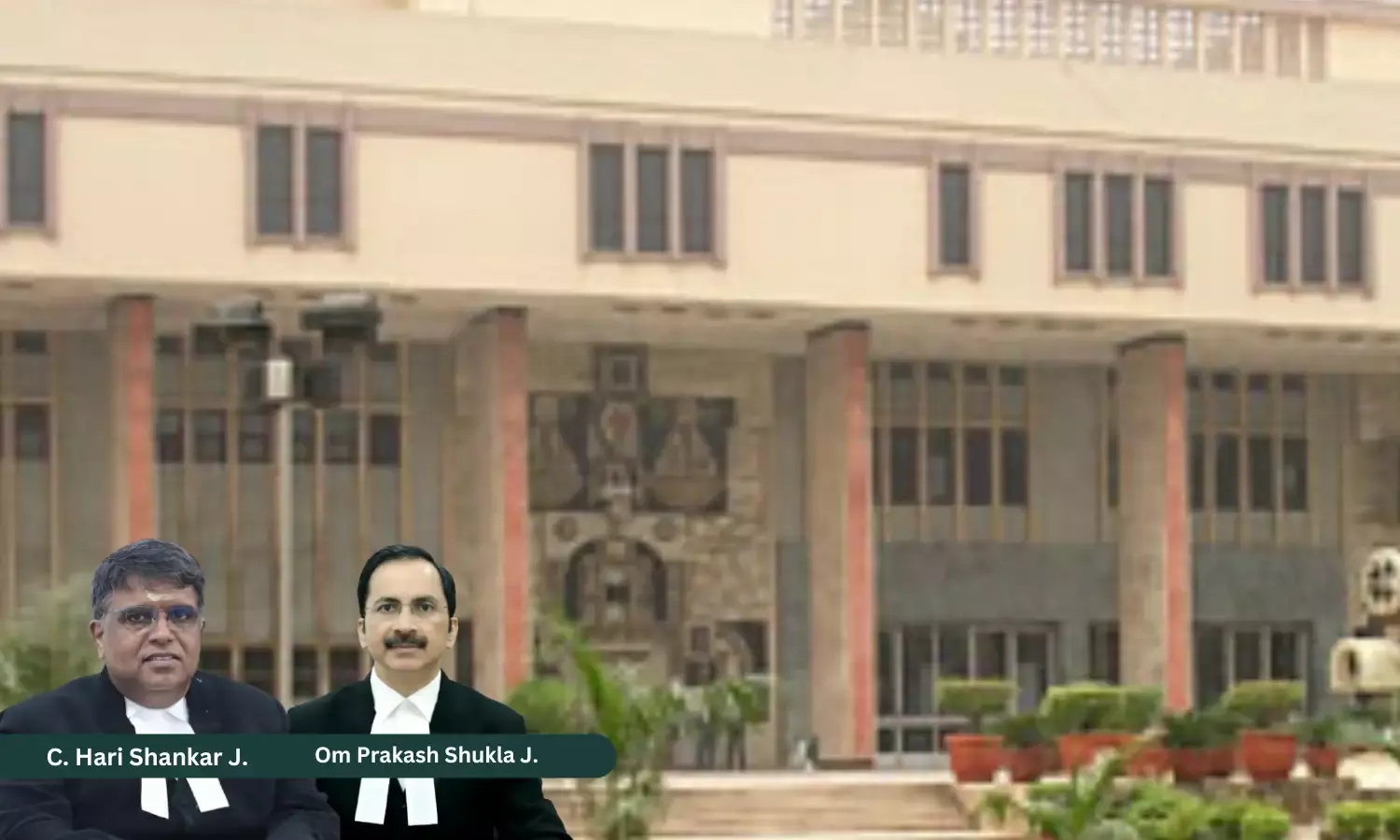
Justice C. Hari Shankar, Justice Om Prakash Shukla, Delhi High Court
The Delhi High Court has upheld the constitutional validity of the Payment of Bonus (Amendment) Act, 2015, including its retrospective application from April 01, 2014, holding that the legislation does not infringe Articles 14, 20(1), or 300-A of the Constitution of India.
Rejecting the employers' challenge, the Court held that retrospective fiscal and welfare legislation is not unconstitutional merely because it creates financial liabilities for a past period. The Bench observed that financial hardship, reopening of accounts, or operational inconvenience cannot invalidate a statutory welfare measure, and emphasised that the precarious condition of a particular industry is irrelevant to the constitutional validity of the amendment.
A Division Bench comprising Justice C. Hari Shankar and Justice Om Prakash Shukla held that the sugar industry's claimed precarious financial condition could not be used to challenge the constitutional validity of the retrospective bonus liability imposed by the 2015 amendment. It observed, “…Payment of bonus under the Act is based on the profits earned, and resultant surplus, and the individual hardship faced by a particular industry cannot be made the basis to invalidate the impugned Amendment Act. Besides, these are exigencies for which any industry is expected to make allowances, and we can certainly not accept a submission that the sugar industry is so financially woebegone that it cannot shoulder the liability. Operational hardships, such as the need to revisit its accounts, and other such considerations, are also totally irrelevant to the constitutionality of the impugned Amendment Act”.
“…Inasmuch as we have already held Section 1(2) of the impugned Amendment Act, which grants retrospective application to the provisions of the impugned Amendment Act to be constitutionally valid, the challenge based on Article 300-A has also to necessarily fail”, it noted further.
Advocate Abhishek Awasthi appeared for the petitioner and Arti Bansal, CGSC appeared for the respondent.
Referring to Supreme Court decisions including Jalan Trading Co. Pvt. Ltd. v. Mill Mazdoor Sabha AIR 1967 SC 691, R.C. Tobacco v. Union of India (2005) 7 SCC 725 and Rai Ramkrishna v. State of Bihar, the Bench observed that hardship, financial inconvenience, or the need to revisit accounts cannot invalidate a welfare-oriented fiscal measure.
Addressing the challenge under Article 20(1) of the Constitution of India, the Court clarified that the constitutional prohibition applies to retrospective criminal liability and not to retrospective monetary obligations. Referring to Supreme Court precedent concerning retrospective wage fixation, the Bench held that even where a liability relates to a prior period, Article 20(1) is not attracted so long as employers are given an opportunity to discharge the liability after the legislation comes into force and are not penalised for past conduct that was lawful when undertaken.
The Court further rejected the argument based on Article 300-A of the Constitution of India, holding that the right to property is not absolute and may be curtailed by valid legislation enacted in public interest. It observed that there is no legal principle insulating an employer’s surplus from statutory welfare obligations imposed by law.
“There is no known legal principle which holds that the surplus with an employer after payment of statutory liabilities is sacred and inviolable. No doubt, it constitutes the property of the employer, as would any and every part of the employer’s assets, but, like all other property, it can be divested by authority of law”, it noted.
Finding that the amendment served the legitimate objective of ensuring a fairer distribution of profits between employers and employees and was neither confiscatory nor expropriatory in nature, the Bench upheld its retrospective operation.
However, it granted employers eight months to make the additional bonus payments for the relevant period, failing which interest at 8% per annum would become payable.
Cause Title: Aviva Life Insurance Company India Ltd. v. Union Of India & Anr. (Neutral Citation: 2026:DHC:4853-DB)
Appearances:
Petitioner: Abhishek Awasthi and Amisha Ray, Advocates.
Respondent: Arti Bansal, CGSC, Shruti Goel, Advocate.