Victim's Father Admitted Falsifying Daughter's Age For School Admission: Delhi High Court Acquits POCSO Accused
The Court held that the school record relied upon by the prosecution was based on information supplied by the father himself, who later admitted that he had mentioned a lesser age to secure school admission for his daughter.
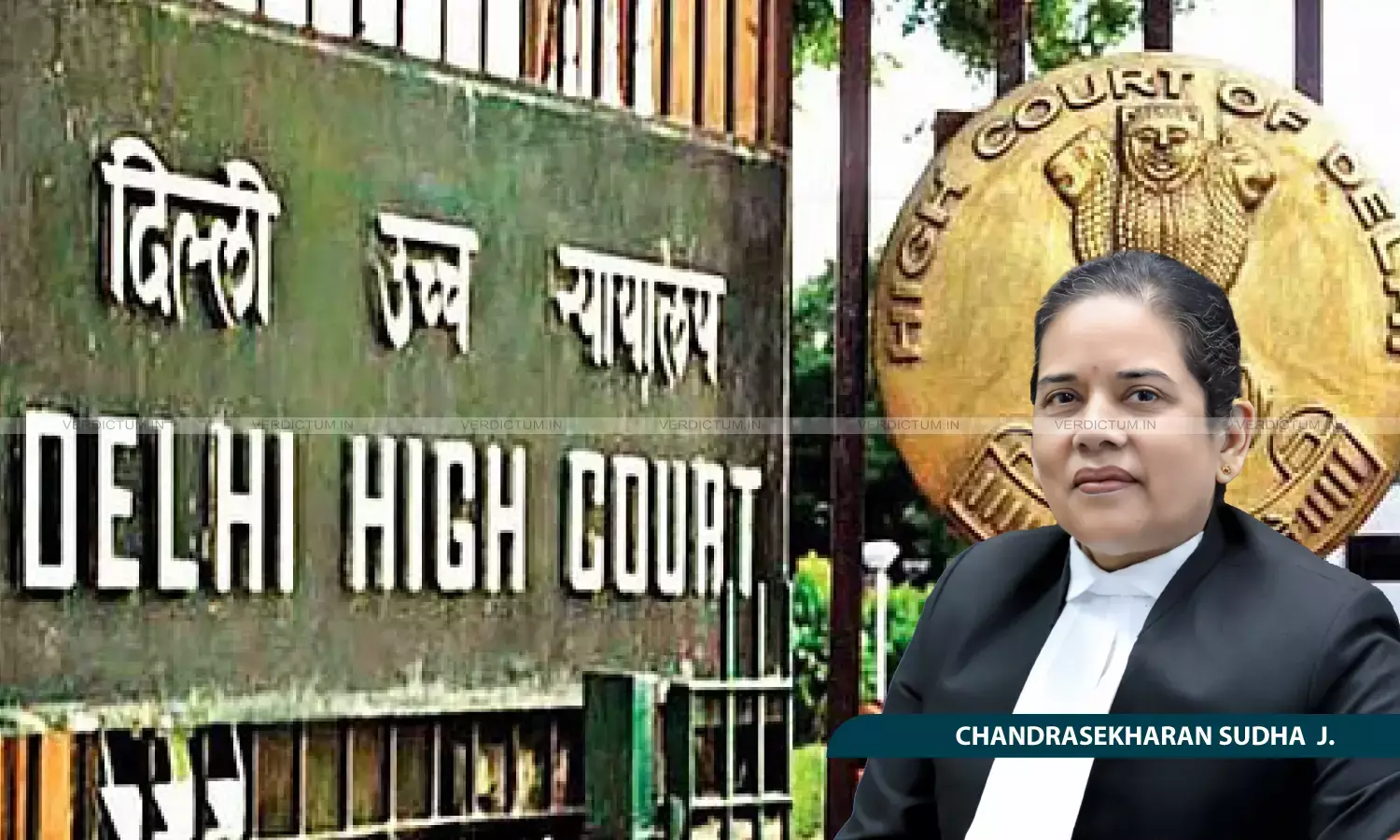
The Delhi High Court has acquitted a man of charges under Section 376(1) IPC and Section 6 of the POCSO Act after finding that the prosecution failed to prove the prosecutrix was a minor, particularly when her father admitted that he had deliberately furnished a lesser age for her school admission.
The Court was hearing a criminal appeal filed by the accused under Section 374(1) CrPC against the judgment and order on sentence passed by the Special Court under the POCSO Act, which had convicted him and sentenced him to rigorous imprisonment for ten years with a fine.
A Bench of Justice Chandrasekharan Sudha observed:“Now, PW3, who had given Ext. PW2/D affidavit, himself appears before the court and says that his affidavit is wrong. If that be so and if PW3 was well aware that his daughter was not a minor at the time of the alleged incident, what was the earthly purpose for him to have given Ext. PW3/A FIS/FIR alleging that his minor daughter had been kidnapped by some unknown person? So, was there any demand for money made by PW3 to the accused, which demand on being refused by the latter, led to the registration of the present crime (containing false allegations) as contended by the accused? This appears quite probable especially in the light of the Ext. X-1 FIR and X-2 judgment. Is giving false complaints one after the other the modus operandi adopted by PW3 to extract money from others as contended by the accused? I refrain from making further comments or recommending or initiating action against either the father or daughter, as it appears from the materials on record that PW1 and the accused are leading a married life and also have children.”
Advocate Rashid Hashmi appeared for the appellant, while APP Satinder Singh Bawa appeared for the State.
Background
The prosecution's case was that the accused kidnapped PW1, who was alleged to be below thirteen years of age, took her away from Delhi, and repeatedly committed aggravated penetrative sexual assault upon her. The case was registered on the basis of the complaint lodged by PW3, the father of PW1.
The accused denied the allegations. In his statement under Section 313 CrPC, he stated that he had married PW1 with the consent of both families. He further stated that PW3 demanded money from him after the nikah, and that on refusal, he was falsely implicated.
Before the High Court, the accused argued that PW1 had voluntarily left her parental home and solemnised nikah with him. He also submitted that PW1 had stated in her testimony and in her Section 164 CrPC statement that she married him voluntarily, and that the prosecution had failed to prove that she was a child on the date of the incident.
The State supported the Trial Court’s conviction and submitted that there was no infirmity in the judgment warranting interference.
Court’s Observations
At the outset, the Court noted that after the accused was questioned under Section 313(1)(b) CrPC, compliance with Section 232 CrPC was mandatory. It found that no hearing as contemplated under Section 232 CrPC appeared to have been conducted by the Trial Court.
However, relying on Moidu K. v. State of Kerala (2009), the Court held that non-compliance with Section 232 CrPC would not by itself vitiate the proceedings unless serious and substantial prejudice to the accused was shown. Since the accused did not contend that any such prejudice had been caused, the Court proceeded to examine the evidence.
The Court noted that PW1 had stated in her Section 164 CrPC statement that she had gone with the accused of her own free will, married him, and wanted to live with him.
The Court recorded: “In Ext. PW1/A 164 statement seen recorded on 17.07.2015, PW1 has stated thus:- She is a 15-year-old girl. Earlier, she used to reside with her family in a house at Wazirabad, Gali no. 9, Timarpur. The accused used to reside in her neighbourhood in Timarpur itself. They got acquainted and they took a liking to each other. They were afraid that their parents would refuse their marriage, therefore they did not tell them anything. On 07.10.2014 she called Anarul (the accused) on her own and went away with him of her own free will. On the same day, they went to a madarsa and got married. Then they went to Bengal, where her in-laws' house is located. The accused works there as a contractor. Only her mother-in-law lives at her in-laws' house. She has a child who was born just a few days back. Two days ago, she along with her child came to Delhi to meet her father (PW3) to seek forgiveness. Then she came to know that her father (PW3) had lodged a missing report. She had voluntarily left her home and married the accused. None has committed any wrong act with her or enticed or lured her. She is married now and wants to live with her husband (the accused).”
The Court also noted that in her deposition, PW1 stated that she had married the accused with the consent of both families and that her father was aware that she was accompanying the accused after the nikah.
The prosecution relied on the school admission register to prove PW1’s age. The Court noted that the school register recorded her date of birth on the basis of the admission form and affidavit submitted by PW3.
The Court found that the source of the school entry itself was shaken because both PW1 and PW3 stated that the age given in school records was incorrect and had been reduced for securing admission.
The Court observed: “The prosecution has sought to prove the age of PW1 on the basis of Ext. PW2/A admission register of the first school attended by her wherein her date of birth is recorded as 04.03.2002. The entry was made on the basis of Ext. PW2/C the admission form and Ext. PW2/D affidavit submitted by her father, PW3. There is no dispute that the school record was prepared on the information supplied by PW3. It is settled that the record of the first school attended is an important piece of evidence for determining age. However, in the case on hand, PW3 admitted in his testimony that he had mentioned a lesser age of PW1 at the time of her admission in school so that she could secure admission. PW1 also stated that the date of birth recorded in the school record was not her actual date of birth and that PW3 had deliberately mentioned a lesser age. Thus, the person who supplied the information for preparing the school record later stated that the information given is incorrect.”
The Court added that there was no birth certificate issued by any municipal authority, panchayat or hospital, no matriculation certificate, and no ossification test or other medical examination for age determination.
The Court held: “Although the testimony of PW1 and PW3 also do not independently establish the age of PW1, the admissions made by PW1 and PW3 regarding the incorrect school entry cannot be ignored altogether. In these circumstances, the prosecution evidence regarding the age of PW1 is not free from doubt. In the absence of any reliable independent evidence, it cannot be said that the prosecution has proved beyond reasonable doubt that PW1 was below eighteen years of age on the date of the incident. That being the position, an offence of rape as contemplated under Section 375 IPC is not made out in the light of the testimony of PW1 that the relationship was consensual. The offence punishable under Section 6 PoCSO Act would also not be made out as there is no clear proof that PW1 was a minor at the time of the incident.”
The Court also referred to an earlier FIR lodged by PW3, in which he had alleged that PW1 had been kidnapped by unknown persons. In that earlier case, two persons were charged with offences under Section 376 IPC, Section 6 POCSO Act and Section 9 of the Prohibition of Child Marriage Act, 2006, but PW1 turned hostile and stated that she had not been kidnapped or sexually assaulted. The accused persons in that case were acquitted.
The Court found that the allegations in the present FIR were similar to those in the earlier FIR, and that PW3 had again alleged that his daughter had gone out and had been enticed or taken away by an unknown person.
The Court noted that PW3, who had described PW1 as a minor in the FIR, later testified that she was a major at the time of the incident and that he had intentionally given a wrong date of birth while admitting her to school.
The High Court held that the materials on record were unsatisfactory and that the Trial Court erred in finding the accused guilty of the offences under Section 376(1) IPC and Section 6 of the POCSO Act.
The Court held: “In the light of the aforesaid unsatisfactory materials on record, I find that the trial court went wrong in finding the accused guilty of the offences punishable under Section 376(1) IPC and Section 6 of the PoCSO Act.”
Conclusion
The Delhi High Court allowed the appeal and set aside the conviction and sentence.
The accused was acquitted under Section 235(1) CrPC of the offences punishable under Section 376(1) IPC and Section 6 of the POCSO Act. The Court directed that he be set at liberty, his bail bond stand cancelled, and the sureties, if any, stand discharged.
Cause Title: Anarhul Haque v. State (Neutral Citation: 2026:DHC:5470)
Appearances
Appellant: Rashid Hashmi, Advocate
Respondent: Satinder Singh Bawa, APP for the State, with SI Abhishek Singh; Inderjeet Sidhu, Advocate for Victim/Prosecutrix, DHCLSC