

Law Student Not Attending Any Class In A Semester Can’t Claim Progression To Next Semester: Delhi High Court
A law student had approached the Delhi High Court challenging a judgment whereby the relief sought by him for admission to Semester-IV was declined.

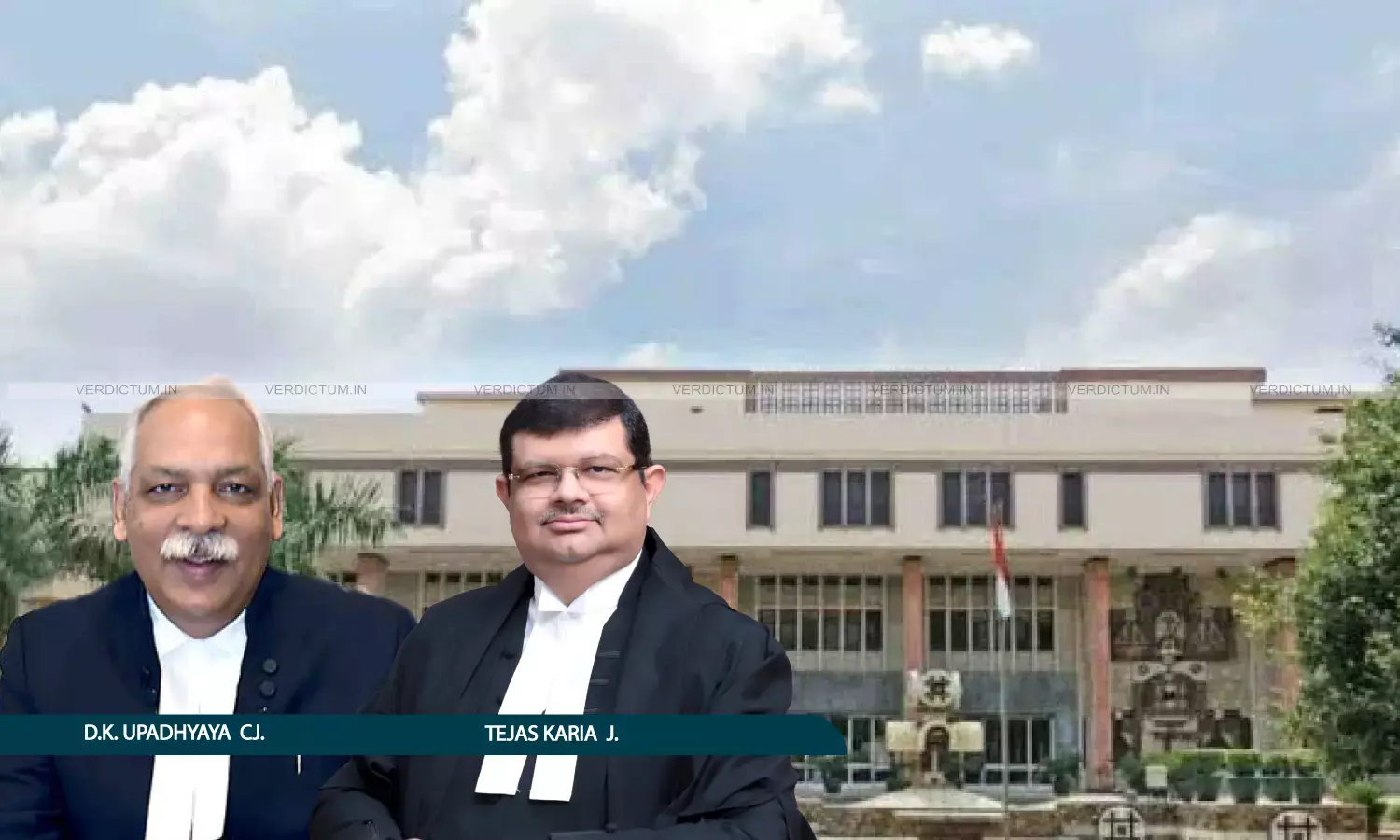
The Delhi High Court has refused to allow the appeal of a Delhi University law student seeking relaxation in attendance regulations for his admission in Semester-IV, while observing that students who have neither attended even a single class in a particular semester nor appeared in the examinations for that semester cannot claim the benefit of progression to the next semester.
A law student had approached the High Court challenging a judgment whereby the relief sought for admission to Semester-IV, without having attended any classes or appeared in the Semester-III examinations, was declined on the ground that non-attendance of even a single class cannot be equated with a mere shortage of attendance.
The Division Bench of Chief Justice Devendra Kumar Upadhyaya and Justice Tejas Karia held, “We are of the considered view that students, who have neither attended even a single class in a particular semester nor appeared in the examinations for that semester, cannot claim the benefit of progression to the next semester, even where the denial of admission was for reasons not attributable to them. In the present case, the Appellant had a shortage of attendance in Semester-II and was, therefore, only provisionally permitted to appear in the Semester-II examinations, subject to the outcome of the proceedings before the Committee constituted by the Respondents. Consequently, the Appellant was not granted admission to Semester-III and did not attend any classes for that semester.”
Advocate Gaurav Arya represented the Appellant while Advocate Preet Pal Singh represented the Respondent.
Factual Background
The Appellant, a student of the LL.B. programe at Law Centre-I, Faculty of Law, University of Delhi, had cleared all five papers of Semester-I, securing 354 out of 500 marks. In Semester-II, the Appellant was detained on the grounds of a shortage of attendance, as it was recorded at 27.58%. However, pursuant to the recommendation of the Committee constituted by the Respondents in terms of the official notice, the Appellant was provisionally permitted to appear in the Semester-II examinations, subject to the outcome of the Committee proceedings. Although the Appellant appeared in the Semester-II examinations, his result was withheld, and he was denied admission to Semester-III.
The Appellant contended that, despite repeated representations, no final decision of the Committee proceedings was ever communicated to him. Thereafter, notwithstanding that the Appellant had undertaken the Semester II examinations and no allegation of misconduct or malpractice was ever levelled against him, he took re-admission in Semester II and deposited re-admission fees with a view to avoiding academic discontinuity. The Appellant thereafter approached the Court and the Respondents were directed to immediately declare the Semester-II results. However, the Respondent did not promote the Appellant to Semester-III to afford academic continuity. In the Impugned Order, the Single Judge declined to grant consequential relief on the ground that the Appellant had neither attended the Semester-III classes nor appeared in the Semester-III examinations.
Reasoning
On a perusal of the facts of the case, the Bench noted that the Appellant had a shortage of attendance in Semester-II. Notwithstanding the same, he was provisionally permitted to appear in the Semester-II examinations held in May–June 2025, subject to the outcome of the proceedings before the Committee constituted by the Respondents. Upon completion of the Semester-II examinations, the Appellant’s result was withheld, and he was consequently denied promotion to Semester-III in August 2025 and was also precluded from appearing in the Semester-III examinations in December 2025.
The Bench took note of the fact that the Single Judge had refused to grant him the benefit based on the judgment in Courts on its Own Motion Re: Suicide Committed by Sushant Rohilla, Law Student of I.P. University (2017) , as the Appellant had neither attended a single class in Semester-III nor cleared the examinations for that semester. The Single Judge held that no parity could be drawn between nil attendance and mere shortage of attendance and, on that basis, declined the consequential relief of admission to Semester-IV.
Considering that the appellant was not granted admission to Semester-III and did not attend any classes for that semester, the Bench stated, “In view of the above, the Appellant cannot be permitted to bypass an entire semester without attending a single class by placing reliance upon the decision in Sushant Rohilla (supra), which dealt with a case of shortage of attendance and not one of nil attendance. Accordingly, there is no parity between the Appellant’s case of 0% attendance and cases involving shortage of attendance. The benefit of the decision in Sushant Rohilla (supra) cannot be extended to students who neither took admission to nor attended any classes in the relevant semester, as the ratio of the said decision was confined to situations where the students fell short of the prescribed minimum attendance in that semester.”
The Bench was of the view that the appellant couldnot be permitted to appear in supplementary examinations for Semester-III and, on that basis, seek admission to Semester-IV as he did not attend even a single class in Semester-III. Thus, finding no ground for interference with the Impugned Order, the Bench dismissed the appeal.
Cause Title: Aman Bansal v. University of Delhi & Ors. (Neutral Citation: 2026:DHC:4398-DB)
Appearance
Appellant: Advocates Gaurav Arya, Harsh Goyal, Naveen Bamel, Yuvraj, Aakarshak Rathi, Manav Trivedi
Respondent: Advocates Preet Pal Singh, Tanupreet Kaur, Gaurav, Simran Kumari, Pooja, Medha Sharma