

Deductions Arising Out Of Loan Repayments For Acquisition Of Assets Or Vehicles Can't Dilute Obligation To Pay Maintenance: Delhi High Court
The Delhi High Court was considering a petition whereby the wife sought the setting aside of the judgment passed by the Family Court.

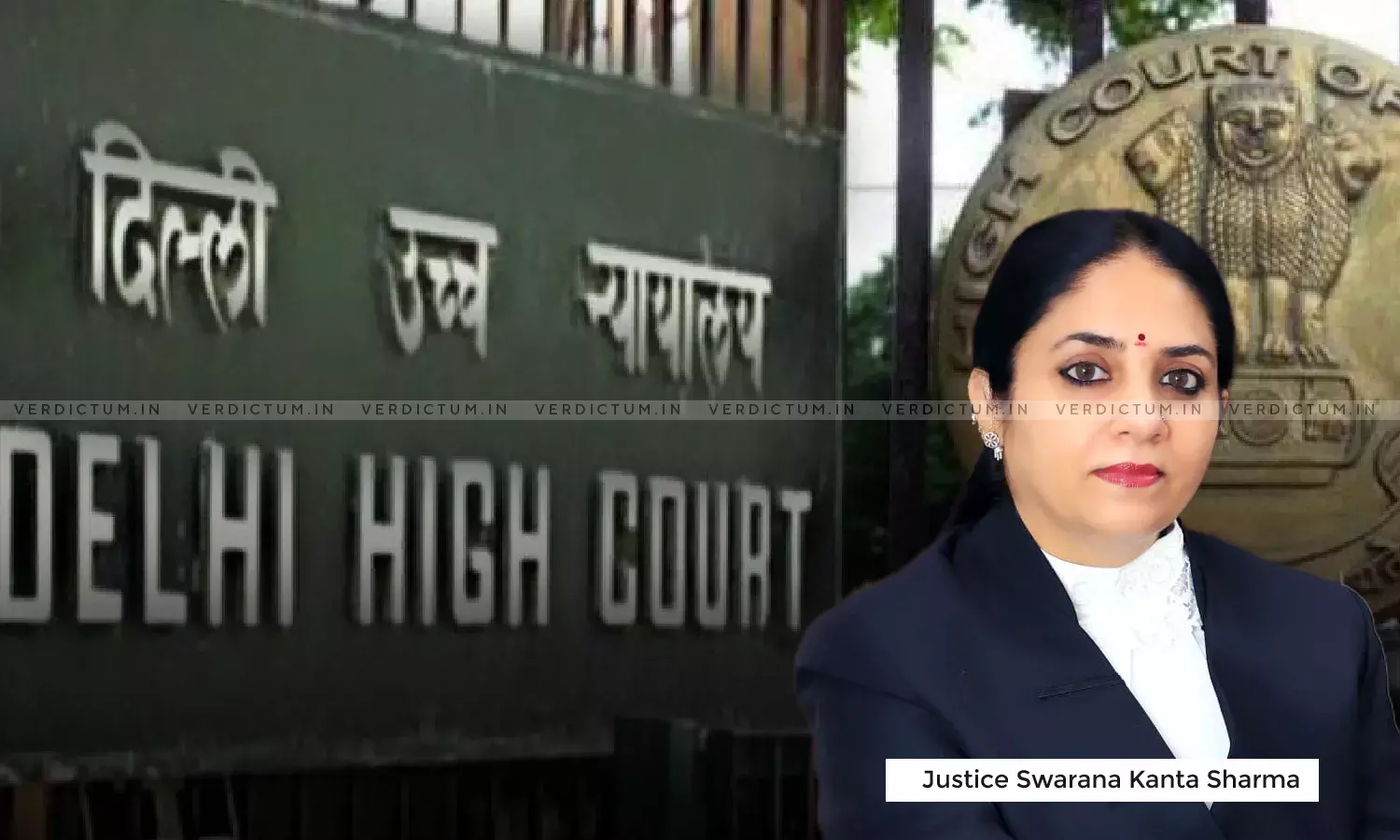
Justice Swarana Kanta Sharma, Delhi High Court
While remanding a maintenance dispute to the Family Court, the Delhi High Court has held that deductions arising out of voluntary financial commitments, such as loan repayments for the acquisition of assets or vehicles, cannot be permitted to dilute the obligation to pay maintenance.
The High Court was considering a Petition whereby the wife sought the setting aside of the judgment passed by the Family Court filed under Section 125 of the Code of Criminal Procedure, 1973 (CrPC).
The Single Bench of Justice Swarana Kanta Sharma stated, "In this Court's view, the approach adopted by the learned Family Court is contrary to the settled position of law. It is well-settled that while determining the income of the earning spouse, only statutory and compulsory deductions are to be considered. Deductions arising out of voluntary financial commitments, such as loan repayments for acquisition of assets or vehicles, cannot be permitted to dilute the obligation to pay maintenance."
“Where the parent is receiving a regular pension, the dependency cannot be treated as absolute so as to substantially reduce the share of the wife and minor child", it added.
Factual Background
The marriage between the petitioner and the second respondent was solemnised in 2014. It was alleged that before and after the marriage, the petitioner wife was subjected to cruelty and harassment on account of dowry demands, including the demand of cash and a car, and her jewellery was retained by the husband’s family. It was further alleged that she was physically and mentally harassed on multiple occasions and was ultimately compelled to leave the matrimonial home. A female child was born out of wedlock. It was further alleged that despite having a regular source of income, the respondent husband allegedly neglected and refused to maintain the petitioners, compelling them to file the petition under Section 125 seeking maintenance. The petitioners were awarded ad-interim maintenance in the sum of ₹20,000 per month.
Thereafter, the first petitioner led evidence, and upon hearing arguments on behalf of both parties, the Family Court observed that although the respondent was earning about ₹1 lakh per month, his net income, after deductions, was about ₹50,000 per month. Taking into account that the respondent had one additional dependent, i.e., his aged mother, the Family Court apportioned the said income into five shares, out of which two shares were attributed to the petitioners, two to the respondent and one for the old mother. Accordingly, maintenance of ₹8,000 and ₹5,000 per month was awarded to the wife and the daughter. Aggrieved by the quantum of maintenance, the petitioners approached the High Court.
Reasoning
The Bench reiterated the settled view that while determining the income of the earning spouse, only statutory and compulsory deductions are to be considered, and deductions arising out of voluntary financial commitments cannot be permitted to dilute the obligation to pay maintenance. Considering that the Family Court had taken the net salary of ₹50,833 as the basis for determining maintenance, after deducting various amounts, including EMIs towards housing loan and vehicle loan, the Bench stated, “Thus, the learned Family Court has clearly committed an error in treating EMIs towards housing loan and vehicle loan as necessary deductions and in assessing the respondent's income on the basis of net salary”, it added.
Coming to the appropriation of the husband’s salary, the Bench stated that the extent of such dependency has to be assessed based on the financial position of the parent. The Bench was of the view that the Family Court mechanically treated the mother of the respondent as fully dependent upon him, without examining the effect of the pension being received by her. The Bench further clarified that in the absence of any pleading or proof, major siblings cannot be treated as dependents for the purpose of determining maintenance.
Considering that there was no material on record to show that the wife was actually earning any income, the Bench held that the finding of the Family Court that she may be earning or deliberately not earning was only speculative and could not form the basis for reducing the amount of maintenance.
As per the Bench, the approach adopted by the Family Court in first reducing the income of the respondent to about ₹50,000 by including non-statutory deductions, then further inflating the number of dependents, and thereafter reducing the share of the petitioners on speculative grounds, had resulted in fixation of total maintenance at ₹13,000 per month for both petitioners, which was apparently disproportionate to the admitted gross income of the respondent.
Thus, setting aside the impugned judgment, the Bench remanded the matter back to the Family Court for fresh determination of maintenance.
Cause Title: A v. The State NCT of Delhi & Anr. (Neutral Citation: 2026:DHC:3850)
Appearance
Petitioner: Advocate Divya Malhotra
Respondent: Advocates Sneha Rani, Abhishek Verma, Satayam Singh