

Husband Didn’t Make Full Disclosure; Attempted To Conceal Actual Income: Delhi High Court Enhances Maintenance Amount
The Delhi High Court was considering the cross-petitions preferred by a husband and a wife against a common order granting maintenance.

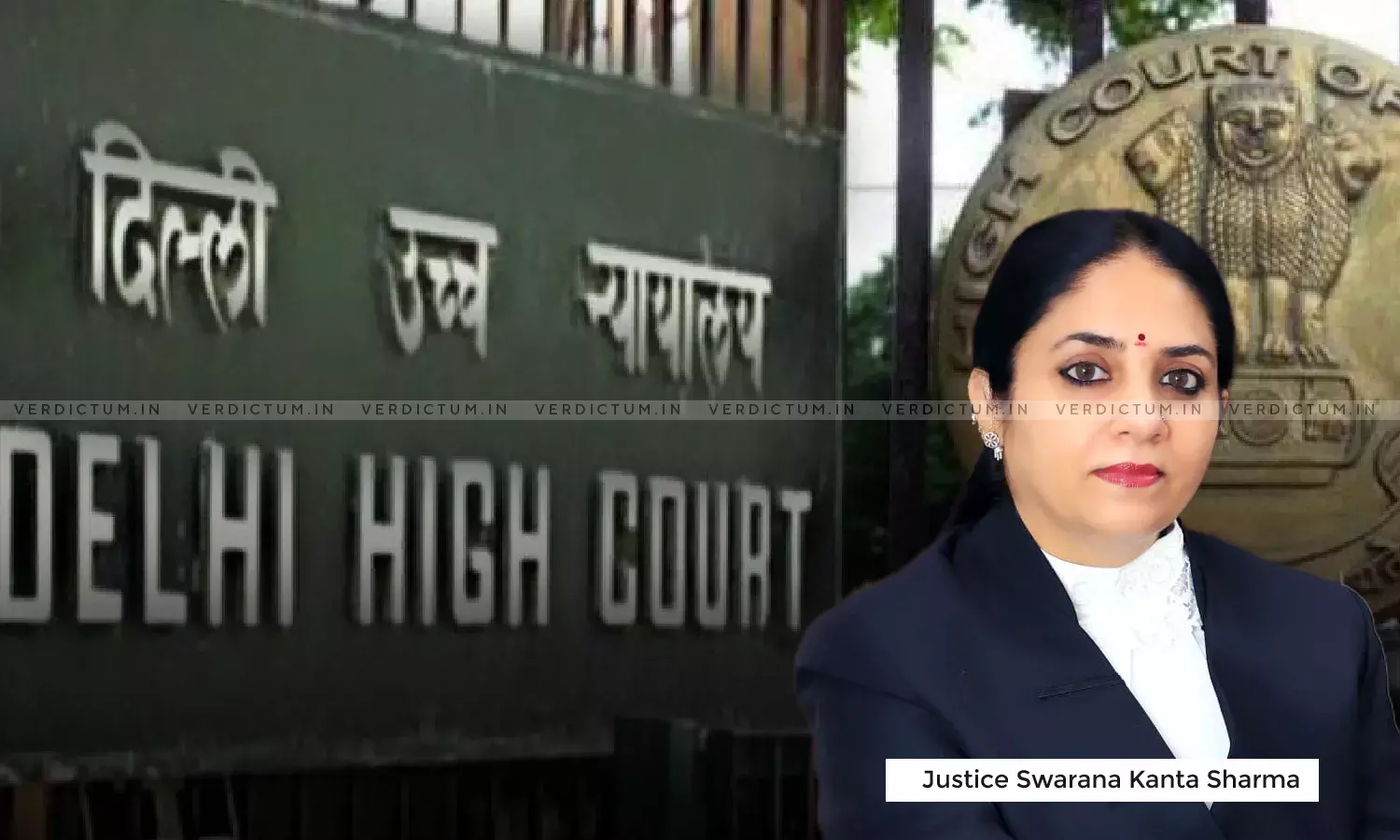
Justice Swarana Kanta Sharma, Delhi High Court
The Delhi High Court has come to the aid of a woman by enhancing the maintenance amount after noting that the husband appeared to have withheld material information regarding his actual income and also attempted to conceal his financial status.
The High Court was considering the cross-petitions preferred by a husband and a wife against a common order granting maintenance to the wife and the two minor children in her custody. The wife claimed that the amount was meagre.
The Single Bench of Justice Swarana Kanta Sharma held, “In these circumstances, this Court finds no reason to disagree with the observations of the learned Appellate Court that the husband appears to have withheld material information regarding his actual income and financial status. The material placed on record therefore prima facie indicates that the husband has not made a full and candid disclosure of his financial position.”
“Therefore, the contention of the husband that he, despite being a graduate and having earlier run a proprietorship firm, is presently earning only ₹12,000/- per month after the separation between the parties, does not appear to be credible to this Court. As noted above, the material placed on record also indicates that the husband has not made a full and candid disclosure of his financial capacity and appears to have attempted to conceal his actual income and financial status. In these circumstances, this Court is of the view that the income of the husband cannot be assessed at less than ₹20,000/- per month”, it added.
Advocate Vikram Saini represented the Petitioner, while Advocate Vikram Saini represented the Respondent.
Factual Background
The marriage between the parties was solemnized in 2014 according to Hindu rites and ceremonies. From the said wedlock, two daughters were born, but the parties separated in April 2016. In 2017, the wife filed an application under Section 125 of the Code of Criminal Procedure, 1973 (CrPC), seeking maintenance for herself and the two minor children. In the said proceedings, after taking into account the admitted income of ₹14,000 per month of the husband, the Family Court granted ad-interim maintenance of ₹7,000 per month to the wife and the minor children. Thereafter, the wife also filed an application under Section 12 of the PWDV Act against the husband and his family members, alleging acts of physical, emotional, sexual and economic abuse, including demands of dowry.
It was further alleged that when she became pregnant for the second time, she was forced by her husband and in-laws to undergo a sex determination test. Upon her refusal, she was allegedly thrown out of the matrimonial home. Aggrieved by the order, the wife preferred an appeal under Section 29 of the PWDV Act before the Appellate Court. The Appellate Court directed that a total amount of ₹13,000 per month be paid to the wife for herself and the two minor children in her custody. While the husband contended that the interim maintenance awarded by the Appellate Court was arbitrary and excessive, the wife submitted that the said amount was meagre and not commensurate with the financial status of the husband.
Reasoning
Noting that the husband had claimed that he had been earning only a salary of ₹12,000 per month, the Bench found that the husband had neither filed the computation of income accompanying the said returns nor placed on record the Income Tax Returns for the period after the assessment year 2018–2019.
The Bench was of the view that, despite the wife having pointed out the existence of bank accounts and financial records relating to the husband and his firm, the husband had not placed on record any clear explanation regarding the status of those accounts or the circumstances in which the business activities allegedly ceased. “In particular, no satisfactory explanation has been offered regarding the earlier accounts maintained in his name and in the name of the firm or the circumstances under which they were closed”, it added.
The Bench further stated, “Considering the fact that the husband claims to be earning only ₹12,000/- per month, which is even below the minimum wages applicable in Delhi, this Court finds no ground to accept such a claim at this stage.”
Thus, assessing the husband’s income at ₹20,000 per month and noting that the husband has no other dependents to maintain apart from the wife and the two minor children, the Bench ordered, “In view thereof, this Court finds that the wife and the two minor children in her custody are entitled to interim maintenance in the sum of ₹13,000/- per month from the date of filing of the application under the PWDV Act.”
Cause Title: A v. B ( Neutral Citation: 2026:DHC:2819)