

Delhi High Court Upholds Validity Of 10% Management Quota Admission Rules For Professional Colleges
The Court ruled that private unaided institutions are legally empowered to conduct separate counselling for filling their allocated ten per cent management seats based on entrance test merit.

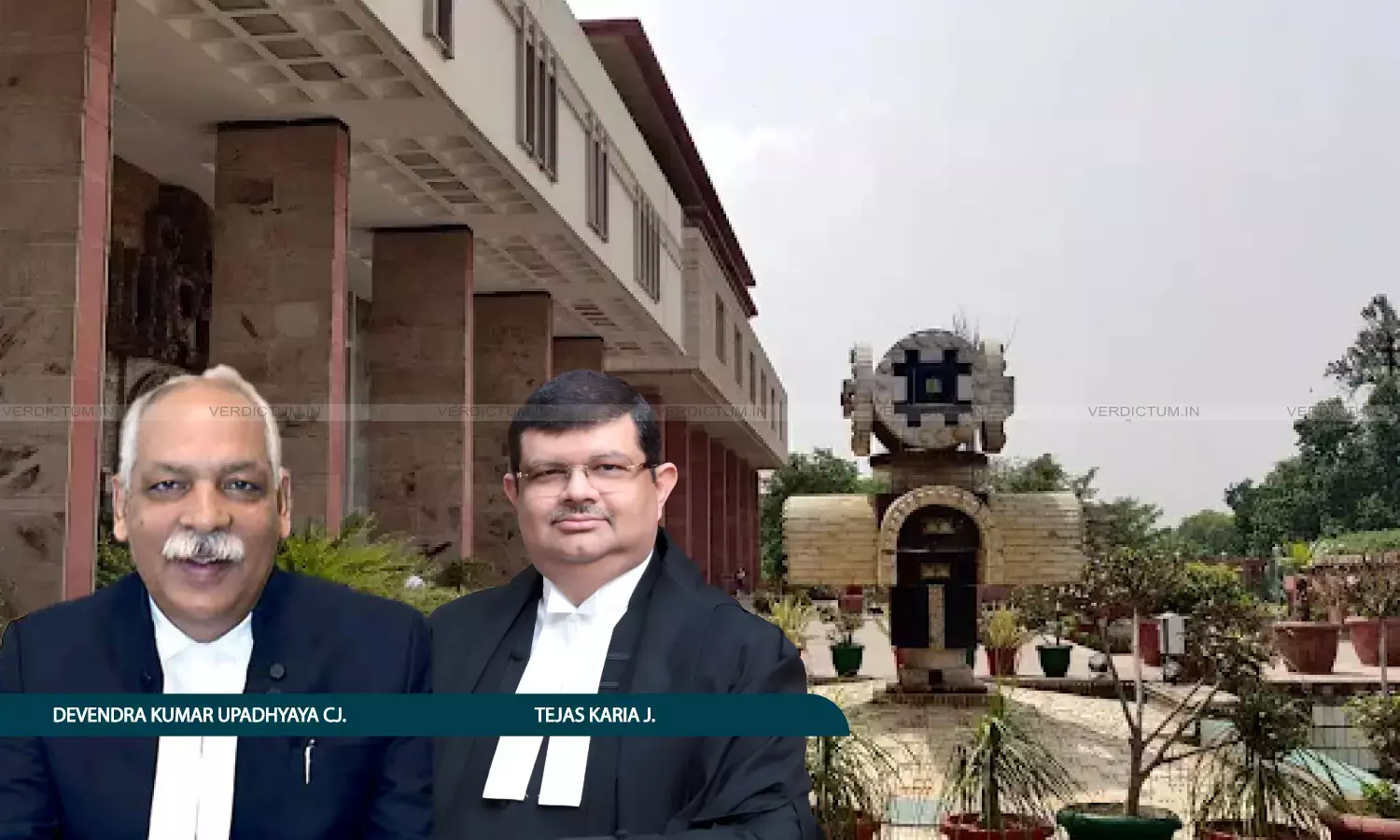
The Delhi High Court upheld the statutory validity of Rule 8(2)(a)(v) of the Delhi Professional Colleges Rules, 2007, ruling that private unaided institutions are legally empowered to conduct their own counselling for filling the 10% Management Quota Seats (MQS) from entrance-qualified candidates.
The Court dismissed a Public Interest Litigation filed by the organization Justice For All, which had challenged the rule and the Academic Session 2026-27 admission brochure on the grounds that allowing independent institutional merit lists and simultaneous physical counselling was non-transparent and ran contrary to the definition of a centralized "Common Entrance Test" under the parent Act.
Holding that forcing management seats into centralized agency counselling would render the statutory proviso to Section 13 of the Act redundant, the Bench clarified that the Common Entrance Test qualification does not inherently encompass centralized counselling for the management quota, while granting the petitioner liberty to approach the Admission Regulatory Committee regarding operational grievances like online counselling and seat de-reservation.
The Division Bench of Chief Justice Devendra Kumar Upadhyay and Justice Tejas Karia has said, "If the submission of learned Counsel for the Petitioner is acceded to, the same will amount to all the seats including the MQS being filled in from amongst the candidates who have qualified the CET and are subjected to counselling by the designated agency. That submission, if accepted, will make the provisions contained in proviso to Section 13 of the Act redundant. Accordingly, we are not convinced with the submissions made by the learned Counsel for the Petitioner in so far as challenge to Rule 8(2)(a)(v) of the Rules is concerned."
Advocate Khagesh B. Jha appeared for the Petitioner, while Advocate Anita Sahani appeared for Respondent No. 3
Brief Facts
The Petitioner preferred a Public Interest Litigation challenging Rule 8(2)(a)(v) of the Delhi Professional Colleges or Institutions (Prohibition of Capitation Fee, Regulation of Admission, Fixation of Non-Exploitative Fee and Other Measures to Ensure Equity and Excellence) Rules, 2007.
The Petition further assailed the Admission Brochure issued for the Academic Session 2026-27, which permitted the de-reservation of reserved category seats and the conversion of Delhi Quota seats into Outside Delhi Quota seats during the Management Quota Admissions.
Additionally, directions were sought to compel the Respondents to conduct a common, centralized, transparent, and online counselling process for all seats, including the 10% Management Quota Seats, under the aegis of the Admission Regulatory Committee, and to implement a mandatory Standard Operating Procedure for the same.
Contentions of the Parties
The Petitioner contended that Rule 8(2)(a)(v) of the Rules ran contrary to Section 2(d) of the parent Act. It was argued that since the "Common Entrance Test" was defined under the Act to mean an entrance test followed by centralized counselling, the Common Entrance Test must inherently encompass the counselling process.
The Petitioner urged that the impugned Rule unlawfully permitted private unaided institutions to prepare their own merit lists for Management Quota Admissions. It was further submitted that simultaneous physical counselling by different private institutions effectively deprived candidates of the opportunity to participate in the admission process of multiple colleges, thereby rendering the mechanism non-transparent and violative of the merit-based choice of the candidates.
Observations of the Court
The High Court observed that there was no force in the challenge mounted against Rule 8(2)(a)(v) of the Rules. It was noted that the statutory scheme under Section 12 and Section 13 of the Act explicitly allocated 10% of the total seats as Management Quota Seats and empowered the respective institutions to fill them.
The Court observed that the proviso to Section 13 of the Act clearly mandated that Management Quota Seats were to be filled by the institution itself through advertisement from amongst candidates who qualified the Common Entrance Test, based on their merit in the qualifying examination.
The Court further held that qualifying for the Common Entrance Test did not mean participation in the centralized counselling conducted by the designated agency, which was meant only for the remaining 90% seats. It was observed that accepting the Petitioner's interpretation would render the statutory proviso to Section 13 redundant.
"On the basis of CET, the merit list is prepared and counselling is held by the designated agency for the purposes of making admission to 90% seats, that means, the seats excluding the MQS, which as per Section 12(a) of the Act is 10% of the total seats. These 10% of the seats, which are in management quota are, thereafter filled in by the institution concerned after making an advertisement and selecting the candidates from amongst those who have qualified the CET conducted by the designated agency", The Court said.
Consequently, the Court upheld the validity of the Rule. For the remaining grievances concerning online counselling and procedural discrepancies, the Court observed that the Admission Regulatory Committee was the competent statutory authority to regulate admissions and ensure a fair and non-exploitative procedure.
The Petitioner was accordingly granted liberty to approach the said Committee with an exhaustive representation.
Cause Title: Justice For All v. Hon'ble Lieutenant Governor Govt of NCT of Delhi [Neutral Citation:2026:DHC:5243-DB]
Appearances:
Petitioner: Advocate Khagesh B. Jha
Respondent No. 3: Advocate Anita Sahani