When Section 175(4) BNSS Must Be Invoked?: Supreme Court Issues Procedural Guide For Judicial Magistrates
Clarifying the discretionary and situational operation of Section 175(4) of the Bharatiya Nagarik Suraksha Sanhita, 2023, the Supreme Court laid down structured guidance for judicial magistrates on when to invoke the special procedure applicable to complaints against public servants, and when to proceed under the general procedure under Section 175(3).
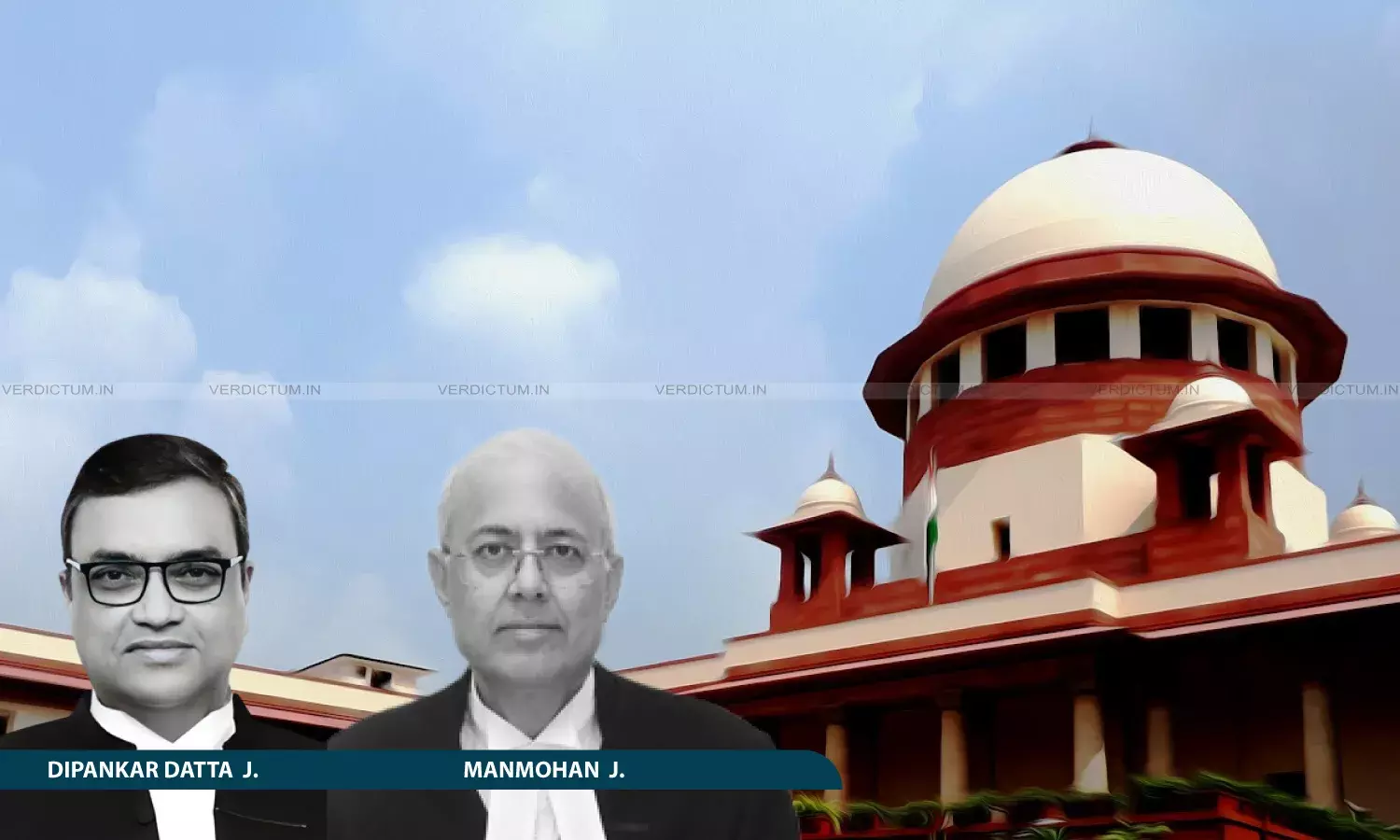
Justice Dipankar Datta, Justice Manmohan, Supreme Court
The Supreme Court has issued a detailed procedural framework to guide judicial magistrates on the circumstances in which the special procedure under Section 175(4) of the Bharatiya Nagarik Suraksha Sanhita, 2023 (“BNSS”) must be invoked in complaints alleging offences by public servants in the discharge of official duties.
The Court clarified that Section 175(4) is not automatic in its application and that the use of the word “may” in the provision indicates the presence of judicial discretion, to be exercised based on a prima facie assessment of the complaint and the nexus of the alleged act with official duties.
A Division Bench of Justice Dipankar Datta and Justice Manmohan laid down a structured guide for judicial magistrates to follow while considering applications under Section 175.
Background
The Supreme Court was examining the scope and operation of Sections 175(3) and 175(4) of the BNSS in the context of complaints made against public servants for acts alleged to have been committed in the discharge of official duties.
Having clarified the symbiotic relationship between sub-sections (3) and (4) of Section 175, the Court proceeded to lay down specific guidance to assist judicial magistrates in determining when the special procedure under Section 175(4) ought to be activated.
The Court noted that clarity on this issue was necessary to ensure uniformity in judicial approach and to prevent both mechanical invocation of Section 175(4) and improper bypassing of its safeguards.
Court’s Observation
The Supreme Court held that the use of the modal verb “may” in Section 175(4) signifies that the provision is discretionary in nature and must be applied bearing in mind the context in which it appears and the object sought to be achieved.
The Court then identified three distinct situations to guide judicial magistrates.
First, where upon reading the complaint, the judicial magistrate is prima facie satisfied that the alleged act giving rise to the offence arose in the course of discharge of official duties by the public servant, the magistrate may not have any option other than to follow the procedure prescribed under Section 175(4), including calling for reports from the superior officer and the accused public servant.
Second, where, on a consideration of the complaint, the judicial magistrate entertains a prima facie doubt, depending on the circumstances, as to whether the offence alleged arose in the course of discharge of official duties, the magistrate may err on the side of caution and proceed to follow the procedure prescribed under Section 175(4).
Third, where the judicial magistrate is satisfied that the alleged act was not committed in the discharge of official duties and/or bears no reasonable nexus thereto, and that the rigours of Section 175(4) are not attracted, the complaint may be dealt with in accordance with the general procedure prescribed under Section 175(3).
The Supreme Court further clarified that a judicial magistrate retains the authority to reject an application under Section 175(3) lodged against a public servant where the allegations are found to be wholly untenable, manifestly absurd, or so inherently improbable that no reasonable person could conclude that any offence is disclosed. The Court emphasised that such rejection must be supported by valid reasons and must not be based on whims or fancy.
The Court also addressed a situation where a judicial magistrate has called for a report from the concerned superior officer under clause (a) of Section 175(4), but such officer fails to comply or does not submit the report within a reasonable period of time.
In such circumstances, the Supreme Court held that the judicial magistrate is not obliged to wait indefinitely and may proceed further in accordance with Section 175(3) after considering the version of the accused public servant under clause (b) of Section 175(4), if such version is on record.
The Court clarified that what constitutes “reasonable time” cannot be determined in rigid or inflexible terms and must necessarily depend on the facts and circumstances of each case, to be assessed by the judicial magistrate.
Cause Title: XXX v. State of Kerala & Ors. (Neutral Citation: 2026 INSC 88)
Appearances
Appellant: R. Basant, Senior Advocate, Raghenth Basant, Senior Advocate, with Advocates Vikas Jain, AOR, Muhammed Firdouz Av, Shrawani, Hardik Jayal, Akash Rajeev, Hima Bhardwaj, Aviral Saxena and Others
Respondents: Siddhartha Dave, Senior Advocate, Ranjit Kumar, Senior Advocate, with Advocates A. Karthik, AOR, Smrithi Suresh, Ujjwal Sharma, Sugam Agrawal, Nayan Dham, C. K. Sasi, AOR, and Others.