

Loss Of Love & Affection Not Distinct Head Of Motor Accident Compensation; It's Comprehended Within Broader Head of Consortium: Supreme Court
The Supreme Court was considering an appeal challenging the judgment of the Madras High Court partly allowing the appeal filed by the claimants (heirs of the deceased) and modifying the award of the Motor Accidents Claims Tribunal, Chennai.

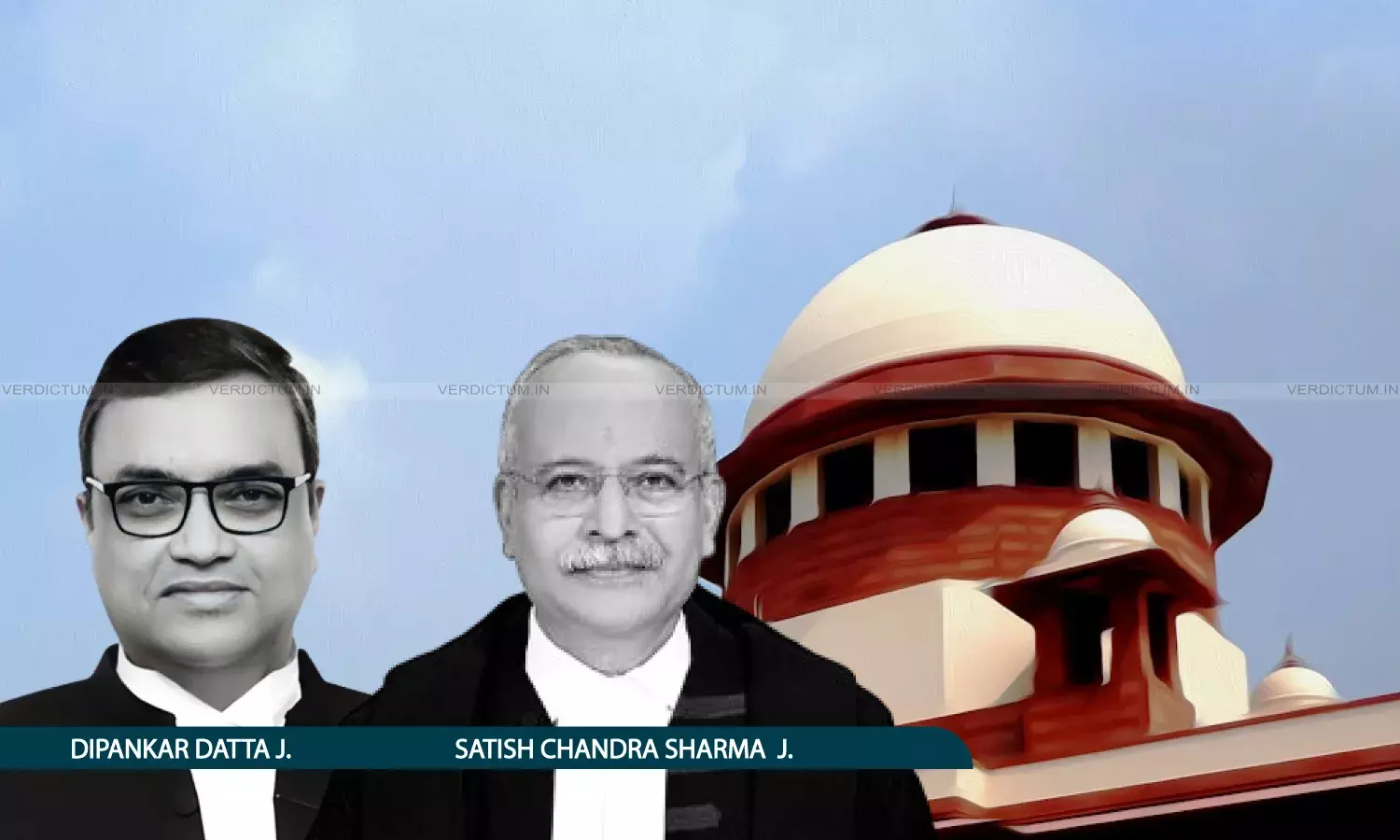
Justice Dipankar Datta, Justice Satish Chandra Sharma, Supreme Court
While awarding enhanced compensation to the motor accident claimants, the Supreme Court has held that loss of love and affection is not a distinct head of compensation and such non-pecuniary loss arising from deprivation of love and affection is comprehended within the broader head of consortium.
The Apex Court was considering an appeal challenging the judgment of the Madras High Court partly allowing the appeal filed by the claimants (heirs of the deceased) and modifying the award of the Motor Accidents Claims Tribunal, Chennai while deciding a claim petition under Section 166 of the Motor Vehicles Act, 19885 .
Referring to various judgments of the Apex Court, the Division Bench of Justice Dipankar Datta and Justice Satish Chandra Sharma held, “Consistent with the aforesaid position but notwithstanding the reservations noted earlier, this Court is bound by the law declared by the Constitution Bench in Pranay Sethi (supra), which does not countenance “loss of love and affection” as a distinct head of compensation. As subsequently clarified in Satinder Kaur (supra), referring to both Pranay Sethi (supra) and Magma General Insurance (supra), the non-pecuniary loss arising from deprivation of love and affection is comprehended within the broader head of “consortium”. Consequently, no separate award under the head of loss of love and affection is warranted.”
AOR T. Harish Kumar represented the Appellant, while Advocate Sandeep Jha represented the Respondent.
Factual Background
The case dates back to the year 2011, when one D. Velu, aged about 37 years, died when a tanker lorry insured with the respondent–insurance company hit his two-wheeler. The claimants, i.e, the widow of the victim, their two minor children and the victim’s parents lodged a claim petition before the MACT, claiming compensation of Rs 20 lakh on account of loss of dependency and other conventional heads. It was claimed that the victim, employed as a driver at the material time, was earning a regular monthly income of Rs 10,000 and since the accident occurred solely due to the rash and negligent driving of the offending vehicle, they were entitled to “just compensation”.
Before the MACT, the insurer contested the claim, disputing negligence, the income of the victim, and the quantum of compensation claimed. Aggrieved by the quantum of compensation awarded by the MACT, the claimants preferred an appeal before the High Court under Section 173. The High Court, by the impugned order, affirmed the finding on negligence, modified the award by enhancing the quantum of compensation payable by the insurer from Rs 9,37,000 to Rs 10,51,000. Dissatisfied with the minor modification of compensation as well as the denial of future prospects, the claimants approached the Apex Court seeking enhancement.
Reasoning
The Bench, at the outset, explained that when an individual dies as a result of a fatal road accident, and his distressed dependents apply for compensation either from the owner of the vehicle responsible for the death or the insurance company with whom such vehicle is insured, no amount of money can truly compensate for the loss. “Considering the income of the deceased, the needs of his dependents and the emotional toll of the loss, the best that can be ensured is that the compensation is fair and reasonable, without being either arbitrary or niggardly. This would be in accord with the foundational principle governing the determination of “just compensation” under Section 168 of the Act”, it added.
Elucidating upon the concept of ‘just compensation’, the Bench held that the determination should be fair, reasonable and equitable by accepted legal standards and not a bonanza. “Though “just” compensation can never be prefect or absolute compensation, since loss of human life can never be compensated by monetary terms, the principle of awarding “just” compensation and assessing the extent of dependency would depend on examination of the unique situation of each individual case”, it held.
Coming to the facts of the case, the Bench referred to the salary certificate issued by the employer of the victim, which unequivocally recorded that the victim was employed as a driver on a fixed monthly salary of Rs 10,000. This documentary evidence was further corroborated by the affidavit sworn by the victim’s employer. “On the face of such cogent and relevant evidence, which was not impeached by the insurer, it would be wholly impermissible to assess the income at a lower figure. The determination of income must be founded on proof placed on record and cannot rest on conjecture or assumptions divorced from evidence. Accordingly, for the purposes of re-computation, the monthly income of the victim has to be reckoned as Rs. 10,000/-”, it held.
Referring to its judgment in National Insurance Co. Ltd. v. Pranay Sethi (2017), the Court held, “Paragraph 59.4 of Pranay Sethi (supra) unequivocally mandates that where the deceased was self-employed or on a fixed salary and below the age of 40 years, an addition of 40% of the established income towards future prospects is compulsory. This is not a matter of choice, but a binding norm flowing from Article 141 of the Constitution.”
The Bench further reaffirmed that loss of love and affection is not a distinct head of compensation. Thus, awarding an enhanced compensation of Rs 20,80,000 and noting that the victim passed away in 201, the Bench ordered, “His dependants have been pursuing legal proceedings for grant of compensation since the past 15 years. As a consequence, we deem it appropriate to direct that interest @ 9% p.a. be paid on the total compensation awarded, from the date of filing the claim petition, till realization.”
Cause Title: V. Pathmavathi v. Bharthi Axa General Insurance Co. Ltd. (Neutral Citation: 2026 INSC 131)
Appearance
Appellant: AOR T. Harish Kumar
Respondent: Advocates Sandeep Jha, Ram Ekbal Roy, Priyanka Das, Neha Das, Aman Nihal, Ravi Shankar Ravi, AOR Binay Kumar Das