

Can’t Agitate Same Relief Before Two Forums: Supreme Court Upholds Dismissal Of Writ Petition
The Supreme Court held that the first respondent could not have agitated common reliefs before the two forums.

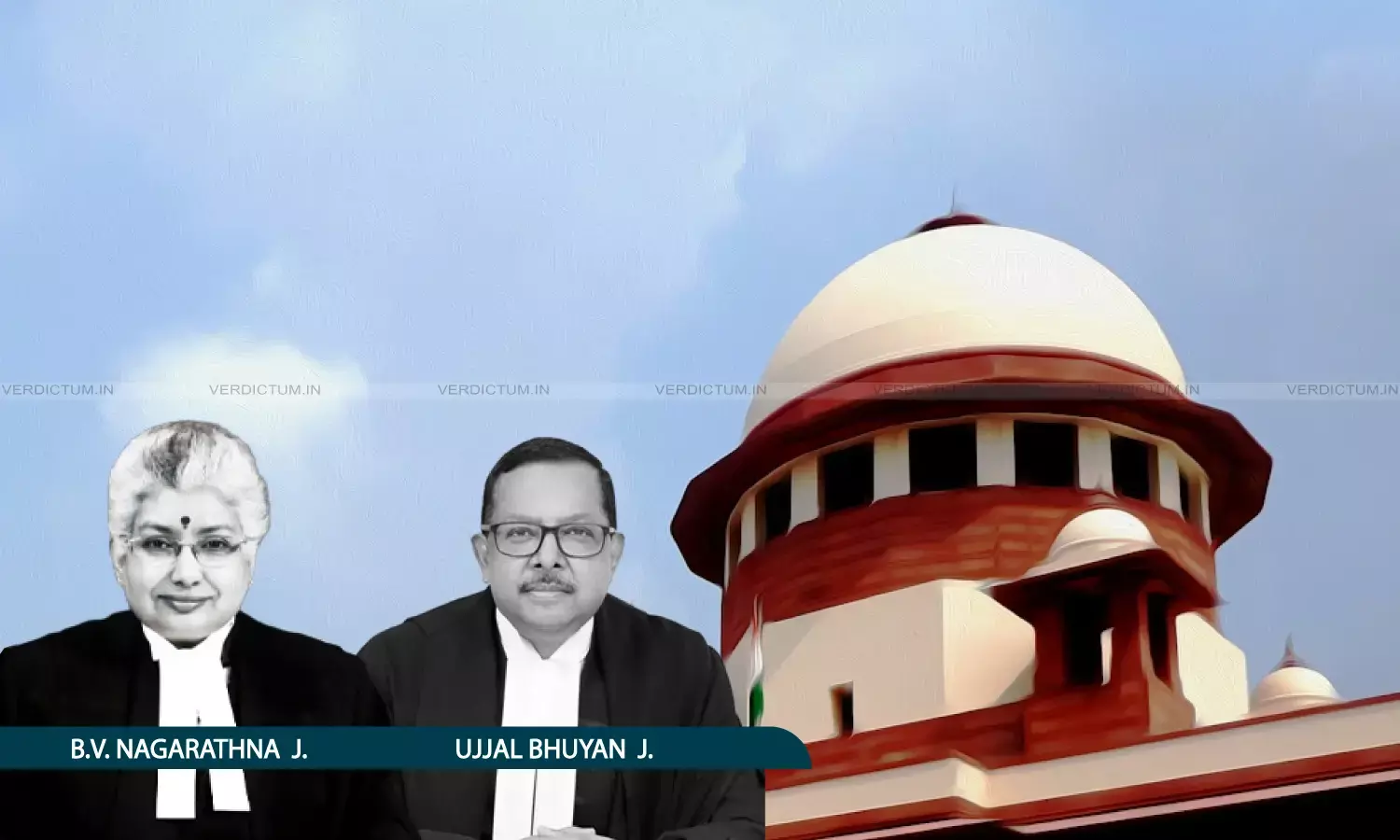
While dealing with a property dispute matter, the Supreme Court has found the filing of a writ petition to be an abuse of the process of law. The Apex Court noted that common prayers were made in the suit as well as in the writ petition concerning the very same property.
The Apex Court held that the first respondent could not have agitated common reliefs before the two forums.
The Division Bench of Justice B.V. Nagarathna and Justice Ujjal Bhuyan held, “In the backdrop of the submissions made by learned counsel for the respective parties, we have perused the prayers sought by respondent No.1 herein in the suit as well as the prayers sought by the very same respondent in the writ petition; the prayers concern the very same property, prayer (d) in the suit and in the writ petition are common. The first respondent herein would not have a shortcut in the adjudication of his case by seeking prayer (d) in the suit in the form of a prayer for Writ of Mandamus in the writ petition. The first respondent could not have agitated this relief before the two forums.”
Advocate Sanjay Mani Tripathi represented the Appellant while Advocate D Durga Devi represented the Respondent.
Factual Background
The appellant was arrayed as the sixth respondent in the petition where the writ petitioner (first respondent) sought issuance of a direction for the demolition of the unauthorized constructions made by the sixth respondent for an extent of 5.33 cents constructed without building plan approval. The said writ petition was disposed of by an order without issuance of any notice to the appellant. Aggrieved thereby, the appellant preferred a Review Application before the High Court. The said Review Petition was also dismissed by the Division Bench of the High Court.
Arguments
It was the appellant’s case that the parties (appellant as well as first respondent) were related to each other and the original suit filed by the first respondent against the appellant was pending adjudication before the District Judge, Ariyalur.
Reasoning
On a perusal of the prayers sought by first respondent in the suit as well as the prayers sought by the very same respondent in the writ petition, the Bench noted that the the prayers concerned the very same property. It was further noticed that prayer (d) in the suit and in the writ petition were common.
Holding that the respondent could not have a shortcut in the adjudication of his case, the Bench stated, “We find that the filing of writ petition was an abuse of the process of law. Hence, the writ petition is dismissed and consequently, the impugned orders are also set-aside.”
Thus, allowing the appeal in the aforesaid terms, the Bench clarified, “We however observe that this order would not come in the way of the suit being tried in accordance with law and on its own merits.”
Cause Title: V. Anima Malar v. S. Aadhavan (Neutral Citation: 2026 INSC 108)
Appearance
Appellant: Advocates Sanjay Mani Tripathi, V Elangovan, Gouri Karuna Das Mohanti, AOR Anu Gupta
Respondent: Advocate D Durga Devi, AOR Pranab Prakash, Advocates Balaji Subramaniam Aag, AOR G. Indira, Advocates P Gandepan, Anurag Kashyap, Anjali Singh, Raniba Pangnila, Akash Kundu