

Mere Undertaking To Infuse Funds Into Borrower Does Not Amount To Contract Of Guarantee U/S.126 Contract Act: Supreme Court
The Apex Court held that an undertaking to arrange or infuse funds into a borrower to enable compliance with financial covenants cannot, by itself, be equated with a promise to discharge the borrower’s liability to the creditor.
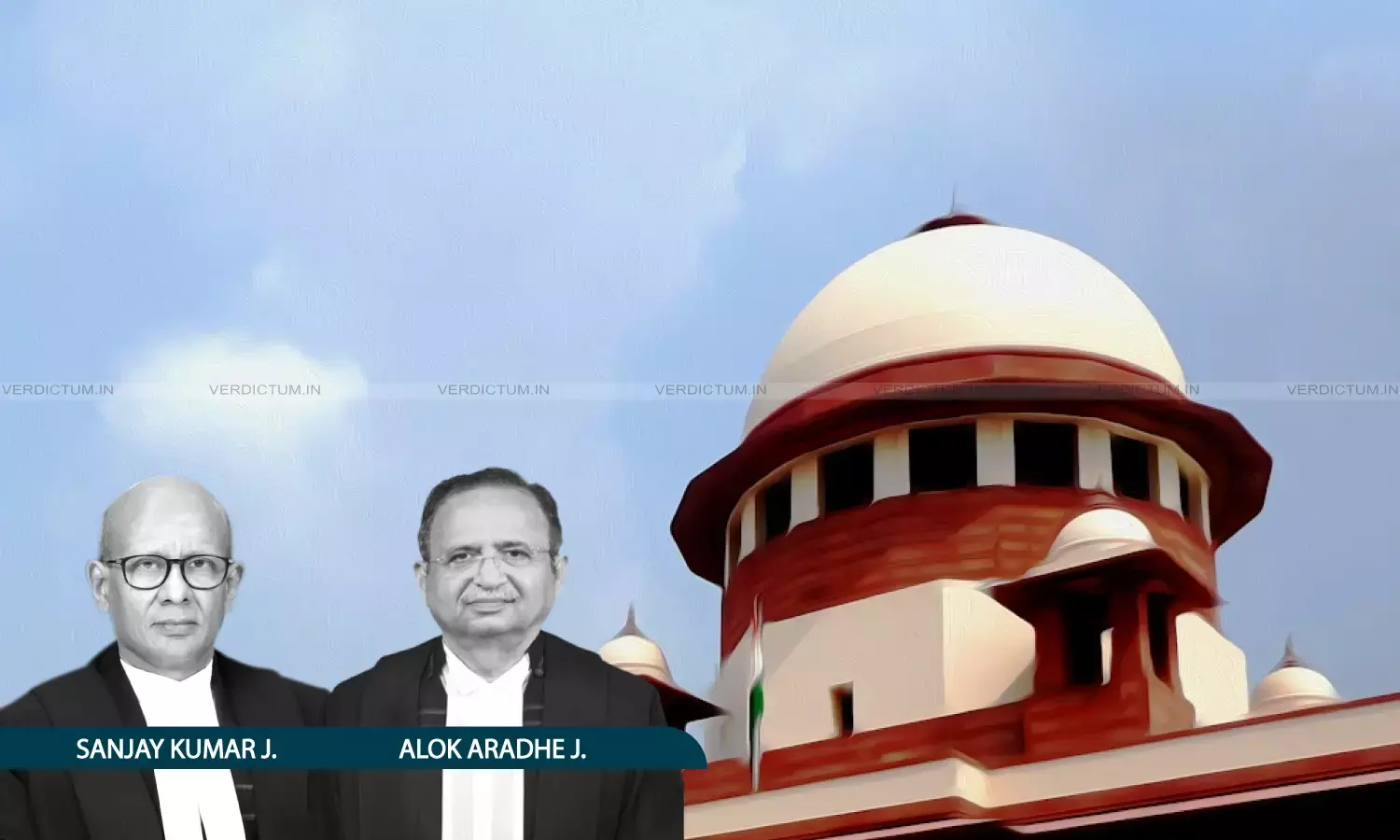
Justice Sanjay Kumar, Justice Alok Aradhe, Supreme Court
The Supreme Court held that a covenant requiring a promoter to arrange the infusion of funds into a borrower to ensure financial discipline does not constitute a contract of guarantee within the meaning of Section 126 of the Indian Contract Act, 1872.
The Court was hearing an appeal arising from a judgment of the National Company Law Appellate Tribunal, which had affirmed the dismissal of an application filed under Section 7 of the Insolvency and Bankruptcy Code, 2016, seeking initiation of corporate insolvency resolution proceedings based on an alleged guarantee.
A Bench comprising Justice Sanjay Kumar and Justice Alok Aradhe observed that “an undertaking to infuse funds into a borrower, so that it may meet its obligations, cannot, by itself, be equated with the promise to discharge the borrower’s liability to the creditor”, while further holding that “a mere covenant to ensure financial discipline or infusion of funds does not satisfy the statutory requirements of Section 126 of the Act.”
Background
The dispute arose from financial facilities extended to a borrower company by a financial institution pursuant to a sanction letter. Under the sanction letter, the securities for the facility were confined to a demand promissory note and post-dated cheques, and no personal or corporate guarantee was stipulated.
As part of the financing arrangement, the promoter of the borrower executed a deed of undertaking in which it agreed to arrange for infusion of funds into the borrower to enable compliance with stipulated financial covenants. Clause 2.2 of the deed obligated the promoter to arrange such infusion in the event the borrower was unable to comply with the covenants.
Subsequently, the borrower underwent a corporate insolvency resolution process under the Insolvency and Bankruptcy Code, pursuant to which a resolution plan was approved and implemented. Following the resolution, the original lender issued a no-dues certificate, though a residual claim was later asserted and assigned to the appellant.
The appellant thereafter filed an application under Section 7 of the Insolvency and Bankruptcy Code, 2016, against the promoter, contending that the deed of undertaking constituted a corporate guarantee and that a financial debt subsisted. The application was dismissed by the adjudicating authority, a view which was affirmed by the appellate tribunal, leading to the present appeal.
Court’s Observation
The Supreme Court examined the scope and ambit of a “contract of guarantee” as defined under Section 126 of the Indian Contract Act, which requires a promise to perform or discharge the liability of a third person in case of default. It noted that the essential ingredients of a guarantee include the existence of a principal debt, default by the principal debtor, and an unambiguous promise by the surety to discharge the liability of the debtor upon such default.
The Court explained that “a guarantee being a mercantile contract, the Court does not apply to it merely technical rules but construes it so as to reflect what may fairly be inferred to have been the parties’ real intention and understanding as expressed by them in writing and to give effect to it rather than not.”
The Court analysed Clause 2.2 of the deed of undertaking, which obligated the promoter to arrange infusion of funds into the borrower to enable compliance with financial covenants. It observed that the clause did not record any undertaking to discharge the debt owed to the creditor, nor did it contemplate payment to the lender in the event of default.
The Bench held that the obligation under the clause was a promise to the borrower to facilitate compliance with financial covenants, and not a promise to the creditor to discharge the borrower’s liability. It emphasised that "for an obligation to be construed as a guarantee under Section 126 of the Act, there must be a direct and unambiguous obligation of the surety to discharge the obligation of the principal debtor to the creditor".
The Court further noted that the original sanction letter did not envisage any personal or corporate guarantee and expressly identified the securities for the facility. This position was reinforced by contemporaneous documents, including the information memorandum prepared during the insolvency process, the assignment agreement, and the audited financial statements, none of which reflected the existence of any guarantee obligation.
Addressing the argument based on the concept of a “see to it” guarantee, the Court observed that while such guarantees are recognised in English common law, “a ‘see to it’ guarantee does not include an obligation to enable the principal debtor to perform its own obligation”, while stating that “such an arrangement would not be a guarantee under Section 126 of the Indian Contract Act”.
The Bench also considered the reliance placed on certain payments made by the promoter during the insolvency proceedings and statements made in pleadings before other courts. It held that voluntary payments made in the capacity of a promoter, in the absence of a contractual obligation, do not give rise to a contract of guarantee. It further reiterated that pleadings must be read as a whole and cannot be selectively relied upon to infer admissions of liability where none exist.
Conclusion
The Supreme Court held that Clause 2.2 of the deed of undertaking did not constitute a contract of guarantee under Section 126 of the Indian Contract Act, and that the promoter could not be treated as a guarantor for the financial facilities availed by the borrower.
Finding no infirmity in the concurrent findings of the adjudicating authority and the appellate tribunal, the Court dismissed the appeal.
Cause Title: UV Asset Reconstruction Company Limited v. Electrosteel Castings Limited (Neutral Citation: 2026 INSC 14)
Appearances
Appellant: Senior Advocate Gopal Subramanium, with Advocates Dhruv Dewan, Rohan Batra, AOR, Gauri Subramanium, Raghav Kohli, Rishabh Bhargava, Sanjukta Roy, Dhruv Sethi, Pranav Diesh
Respondent: Senior Advocate Mukul Rohatgi & Dhruv Mehta, with Advocates Vikas Mehta, AOR, Pulkit Deora, Hemant Kothari, Sameer Rohatgi, Muthu Thangathurai, Kartikeya Sharma, Kartik Pandey, Nitika Grover, Nishant Anshul
