

Not Named In FIR; Arrested Subsequently Based On Oral Dying Declaration: Supreme Court Dismisses Appeal For Bail Cancellation
The appeal before the Supreme Court challenged the order of the Allahabad High Court directing the release of the respondent on bail, who is an accused in a case registered under the provisions of the Indian Penal Code, 1860 and Section 7 of the Criminal Law (Amendment) Act.

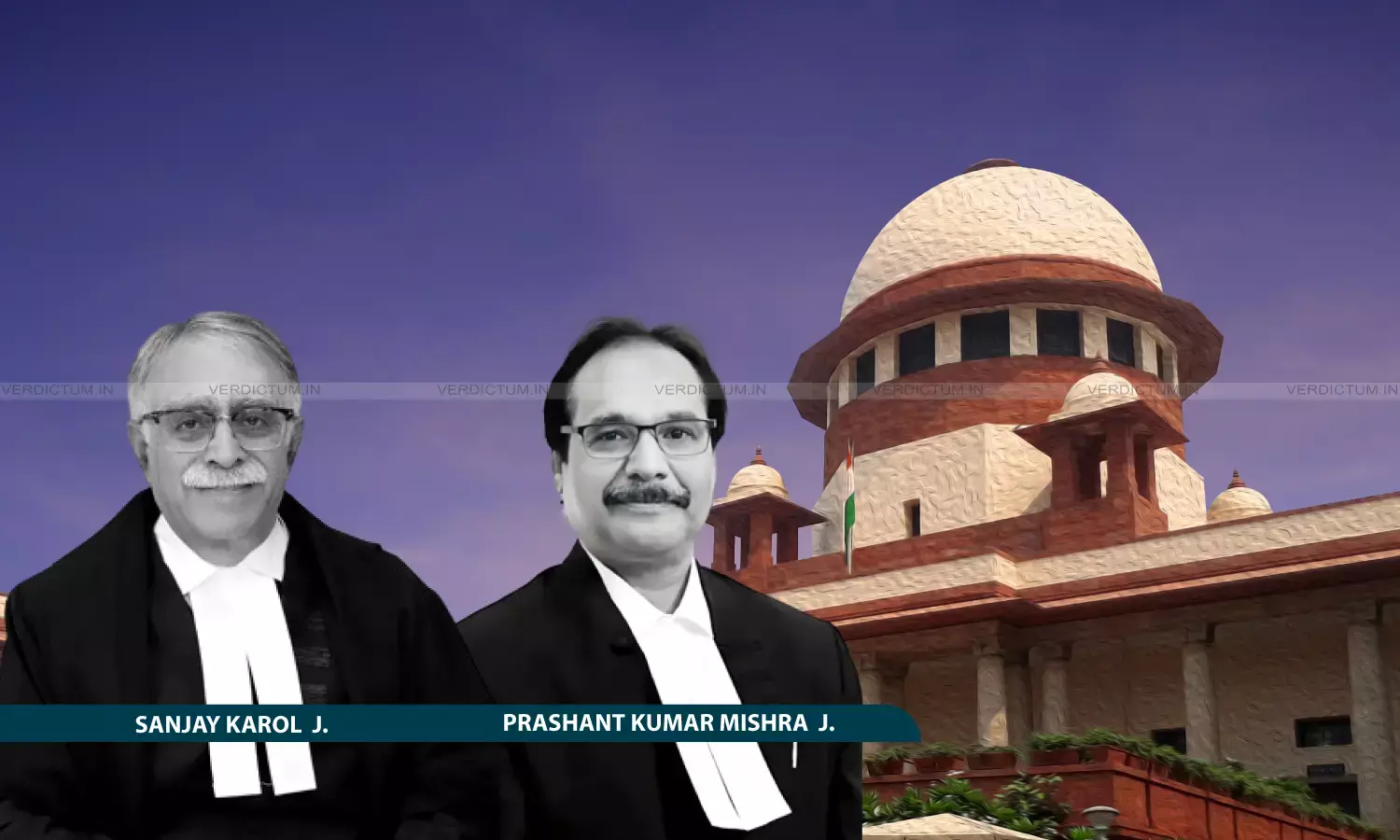
Justice Sanjay Karol, Justice Prashant Kumar Mishra, Supreme Court
The Supreme Court has upheld an order directing the release of a murder accused who suffered incarceration for over 6 years. The Apex Court took note of the fact that he was not named in the FIR and was arrested subsequently on the basis of the oral dying declaration of the deceased and the disclosure statement of the co-accused.
The appeal before the Apex Court challenged the order of the Allahabad High Court directing the release of the second respondent on bail, who is an accused in a case registered under Sections 147, 148, 149, 302, 120B and 34 of the Indian Penal Code, 1860 and Section 7 of the Criminal Law (Amendment) Act.
The Division Bench of Justice Sanjay Karol and Justice Prashant Kumar Mishra held, “Considering the matter on the anvil of law laid down by this Court in Mahipal (supra) and Dolat Ram (supra), it is significant to mention that respondent No.2 was not named in the FIR and was arrested subsequently on the basis of the oral dying declaration of the deceased and disclosure statement of the co-accused. He has suffered incarceration for about six and a half years when the impugned order was passed by the High Court.The High Court passed the impugned order on 22.01.2025 i.e., more than a year ago and there is no allegation that, during this period, respondent No.2 has misused the liberty granted to him. Thus, considering long pre-trial incarceration of respondent No.2 and the evidence against him, this Court is of the considered opinion that the present is not a case where the discretion of grant of bail exercised by the High Court in favour of respondent No.2 should be interfered.”
Factual Background
The incident dates back to the year 2018 when the deceased was fatally shot by unknown people while he went for his daily exercise. He was taken to the hospital, where he was declared dead. It was the case of the prosecution that while on his way to the hospital, the deceased made a statement that he was attacked by one Rakesh Jaiswal and one Ravi Jalan in connivance with many others. An FIR was registered against Rakesh Jaiswal, Ravi Jalan and four unknown attackers. The alleged assailant, Kashmir Paswan, was arrested by Police and on his disclosure statement, the second respondent was subsequently arrested. It was stated that the witnesses also stated in their case diary statements that the deceased, before his death, made a statement that the second respondent was also involved in the incident. Two co-accused persons had already been released on bail by the High Court.
Reasoning
The Bench noted that the prosecution proposed to examine 55 witnesses. However, only 13 witnesses, including material witnesses, were examined. The Bench noticed that the second respondent was not named in the FIR, but was made an accused based on the oral dying declaration of the deceased and the disclosure statement of the co-accused.
The Bench also referred to the judgment in Dolat Ram and Others vs. State of Haryana (1995) wherein it has been observed that rejection of bail in a non-bailable case at the initial stage and the cancellation of bail so granted have to be considered and dealt with on a different basis. It has also been held therein that very cogent and overwhelming circumstances are necessary for an order directing the cancellation of the bail already granted.
The Bench also found that the second respondent had suffered incarceration for a period of six and a half years in jail when the impugned order was passed by the High Court. “It is also to be noted that co-accused in the same FIR has been granted bail by the High Court”, it added.
Thus, refusing to interfere with the discretion of the grant of bail exercised by the High Court, the Supreme Court dismissed the appeal.
Cause Title: Usman Ali v. State of Uttar Pradesh (Neutral Citation: 2026 INSC 98)